SEO vs. GEO: How to Rank in the Era of AI Search
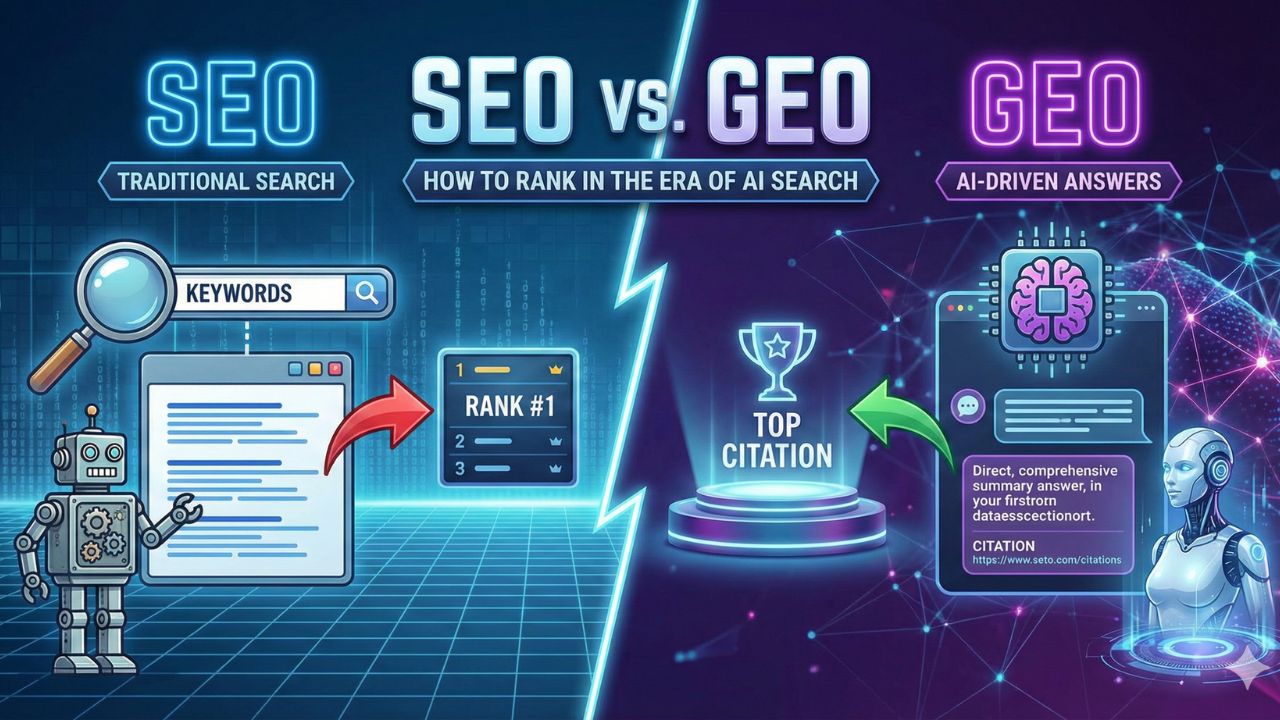
- The Pivot: Marketing goals have shifted from "Traffic" to "Citations" as 26% of searches now end without a click.
- The New Ranking Factor: "Data Density"—the ratio of unique facts to total words—is now the primary metric for visibility.
- The Action: Structure content with Schema Markup, "Definition-Ready" blocks, and high-information-gain statistics to get cited by Gemini and ChatGPT.
For 20 years, the goal of marketing was simple: Rank #1, get the click. In 2026, the game has changed. With the dominance of "Answer Engines" like Gemini, ChatGPT Search, and Perplexity, users are getting their answers directly on the results page.
The Stat: Recent data shows that 26% of search sessions now end without a click because the AI summary provided the answer.
The Pivot: This doesn't mean search is dead; it means the goal has shifted from "Traffic" to "Citations." If your brand isn't the source the AI quotes, you are invisible. This guide explains Generative Engine Optimization (GEO)—the new science of structuring your content so AI models trust, cite, and recommend you.
2. SEO vs. GEO: The Core Differences
While traditional SEO focuses on "convincing an algorithm to list you," GEO focuses on "convincing an LLM to quote you."
| Feature | Traditional SEO | Generative Engine Optimization (GEO) |
|---|---|---|
| Primary Goal | Rank #1 in Blue Links | Be cited in the AI Snapshot/Answer |
| User Journey | Search -> Click -> Browse | Ask -> Read Answer -> Verify (Maybe Click) |
| Success Metric | Organic Traffic / CTR | Share of Voice / Citation Frequency |
| Primary Tactic | Keywords & Backlinks | Data Density & Authority |
| Content Style | Long-form "Ultimate Guides" | Structured Facts & Direct Answers |
| Competition | 10 Blue Links | 1-3 Cited Sources |
Key Takeaway: SEO is about distribution. GEO is about authority.
3. The New Ranking Factor: "Data Density"
Large Language Models (LLMs) are trained to hate "fluff." They are prediction machines that look for high-information-gain sentences. To rank in GEO, you must increase your Data Density.
What is Data Density?
It is the ratio of unique facts to total words.
- Low Density (SEO Fluff): "Choosing the right software is important for your business growth and can help you succeed in the long run." (0 facts)
- High Density (GEO Gold): "The 2025 Marketing Report shows that 60% of B2B buyers prefer self-service tools over sales calls." (2 facts)
How to Optimize for Data Density:
- Kill the Intro: Skip the "In today's digital world..." intros. Start with the answer in the first 50 words.
- Use Statistics: LLMs prioritize content that contains specific numbers (e.g., "27% increase" rather than "significant increase").
- Be the Primary Source: Publish original survey data or proprietary benchmarks. AI models crave "Ground Truth" data that cannot be found elsewhere.
4. Platform-Specific Strategies (2026 Edition)
Not all AI engines work the same way. You need a nuanced approach.
A. Google AI Overviews (Gemini)
Google is a hybrid. It still relies on its traditional index to verify facts (a process called "Grounding").
- Strategy: Schema Markup. Use FAQPage, Article, and Product schema code. This acts as a "signpost" that helps Gemini parse your content structure instantly.
- Format: Use "Definition-Ready" blocks. Ask a question in an H2 header (e.g., "What is GEO?") and answer it immediately in the following paragraph.
B. Perplexity & ChatGPT Search
These are "Citation Engines." They prioritize academic and authoritative sources over commercial blogs.
- Strategy: Citable Quotes. Write distinct, short paragraphs that can be lifted verbatim as a summary.
- Trust Signals: Ensure your "About Us" page and author bios are exhaustive. These engines check your credentials (E-E-A-T) to verify you are a trustworthy source.
5. Technical GEO: Making Content "Machine-Readable"
LLMs don't "read" like humans; they parse tokens. Make it easy for them.
- Lists & Tables: Convert paragraphs into bullet points or comparison tables whenever possible. AI models extract structured data from tables with near-100% accuracy.
- The "Inverted Pyramid": Place the most critical conclusion at the very top. Don't bury the lead.
- Contextual Linking: Use descriptive anchor text for internal links. It helps the AI understand the relationship between your "Cluster" content and your "Pillar" pages.
Frequently Asked Questions (FAQ)
No. Traditional search still drives the majority of transactional clicks (e.g., "buy nike shoes"). However, for informational queries (e.g., "best running shoes for flat feet"), GEO is taking over. You need a hybrid strategy.
No, it hurts you. LLMs are smart enough to detect unnatural language patterns. Focusing on "Semantic Relevance" (covering the topic deeply) is far more effective than repeating a keyword 10 times.
Traditional rank trackers don't work here. You must look at "Share of Voice" metrics—how often your brand is mentioned in AI answers for your category. New tools like "AI Visibility Toolkits" are emerging to measure this.
Generally, no. If you block AI crawlers (like GPTBot) via robots.txt, you effectively remove your site from their knowledge base, making it impossible to be cited.
It is the art of optimizing your brand name and proprietary terms so that even if the user doesn't click, they read your brand name in the AI summary (e.g., "According to [Your Brand]...").
Sources and References
This guide synthesizes data from leading industry reports on the state of search in 2026.
- GEO Definitions & Trends: Wikipedia "Generative Engine Optimization" & Search Engine Land "SEO vs. GEO".
- Data Density: Onely "How To Optimize Content for LLMs" & Fibr AI "LLM Optimization Best Practices".
- Google AI Tactics: Go Fish Digital "AI Overviews SEO" & Single Grain "Ranking in Google AI Overviews".
- Zero-Click Data: Zelitho "Optimize for AI Overviews 2025" & Ahrefs "SEO vs. GEO".