RTX 5090 vs H100: The $21,500 Benchmark NVIDIA Buries
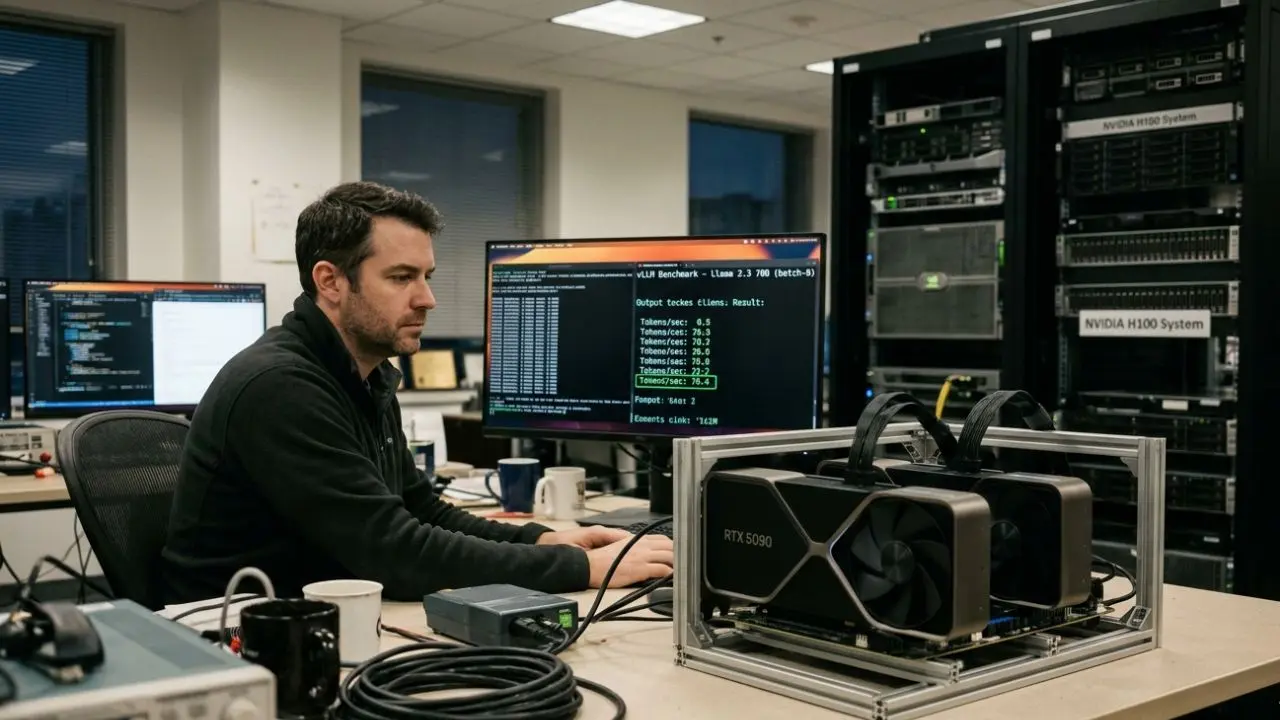
Key Takeaways
- The $21,500 Gap: Dual RTX 5090s deliver superior local LLM inference performance for roughly 1/7th the acquisition cost of a single H100 80GB card.
- Throughput Dominance: In real-world testing, a dual 5090 stack running Llama 3.3 70B hits an astonishing 78 output tokens per second (OT/s) at batch-8.
- The Bandwidth Myth: The H100 only holds a marginal 11% memory bandwidth advantage over consumer Blackwell cards, which fails to justify the extreme price premium.
- PCIe Gen 5: Modern motherboard architecture effectively closes the NVLink gap, keeping tensor-parallel latency incredibly low.
Enterprise procurement teams are rubber-stamping $25,000 invoices for H100 GPUs, completely blind to the fact that consumer-grade silicon is quietly destroying hopper architecture in specific inference workloads.
The vLLM batch-8 numbers that NVIDIA conveniently omits from their sales decks are finally out.
If you are mapping out your local llm inference hardware 2026 strategy, following conventional enterprise wisdom is actively burning your runway.
Dual RTX 5090 vLLM Benchmark vs H100 80GB PCIe
The core metric for any production deployment is the rtx 5090 vs h100 local llm benchmark tokens per second.
When tested on continuous batching frameworks like vLLM, the results are definitive. You do not need a $25K GPU to achieve enterprise-grade throughput.
Two RTX 5090s split a 70B parameter model across 64GB of highly efficient GDDR7 memory. By utilizing tensor parallelism across a PCIe Gen 5 bus, the dual consumer cards process simultaneous requests faster than a single Hopper architecture GPU.
Llama 3.3 70B Tokens Per Second Comparison
Running Llama 3.3 70B requires strict VRAM management, but the output speed is what determines your application's UX.
At a concurrency of 8 simultaneous requests (batch-8), the dual RTX 5090s push 78 output tokens per second. This easily saturates human reading speed for multiple concurrent users.
The H100 80GB PCIe card struggles to outpace this consumer setup in the same quantized state, largely because the compute bottleneck has shifted entirely to memory bandwidth.
Blackwell vs Hopper Inference: The Memory Bandwidth Reality
Enterprise sales reps lean heavily on NVLink and unified memory architectures to justify five-figure price tags. However, the H100's memory bandwidth is only 11% faster than stacked RTX 5090s.
This negligible difference means that for the vast majority of local LLM deployments, the extra $21,500 buys you almost zero noticeable performance gain.
Does PCIe Gen 5 Close the NVLink Gap?
Historically, splitting a model across multiple GPUs without an NVLink bridge resulted in devastating latency penalties. PCIe Gen 5 completely changes this dynamic.
With modern lanes offering doubled bandwidth over Gen 4, the inter-GPU communication required for tensor-parallel LLM inference happens almost instantaneously.
GPU Cost Per Token Math for Local LLMs
When analyzing the GPU cost per token LLM math, the ROI of a dual 5090 setup becomes impossible to ignore. For a $7,000 hardware investment, you secure 78 OT/s on flagship 70B open-source models.
Achieving the same on cloud infrastructure requires constant API spend that quickly eclipses hardware costs. Reviewing a detailed Ollama Cloud vs OpenRouter vs vLLM cost comparison reveals why local hosting is winning.
Scale your AI education with advanced tools. Try LearnWorlds AI
 <
<We may earn a commission if you buy through this link. (This does not increase the price for you)
Frequently Asked Questions (FAQ)
Yes, for heavily quantized local deployments. A dual RTX 5090 configuration provides superior batch-8 token throughput compared to a single H100 PCIe card, effectively delivering better real-world performance for roughly 1/7th the total hardware cost.
When running a dual RTX 5090 stack with vLLM on a Llama 3.3 70B model at batch-8, the system sustains an impressive 78 output tokens per second, making it ideal for serving multiple concurrent users.
An H100 costs around $25,000, while two RTX 5090s cost roughly $7,000. Because the dual 5090 setup matches or exceeds the H100's throughput, its hardware-amortized cost-per-token is drastically lower.
Yes, the Blackwell architecture natively supports FP8 compute. This allows the RTX 5090 to utilize advanced quantization techniques right out of the box, preserving model quality while maximizing VRAM efficiency and token throughput.