Best SLM for On-Device Deployment 2026: Hidden Picks
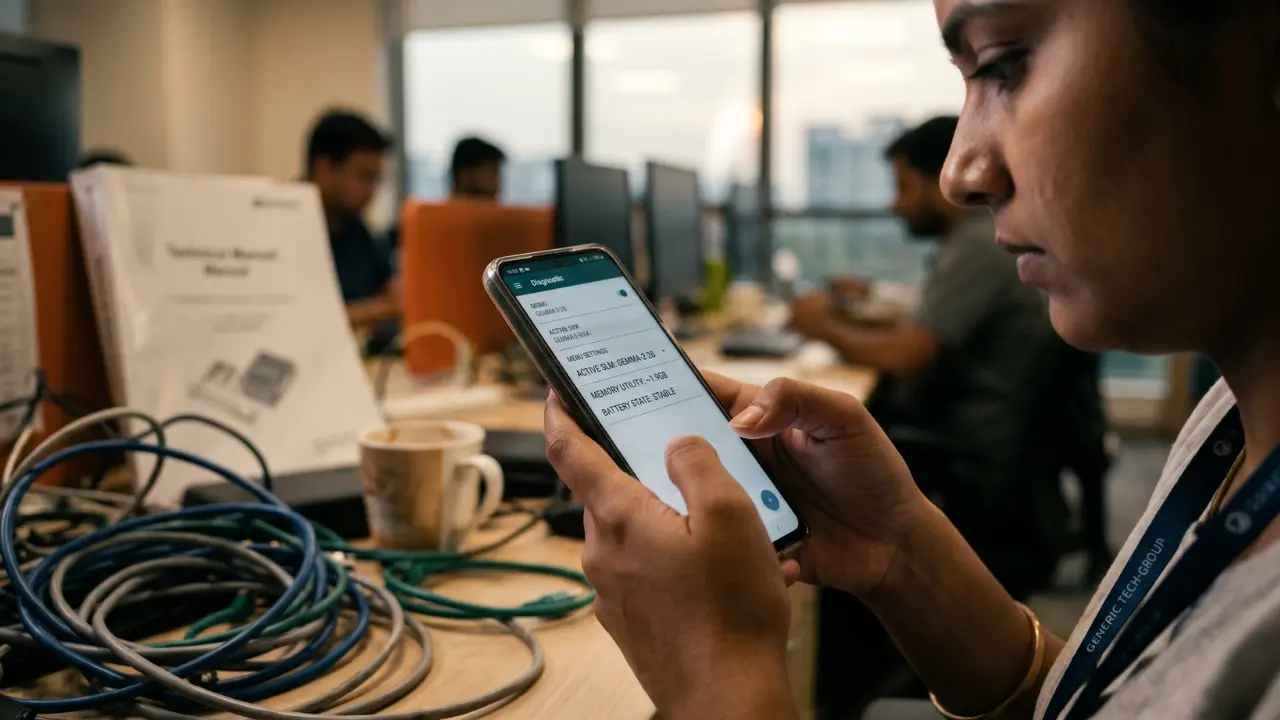
- Quantization is Mandatory: 4-bit quantization is essential. Doing it wrong destroys your inference speed.
- RAM is the Ultimate Bottleneck: A 6GB RAM floor is the harsh, non-negotiable reality for running modern mobile SLMs effectively.
- Apple's Silent Architecture: Apple Intelligence relies on heavily optimized, proprietary models.
- Hardware-Specific Routing: Choosing between Apple Neural Engine and Qualcomm NPUs dictates your overarching compilation strategy.
Most enterprise teams are failing at mobile AI because they fall for the same 4 quantization traps killing their tokens-per-second—while industry giants silently deploy perfectly optimized, hidden architectures.
You cannot scale offline edge intelligence without mastering the deployment of small language models within strict RAM and battery limits. The reality of 2026 is that cloud-dependency for basic text triage is an unacceptable user experience.
If you are testing these architectures locally before pushing to edge devices, ensuring you have the best AI laptop 2026 has to offer will significantly speed up your deployment and quantization pipeline.
The Reality of On-Device SLM Deployment in 2026
Deploying AI to the edge completely flips the traditional enterprise cost model. Instead of tracking cloud bills and API latency, engineering teams must now obsess over memory bandwidth, thermal throttling, and battery drain.
Unlike massive workstation deployments where you track NVIDIA RTX 4090 SLM tokens per second, mobile deployment is an exercise in strict hardware starvation. You are no longer building for maximum intelligence; you are building for "good enough" reasoning that fits inside a smartphone.
Top Contenders: The Best SLMs for Edge AI
Not all models scale down gracefully. Parameter count alone does not dictate success on mobile hardware. The most successful teams are leveraging models explicitly trained for constrained environments.
Llama 3.2 1B vs. Hardware Realities
Meta's Llama 3.2 1B has emerged as a dominant force for offline processing. It is small enough to avoid aggressive OS-level application terminations but smart enough to handle routing, summarization, and basic intent classification. However, you must pair it with a device possessing at least 6GB of RAM.
Apple Neural Engine & The Hidden SLM Architecture
While the open-source community debates parameter limits, Apple Intelligence uses a proprietary on-device model. Apple silently optimized this architecture to lean entirely on its proprietary Neural Engine. This guarantees low power consumption, but it locks developers out of traditional open-weight modifications.
The 4 Quantization Traps Killing Your Tokens-Per-Second
To fit a 1B to 3B parameter model on a phone, you must compress it. However, poor compression strategies ruin the user experience.
1. Over-Quantizing to 4-Bit
While 4-bit quantization is the standard, applying it uniformly across all model layers degrades reasoning capabilities. Smart deployments use mixed-precision quantization, keeping critical attention layers at FP16.
2. Ignoring NPU Bottlenecks
Many teams force the CPU to handle inference. You must compile your model specifically for the Apple Neural Engine or Qualcomm NPUs to achieve acceptable tokens-per-second.
3. Mismanaging Context Windows
Mobile RAM cannot handle massive context windows. If you push an 8K context prompt into an edge SLM, the device will swap memory and your inference speed will drop to near zero.
4. Thermal Throttling Ignorance
Sustained inference generates massive heat. If your app doesn't batch queries effectively, the device's OS will aggressively throttle the processor, killing your generation speed mid-sentence.
 We may earn a commission if you buy through this link. (This does not increase the price for you)
Frequently Asked Questions (FAQ)
Llama 3.2 1B is currently a top contender for edge AI. It offers the best balance of reasoning capabilities and minimal memory footprint, making it ideal for offline edge intelligence and constrained mobile hardware.
Yes, modern smartphones with at least 6GB of RAM can fluidly run 1B-class SLMs offline. High-end devices handle these quantized models without requiring constant cloud connectivity or draining the battery instantly.
For mobile deployment, 4-bit quantization is the industry standard in 2026. It significantly reduces the model's VRAM footprint and memory bandwidth requirements while preserving acceptable reasoning accuracy for most basic triage tasks.
To maintain system stability and avoid OS-level app terminations, a minimum device floor of 6GB total RAM is strictly required. The model itself will consume a significant portion of this active memory during inference.
Absolutely. Meta engineered Llama 3.2 1B specifically for mobile environments. It excels at fast, offline natural language processing and fits comfortably within the power and thermal constraints of standard smartphone processors.
Apple Intelligence utilizes a proprietary, highly customized on-device foundation model. It is optimized exclusively for the Apple Neural Engine, maximizing battery efficiency and offline privacy.
Both architectures are highly capable. Qualcomm's latest NPUs offer slight advantages in open-source framework compatibility, while Apple's Neural Engine provides superior thermal efficiency but favors models converted into its proprietary format.
Continuous SLM inference drains batteries rapidly due to high NPU utilization. However, in typical burst-workloads—like summarizing an email—the battery cost is negligible, often consuming very little power per task.
Yes, leveraging WebGPU, you can run small models directly within a browser. However, PWAs face stricter memory limits than native apps, usually capping deployable model sizes significantly lower than native deployments.
Frameworks that provide hardware acceleration across both iOS and Android are critical. They allow seamless compilation of models for distinct edge NPU architectures, ensuring high tokens-per-second regardless of the device.