Small Language Models 2026: Cheaper, Faster, Beating GPT-5? (May 2026)
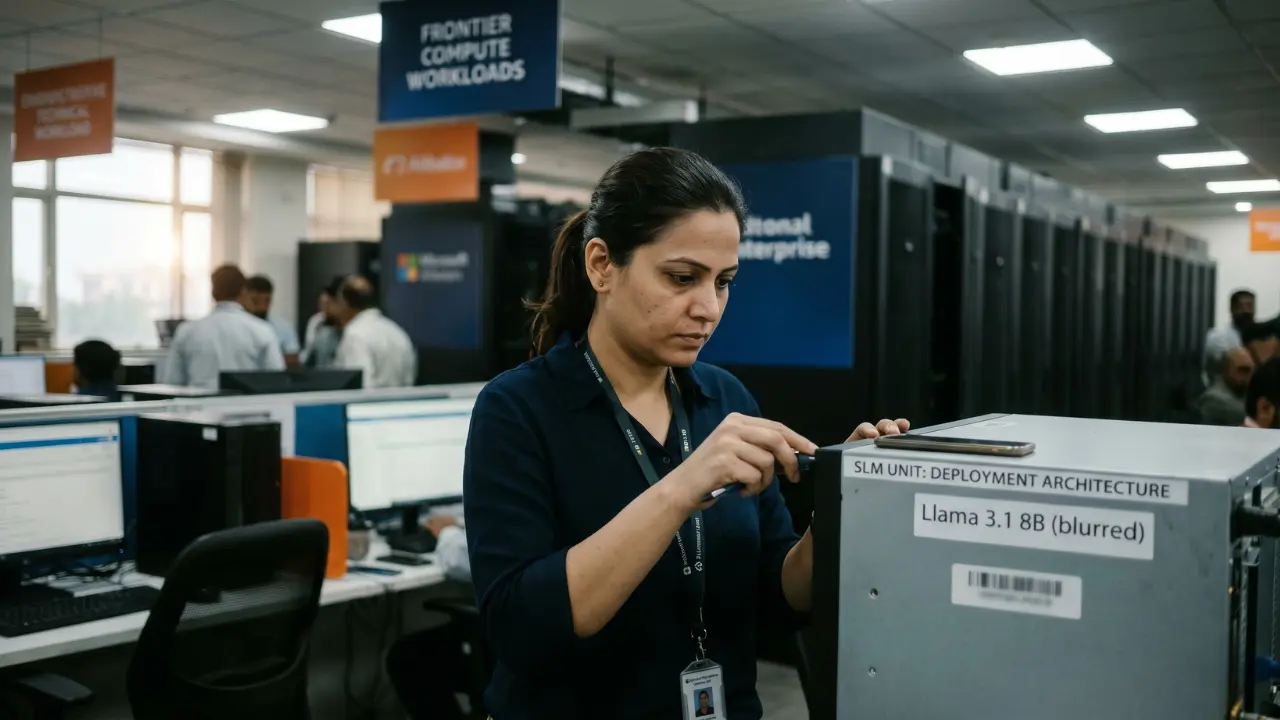
- Model Scale: An SLM is a transformer-based LLM with ~1B to 10B parameters, small enough to run on consumer hardware but highly capable for targeted enterprise tasks.
- Cost Reality: Cloud frontier LLMs run $2–$30 per million tokens; self-hosted SLMs drastically cut this to $0.10–$0.50 per million tokens.
- The Hallucination Myth: SLMs hallucinate more on open-ended trivia but consistently hallucinate less than large models on domain-fine-tuned tasks.
- Fast Break-Even: At 100M tokens/month, routing workflows to self-hosted SLMs typically saves $840K+/year with a TCO crossover inside 18 months.
- Top 2026 Models: Microsoft Phi-3, Google Gemma 2 9B, Mistral 7B, Meta Llama 3.2, and Alibaba Qwen 2.5 dominate enterprise adoption.
Your AI budget for 2026 has been quietly hijacked: a single mid-volume enterprise GPT-5 deployment now consumes more inference spend than your entire data warehouse stack — and your CFO has noticed.
While your team optimizes prompt length to shave 4% off the bill, your competitors have already migrated the boring 80% of their workloads onto Small Language Models (SLMs) like self-hosted Phi-3, Gemma 2, and Mistral 7B. They are slashing inference costs by 30–75x without losing measurable accuracy on production tasks.
This is the definitive 2026 reference on Small Language Models (SLMs) — the model class, the economics, the hardware, and the migration playbook that high-performing engineering organizations are using to take their AI bills back under control before the next budget review.
What Is a Small Language Model (SLM)? A Working Definition
A small language model is a transformer-based neural network with a parameter count typically ranging from a few hundred million to around 10 billion. They are deliberately engineered to run efficiently on constrained hardware — single consumer GPUs, edge devices, and increasingly even mobile silicon.
The "small" label is intentionally relative. A 7-billion-parameter model would have been considered enormous in 2020. In 2026, it qualifies as small because frontier LLMs now exceed a trillion parameters and require entire GPU clusters to serve.
For Enterprise PMO Directors, the practical definition is simpler: an SLM is any model that one engineer can deploy on one machine and one accountable team can govern end-to-end. That governability — not the parameter count — is what makes SLMs the dominant 2026 enterprise pattern.
For teams already exploring local model deployment via Ollama or OpenRouter routing, SLMs are the natural next step up the maturity curve.
Are Small Language Models Really Cheaper Than GPT-5?
Yes — and the cost differential is not subtle. The structural arithmetic is what makes SLMs the dominant 2026 procurement story. Cloud frontier LLM inference in 2026 sits in a $2–$30 per million tokens band depending on tier, batch settings, and commitments.
Self-hosted SLM inference on commodity GPUs lands at $0.10–$0.50 per million tokens — a 6× to 300× reduction, depending on utilization. The cost stack is what most teams miscalculate. GPT-5 pricing is pure marginal cost: every token bills.
Self-hosted SLM pricing is mostly fixed cost: GPU amortization, colocation or cloud GPU rental, and operations headcount. Above a usage threshold, fixed-cost economics always win.
For practitioners modelling this trade-off in detail, the full break-even math, hidden cost categories, and a downloadable calculator live in our enterprise SLM vs GPT-5 cost calculator page.
Which Small Language Model Is Best for Enterprise Use in 2026?
There is no single "best" SLM — there are five winners across five distinct deployment profiles. The right model is determined by your accuracy target, hardware budget, language requirements, and licensing posture.
- Microsoft Phi-3 (3.8B parameters) wins for on-device and CPU-only deployment, with surprisingly strong reasoning for its size. It is the default choice when memory or thermal budget is tight.
- Google Gemma 2 9B wins on quality-per-parameter for cloud-hosted private inference. It is the most balanced choice when the constraint is throughput-per-dollar on a single A10G or L4.
- Mistral 7B wins for custom fine-tuning. Its weights, license, and tooling ecosystem make it the path of least resistance for domain adaptation.
- Meta Llama 3.2 (1B and 3B) wins for mobile and edge deployment, where the constraint is RAM and battery.
- Alibaba Qwen 2.5 wins for multilingual coverage. For any deployment serving Hindi, Arabic, Vietnamese, or Mandarin users, Qwen 2.5 outperforms its size class.
A detailed head-to-head benchmark across MMLU, HumanEval, latency, and licensing — including the small 3B model that quietly outperforms two 9B competitors on coding tasks — is unpacked in our Phi-3 vs Gemma 2 vs Mistral 7B benchmarks deep dive.
Can an SLM Run Offline on a Laptop or Phone?
Yes. This is the capability that genuinely separates the SLM class from frontier LLMs, and it is the foundation of the privacy-preserving and air-gapped use cases driving enterprise adoption. Llama 3.2 1B runs fluidly on any modern smartphone (iPhone 13 and later, Pixel 7 and later, mid-range Android with 6GB+ RAM).
Phi-3 Mini runs offline on any modern laptop with no GPU at all. Mistral 7B Q4-quantized runs on consumer GPUs starting from RTX 3060. Apple Intelligence relies on a custom on-device foundation model that sits squarely in the SLM size class, and Google's on-device Gemini Nano is similar.
The Enterprise PMO implication: on-device SLMs collapse three line items at once — cloud inference cost, data residency risk, and end-to-end latency. For regulated industries, this is not a feature; it is a compliance architecture.
What Is the Difference Between an SLM and an LLM?
The honest answer is that SLM is a marketing distinction, not a technical one. Both are transformer-based language models. The differences are operational, not architectural. SLMs share core architectural strengths with their larger counterparts but operate within a lighter footprint.
The four operational differences that matter to a PMO:
- Hardware floor: SLMs run on a single GPU or even a CPU; LLMs require multi-GPU clusters with high-speed interconnect.
- Cost model: SLM economics are dominated by fixed costs; LLM economics by per-token marginal costs.
- Governance surface: SLMs can sit fully inside your network perimeter; cloud LLMs cannot.
- Customization curve: SLMs can be meaningfully fine-tuned in hours for under $100; frontier LLMs require entirely different and more expensive customization paths.
What SLMs trade away is generality. They sacrifice some breadth and depth compared to frontier LLMs but win on speed, cost, privacy, and deployability — which describes the requirements profile of most enterprise workloads.
The Information Gain — Why "SLMs Hallucinate More" Is Mostly Wrong
Here is the counter-intuitive insight that almost every vendor sales deck quietly avoids: SLMs do not hallucinate more than LLMs in the workloads where enterprises actually deploy them. They hallucinate more on a specific benchmark category — open-ended general knowledge questions.
In domain-fine-tuned production workloads — customer-service triage on your support ticket history, code completion on your monorepo, contract clause classification on your legal corpus — well-tuned SLMs frequently outperform frontier LLMs because they have been narrowed onto the relevant distribution.
This is a structural property, not a fluke. Smaller parameter counts force narrower function approximation. When the function you are approximating is "answer general trivia," that hurts. When the function is "classify this contract clause according to our internal taxonomy," it helps.
What Hardware Do I Need to Run a Small Language Model?
The hardware floor depends almost entirely on the model size and quantization level. The practical 2026 tiers break out cleanly into four bands.
- Tier 1 — Phone-class (1B parameters, 4-bit quantized): Any modern smartphone with 6GB+ RAM. Works perfectly for Llama 3.2 1B and Phi-3 Mini quantized aggressively.
- Tier 2 — Laptop-class (3B parameters, 4-bit): Any modern laptop with 16GB+ RAM, no discrete GPU required. Excellent for Llama 3.2 3B and Phi-3 Mini in higher precision.
- Tier 3 — Workstation-class (7–9B parameters): A single consumer GPU — RTX 4070 (12GB) at the floor, RTX 4090 (24GB) for comfortable headroom. Ideal for Mistral 7B and Gemma 2 9B at production throughput.
- Tier 4 — Server-class (production serving at scale): A10G ($1,500–3,000), L4, or 4090 in colocation, with vLLM or TensorRT-LLM serving 10s of concurrent users per GPU.
A single RTX 4090 ($1,500–$3,000) amortized over 3 years costs roughly $40–80/month — a price point that any meaningful production workload obliterates on cloud LLM tokens within days.
How Much Does It Cost to Fine-Tune a Small Language Model?
A focused LoRA or QLoRA fine-tune of a 7B model in 2026 costs $30–$120 in cloud GPU rental and runs in 2–6 hours on a single A100 or rented H100. The total project cost including data preparation, hyperparameter sweeps, and evaluation typically lands at $500–$3,000 for a well-scoped first attempt.
These numbers represent a roughly 90% reduction from 2023 fine-tuning costs, driven by parameter-efficient methods like LoRA, cheaper cloud GPU availability, and mature open-source tooling like Hugging Face PEFT, Unsloth, and Axolotl.
For PMO Directors, the strategic significance is that fine-tuning is now an expensable expense, not a capital project. A senior engineer can run a meaningful fine-tune on a Friday afternoon for less than the cost of dinner.
The detailed recipe — including the LoRA rank/alpha settings that most teams get wrong, the dataset size threshold where fine-tuning stops helping, and the evaluation harness you need before deployment — lives in our fine-tuning small language model LoRA cost guide.
Which Industries Are Adopting SLMs Fastest in 2026?
Three industry verticals are leading SLM adoption, all for the same underlying reason: regulatory exposure plus high token volume.
- Healthcare leads. Clinical decision support, clinical note summarization, and prior-authorization automation all hit HIPAA's data residency requirements. Air-gapped SLM deployments are now standard in major US health systems.
- Financial services is close behind. FINRA-supervised broker-dealers, regulated retail banks, and Indian fintechs operating under RBI's 2026 authentication mandate all need on-premises or VPC-isolated AI.
- Manufacturing and industrial operations is the fastest-growing category. Field-deployed AI on factory floors, predictive maintenance on edge devices, and warehouse robotics all require offline-capable inference.
For deployment in the highest-stakes regulated environments, the full implementation blueprint lives in our SLM air-gapped deployment for healthcare and finance guide.
Will Small Language Models Replace Cloud LLMs Entirely?
No — and any vendor or analyst claiming otherwise is selling something. The 2026 winning architecture is not SLM-only. It is hybrid by design: SLMs for the high-volume boring 80% of queries, frontier LLMs reserved for genuinely hard requests.
The mechanism that makes this work is the SLM Router — a multi-model architecture where a lightweight classifier inspects each incoming query and routes it to the cheapest model capable of handling it correctly. In production, well-tuned routers achieve 60–80% SLM routing rates while preserving frontier-model accuracy.
Frontier LLMs will remain essential for novel reasoning, complex multi-modal tasks, and queries outside the SLM's domain envelope. What changes is that they stop being the default path. They become the escalation path.
The Complete SLM for Enterprise Handbook — Hub Navigation
The pillar above is the strategic frame. The ten sub-pages below are the operational playbooks. Read in the order shown below — it matches the recommended publishing and rollout sequence.
The head-to-head matrix across MMLU, HumanEval, latency, and licensing.
The audit that exposes which of Meta's two edge SLMs actually ships in production.
Real benchmarks across Phi-3, Mistral, DeepSeek, and the driver fixes that unlock throughput.
Picks and the quantization traps that kill tokens-per-second on mobile.
The multi-model design that cuts inference bills 60%+ in production.
The open-source model that quietly beats Llama 3.2 on Hindi, Arabic, and Vietnamese.
The $60, four-hour recipe and the hyperparameters most teams get wrong.
The break-even formula and a downloadable TCO worksheet.
The 18-month break-even and the hidden colocation costs CFOs miss.
The compliance blueprint for healthcare, finance, and Indian regulated entities.
The Bottom Line for PMO Directors and Engineering Leaders
Three actions to take before your next quarterly review:
1. Audit your AI inference spend by workload class. Categorize every production AI call into "boring 80%" (high volume, narrow task, stable distribution) and "hard 20%" (novel reasoning, multi-modal, open-ended). Most teams discover the boring 80% is 95% of their bill.
2. Run a six-week SLM proof-of-value on one boring workload. Pick the highest-volume, lowest-creativity task — ticket triage, classification, summarization. Fine-tune a 7B model. Measure accuracy parity, latency, and cost differential. The first one usually pays for the next ten.
3. Architect for the hybrid endpoint. Do not bet the company on SLM-only. Build the SLM Router pattern from day one. Reserve frontier LLMs for the requests that actually need them. This is the architecture that will look correct in 2027 and beyond.
The cost arbitrage between cloud LLMs and self-hosted SLMs is the largest AI infrastructure dislocation since the cloud-vs-on-premises shift of 2010. Teams that move on it inside the next two quarters will compound the savings into next year's budget. Teams that don't will spend 2027 explaining a runaway inference line item to the board.

Frequently Asked Questions (FAQ)
A small language model is a transformer-based AI model with approximately 1 to 10 billion parameters, designed to run efficiently on a single GPU or even a CPU. Examples include Microsoft Phi-3, Google Gemma 2, Mistral 7B, Meta Llama 3.2, and Alibaba Qwen 2.5, all widely deployed in enterprise environments through 2026.
Yes — substantially. Cloud frontier LLM inference costs $2–$30 per million tokens, while self-hosted SLM inference runs $0.10–$0.50 per million tokens. At enterprise volumes of 100 million tokens per month, this typically translates to $840K+ in annual savings, with TCO crossover often inside 18 months.
There is no single best — the right choice depends on deployment profile. Phi-3 wins on-device, Gemma 2 9B wins quality-per-parameter for private cloud, Mistral 7B wins for fine-tuning, Llama 3.2 1B/3B wins for mobile edge, and Qwen 2.5 wins for multilingual coverage including Hindi, Arabic, and Vietnamese.
Yes. Llama 3.2 1B runs offline on any modern smartphone with 6GB+ RAM. Phi-3 Mini runs offline on any modern laptop without a GPU. Mistral 7B runs comfortably on consumer GPUs starting from RTX 3060. Apple Intelligence and Google's Gemini Nano are both SLM-class on-device models.
Both use transformer architecture; the difference is operational. SLMs run on a single GPU or CPU, follow fixed-cost economics, can be governed entirely inside your network perimeter, and can be fine-tuned in hours for under $100. LLMs require multi-GPU clusters, follow per-token marginal-cost pricing, and live in vendor clouds.
In domain-fine-tuned production workloads, yes — well-tuned 7B models routinely match or beat 70B general models on narrow tasks with lower hallucination rates. In open-ended general knowledge questions, SLMs hallucinate more. The variance is dominated by fine-tuning quality and task narrowness, not raw parameter count.
Four practical tiers in 2026: any modern smartphone for 1B-class models, any 16GB laptop for 3B models, a single RTX 4070 or 4090 for 7–9B models on a workstation, and A10G, L4, or 4090 GPUs in colocation for production serving with vLLM or TensorRT-LLM at scale.
A focused LoRA or QLoRA fine-tune of a 7B model costs $30–$120 in cloud GPU rental, running 2–6 hours on a single A100 or H100. Total project cost including data preparation, hyperparameter tuning, and evaluation typically lands at $500–$3,000 — roughly 90% cheaper than equivalent 2023 fine-tuning workflows.
Healthcare leads, driven by HIPAA data residency requirements and clinical AI use cases. Financial services follows closely under FINRA and RBI regulatory pressure. Manufacturing and industrial operations are the fastest-growing category because edge and offline deployment is a hard requirement for factory and field operations.
No. The dominant 2026 architecture is hybrid: SLMs handle the high-volume boring 80% of queries, while frontier LLMs are reserved as the escalation path for genuinely hard requests. The SLM Router pattern routinely achieves 60–80% SLM routing rates while preserving frontier-model accuracy on the residual workload.