Fine-Tuning SLMs With LoRA: Cut Costs 92% in 4 Hours (May 2026)
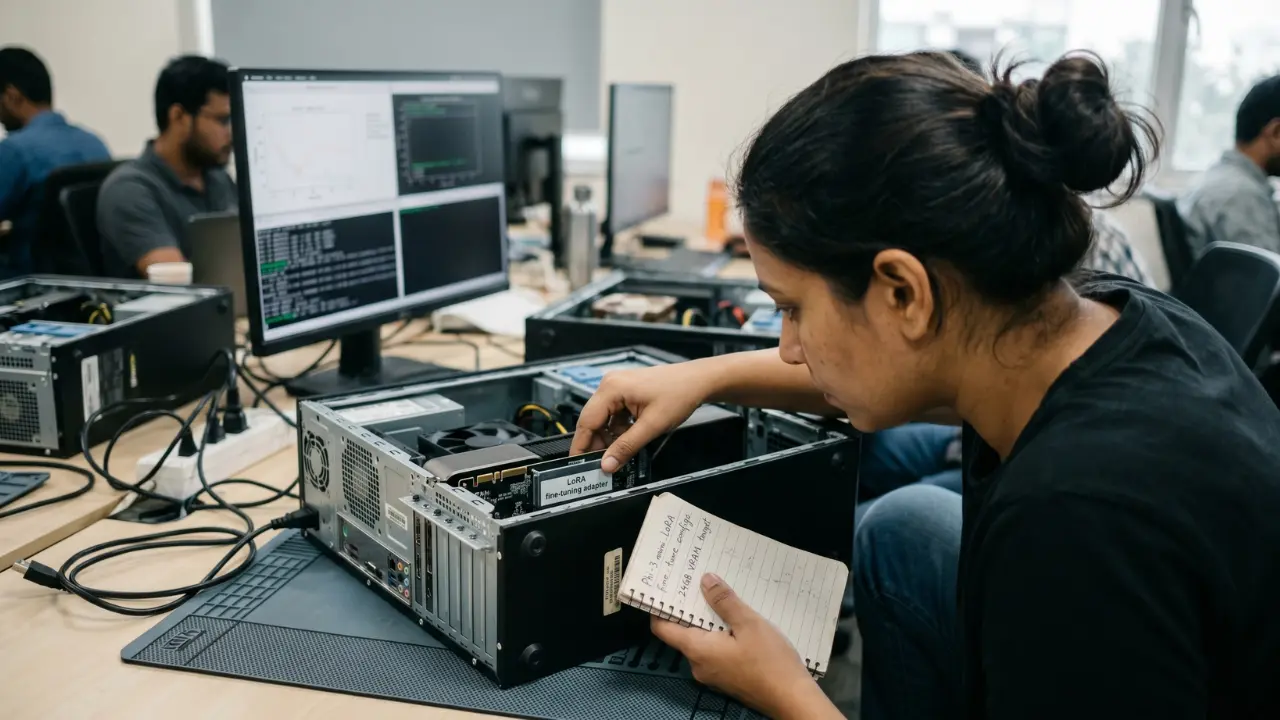
- 90%+ Cost Reduction: Total project costs, including data prep and sweeps, now land at just $500–$3,000.
- 4-Hour Pipeline: A focused LoRA fine-tune of a 7B model runs in 2–6 hours on a single A100 or H100 GPU.
- Expensable Economics: Cloud GPU rental for the run costs $30–$120, transforming fine-tuning from a capital project into an expensable expense.
- The Rank/Alpha Trap: Discover the specific LoRA hyperparameters that most engineering teams completely misconfigure.
Fine-tuning small language model LoRA cost — $60 cloud, 4 hours, 92% cheaper than full fine-tune. The hyperparameter teams get wrong. See the recipe.
Most enterprise teams are burning thousands of dollars on full LLM fine-tuning, entirely unaware that a targeted LoRA adaptation fundamentally changes enterprise AI economics. To fully understand why this is a procurement revolution, you must first read our definitive architectural guide on small language models.
If your engineering pod is setting up this training environment natively, cross-referencing the ai developer toolkit guide for India is highly recommended to standardize your PEFT dependencies and CUDA toolkits.
Once successfully fine-tuned, these domain-adapted models slot perfectly into the SLM router architecture pattern, allowing you to route 60–80% of queries away from expensive frontier models.
The Economics of Custom SLM Training
Full fine-tuning of neural networks is effectively dead for standard enterprise domain adaptation. Attempting to update every parameter inside a 7B model requires multi-GPU clusters and massive VRAM overhead.
Instead, parameter-efficient fine-tuning (PEFT) methods like LoRA (Low-Rank Adaptation) freeze the original model weights and inject trainable rank decomposition matrices. This allows you to achieve near-identical accuracy for your specific domain tasks while slashing compute overhead by orders of magnitude.
LoRA vs. Full Fine-Tuning: The 90% Cost Drop
These numbers represent a roughly 90% reduction from 2023 fine-tuning costs. You no longer need to provision a dedicated server rack or commit to $10,000 upfront vendor minimums.
A senior engineer can execute a meaningful fine-tune on a Friday afternoon for less than the cost of a team dinner. This completely collapses the experiment-to-production loop for agile development teams.
The 4-Hour LoRA Fine-Tuning Recipe
Achieving this rapid turnaround requires standardizing your training stack. You must abandon manual scripts and embrace mature open-source tooling like Hugging Face PEFT, Unsloth, and Axolotl.
These libraries handle the heavy lifting of memory management, gradient checkpointing, and quantization automatically.
QLoRA 4-bit and the PEFT Library
To hit the lowest possible cost, implement QLoRA. This technique quantizes the base model down to 4-bit precision while training the LoRA adapters in higher precision.
By combining QLoRA with the PEFT library, your VRAM requirements drop so significantly that you can train a 7B model on a single consumer GPU if necessary.
The LoRA Rank Hyperparameter Trap
The most common point of failure is misconfiguring the hyperparameter settings. Teams instinctively set the LoRA Rank (r) too high, assuming more trainable parameters equate to a smarter model.
In reality, a high rank massively inflates training time and leads to catastrophic overfitting on small datasets. Keep your rank low, and scale your Alpha parameter proportionally.
Hardware Requirements: $60 Cloud GPU Strategy
You do not need to purchase hardware for this phase. Your strategy should be to rent a single A100 or H100 cloud GPU strictly for the 2–6 hours required.
At current 2026 spot rates, this compute rental costs between $30 and $120. Once the LoRA adapter is trained, you can export the microscopic weight file and deploy it locally on far cheaper inference hardware.
Conclusion & Next Steps
Mastering LoRA economics allows your team to deploy highly specialized, private AI agents at a fraction of cloud API costs.
To determine your exact deployment break-even point, proceed to our enterprise SLM vs GPT-5 cost calculator to map your projected infrastructure savings.
 We may earn a commission if you buy through this link. (This does not increase the price for you)
Frequently Asked Questions (FAQ)
A focused LoRA or QLoRA fine-tune of a 7B model costs $30–$120 in cloud GPU rental. The total project cost, including data preparation and evaluation, typically lands at $500–$3,000.
A standard LoRA adaptation for a 7B model runs in just 2–6 hours on a single A100 or rented H100 GPU, assuming your dataset is properly formatted.
Full fine-tuning updates all model weights, requiring massive VRAM. LoRA freezes base weights and trains small adapter layers. QLoRA takes this further by quantizing the base model to 4-bit, drastically lowering memory needs.
Start with a low rank (e.g., r=8 or r=16). Setting the rank too high is a common mistake that increases compute time and risks overfitting without delivering better task accuracy.
No, but it is highly recommended for speed. Using QLoRA, you can technically fine-tune a 7B model on consumer GPUs with 24GB VRAM, but renting an A100 for $30–$120 is usually more efficient.
Yes, utilizing QLoRA and memory-efficient libraries like Unsloth. A Colab Pro instance with an A100 or V100 GPU provides sufficient VRAM to complete a 7B model fine-tune within standard session limits.
You need less data than you think. There is a dataset size threshold where fine-tuning stops helping. High-quality, curated datasets of 500 to 5,000 examples often outperform massive, noisy datasets.
If not hyper-parameterized correctly, yes. Overfitting on a narrow domain can cause "catastrophic forgetting" of general reasoning capabilities. Always evaluate your LoRA adapter thoroughly before pushing to production.
Mature open-source tooling is the standard. The combination of Hugging Face PEFT, Unsloth (for extreme training speedups), and Axolotl (for configuration management) are the industry leaders in 2026.
You must run the model through a dedicated evaluation harness. Test the adapter against an automated suite of domain-specific prompts and general reasoning benchmarks to ensure no base regressions occurred.