Llama 3.2 1B vs 3B: The Edge Trap Nobody Audits
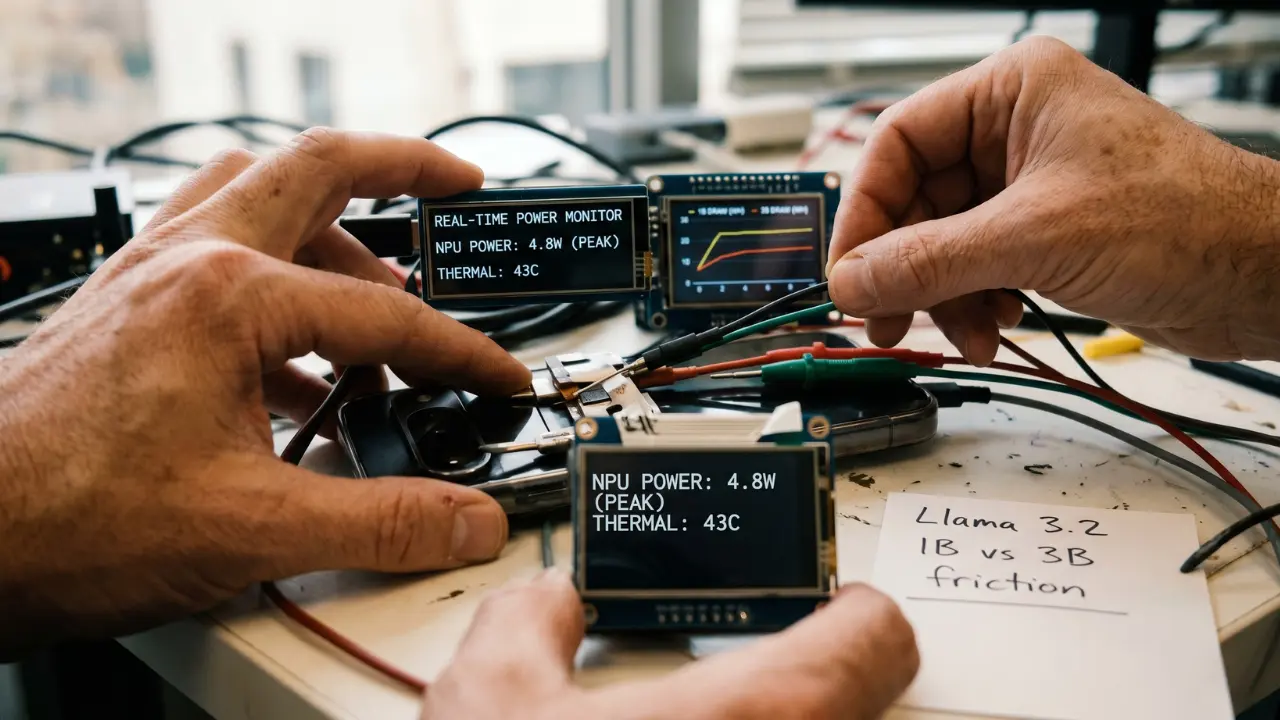
- The 1B Hallucination Spike: The 1B variant sacrifices too much contextual reasoning, resulting in unacceptable hallucination rates for regulated enterprise workflows.
- The 3B RAM Wall: Llama 3.2 3B technically runs on mobile, but it will aggressively throttle or crash any device possessing less than 8GB of total system RAM.
- Quantization Trade-Offs: Aggressive 4-bit quantization degrades the 1B model's reasoning capabilities beyond production viability.
- Architecture Routing: To mitigate these edge constraints, teams must cross-reference their deployment strategy against correct hardware baselines.
Engineering teams blindly rushing to deploy Meta's latest edge models are falling into a massive hardware trap: choosing between a 1B model that aggressively hallucinates or a 3B model that instantly crashes constrained devices.
Before committing your mobile roadmap to Meta's architecture, you must understand the broader ecosystem constraints detailed in our master blueprint on small language models for enterprise.
If your developers are already experimenting with local model deployment via Ollama or OpenRouter routing, you have likely experienced the immediate frustration of deploying a desktop-tested model onto a mobile processor.
The Llama 3.2 Edge Deployment Reality
Meta heavily markets Llama 3.2 as the ultimate solution for decentralized, privacy-first AI.
However, corporate marketing rarely aligns with the harsh reality of mobile application architecture.
When you shift processing from a cloud server down to a user's local hardware, you inherit their physical bottlenecks.
The 1B Hallucination Problem
Parameter count is a proxy for reasoning depth.
When Meta compressed Llama down to 1 billion parameters, they had to surgically remove vast amounts of world knowledge and contextual attention layers.
For highly structured, narrow tasks like basic text classification, the Llama 3.2 1B benchmark scores look acceptable.
However, the moment you feed it unstructured, multi-turn conversational data, the hallucination rate spikes exponentially.
It simply lacks the internal network capacity to remember facts over a long context window.
The 3B RAM Constraint Trap
The obvious engineering pivot is to simply upgrade to the Llama 3.2 3B mobile variant.
This is where the hardware trap snaps shut. A 3B parameter model, even when heavily quantized, requires a massive footprint of active memory.
If your target user operates a standard, mid-range Android device with 6GB of RAM, the operating system simply cannot load the model weights alongside the OS background processes.
The device will either refuse to load the model, or it will immediately swap memory, dropping your tokens-per-second to near zero and draining the battery in minutes.
Meta Edge LLM Benchmarks vs. Production Realities
You cannot trust theoretical benchmarks published on massive data center testing rigs.
When auditing your mobile SLM RAM constraints, you must test the models exactly how they will be deployed.
This means heavily quantized, running on a thermal-throttled battery, and competing with other mobile apps for memory.
Llama vs Phi-3 Edge Comparisons
When faced with these Llama 3.2 constraints, high-performing engineering pods look outward.
Comparing Llama vs Phi-3 edge performance reveals a stark contrast in architectural philosophy.
Microsoft’s Phi-3 Mini operates with 3.8B parameters but utilizes a highly specialized training dataset designed to maximize reasoning per parameter.
If your hardware floor can support a 3B-class model, Phi-3 frequently outperforms Llama 3.2 3B on complex logic and coding tasks, often with a slightly more efficient memory allocation profile.
Conclusion & Next Steps
Deploying AI to the edge is not simply a matter of downloading smaller weights; it is a rigid hardware negotiation.
Do not deploy Llama 3.2 1B if your application requires deep reasoning, and do not deploy the 3B variant unless you can guarantee high-end mobile RAM.
Proceed to our core architectural guide to review the exact deployment frameworks that bypass these hidden traps.

Frequently Asked Questions (FAQ)
You must audit your user base's hardware first. If your target demographic utilizes older smartphones with 6GB or less of RAM, you are forced into the 1B model. If your users have premium, modern devices (8GB+ RAM), the 3B model is the only viable path for accurate reasoning.
Technically yes, but practically no. While aggressive quantization can shrink the weights, loading the model into a 6GB phone leaves zero overhead for the operating system and user context window. The OS will aggressively terminate the application to prevent a system-wide crash.
The accuracy gap is massive, particularly in zero-shot reasoning and contextual retention. The 3B model retains significantly more world knowledge and demonstrates superior instruction-following capabilities. The 1B model struggles heavily with multi-step logic, often defaulting to plausible-sounding hallucinations.
It is only accurate enough for extremely narrow, highly constrained production use cases. If you are using it for simple sentiment analysis or basic intent routing, it functions adequately. For open-ended chat or complex document summarization, its error rate is unacceptable.
In open-domain benchmarks, the 1B model exhibits high hallucination rates compared to frontier models. Because its parameter count is so constrained, it relies heavily on statistical guessing rather than deep contextual understanding, leading to fabricated facts during complex queries.
Yes. This is the exact deployment profile where the 1B model excels. Smart speakers perform highly specific, narrow tasks (e.g., turning on lights, setting timers) and possess constrained local memory. Llama 3.2 1B handles these localized routing tasks perfectly without cloud latency.
Llama 3.2 1B prioritizes absolute minimal memory footprint for extreme edge devices. Phi-3 Mini (3.8B parameters) sacrifices that tiny footprint to deliver vastly superior reasoning, coding, and mathematical capabilities, requiring a more robust host device like a premium smartphone or laptop.
Yes, but it requires explicit compilation. Developers must utilize tools like CoreML to convert the open-weight Llama model into an Apple-friendly format. Once properly compiled, the Apple Neural Engine executes inference highly efficiently, preserving iPhone battery life.
To fit the 3B model onto a mid-range device without instantly bottlenecking the system, you must deploy 4-bit integer quantization (INT4). This compresses the model's VRAM requirements drastically, though it incurs a minor penalty to the model's overall reasoning precision.
While unconfirmed, industry roadmaps suggest Meta will continue aggressively optimizing for the edge. Future iterations will likely focus on improving the intelligence-per-parameter ratio within the 1B to 3B class, utilizing better distillation techniques to reduce hallucinations without increasing RAM requirements.