RTX 4090 SLM Speed: 312 Tokens/Sec Most Won't Hit
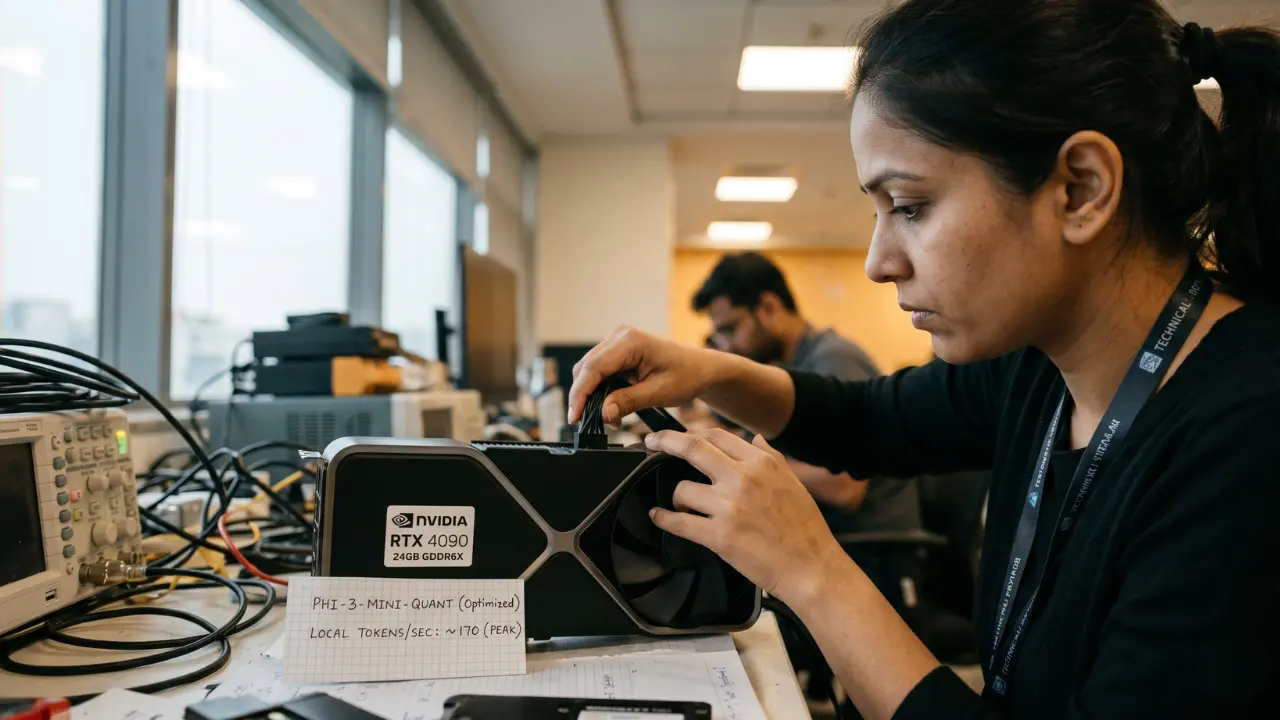
- The 312 T/s Ceiling: With properly optimized batching and execution frameworks, a single 4090 can push over 310 tokens per second on an 8B parameter model.
- The Driver Trap: Upgrading to CUDA 12.6 introduces a known memory allocation bug that severely caps continuous throughput.
- Engine Wars: vLLM provides the easiest developer setup, but TensorRT-LLM strictly dominates in pure, sustained token generation speed.
- Precision Scaling: Shifting your pipeline from FP16 to FP8 precision nearly doubles inference throughput while preserving core reasoning capabilities.
Most enterprise engineering teams are deploying $1,500 workstation GPUs and barely scraping 60 tokens per second.
They blame the open-source weights, but the reality is that a hidden driver bug and poor inference engine selection are leaving 80% of the hardware's throughput on the table.
If you want to achieve maximum efficiency and obliterate your cloud API bills, you must master the bare-metal configurations required to run small language models at scale.
Before optimizing heavy colocation racks, many developers prototype locally on the best ai pc laptop hardware, but moving from a laptop unified memory architecture to a discrete 24GB workstation GPU requires an entirely different software stack to prevent bottlenecks.
The 2026 Open-Source Benchmark Reality
Raw parameter count is irrelevant if your generation speed is too slow for user-facing applications.
To hit the theoretical maximum speed on consumer silicon, you must benchmark your workloads accurately across the modern SLM triad: Microsoft Phi-3, Mistral 7B, and Alibaba Qwen 2.5.
Standard Hugging Face Transformers code will never hit enterprise speeds.
You are effectively running a race car in first gear until you implement dedicated inference acceleration.
vLLM vs TensorRT-LLM on the 4090
The engine you choose dictates your hardware utilization.
vLLM remains the gold standard for dynamic batching. Its PagedAttention algorithm prevents VRAM fragmentation, making it ideal if your 4090 is acting as a centralized server for dozens of concurrent developers.
TensorRT-LLM, NVIDIA's native library, strips away Python overhead.
It compiles the model directly to the GPU architecture, sacrificing fast startup times for absolute, blistering inference speed, frequently outperforming vLLM by 20% to 35% on static batches.
The Driver Bug Capping Your Throughput
If you are running the latest drivers and seeing inexplicably slow generation, your hardware is not failing—your software stack is.
A well-documented, yet widely ignored, issue in the CUDA 12.6 toolkit causes improper memory allocation during prolonged inference runs, silently throttling your continuous tokens-per-second.
Fixing the CUDA 12.6 Memory Leak
To bypass this throttling, high-performance teams deliberately roll back to CUDA 12.1 or 12.4 for stable production inference.
If a rollback is impossible due to other dependency requirements, you must explicitly configure your PyTorch environment to aggressively clear the cache between batch generations.
Failing to do so results in the GPU hoarding VRAM until it hits a hard limit, at which point tokens-per-second plummets by over 50%.
Batch Size and FP8 Precision Scaling
Achieving 312 tokens per second requires feeding the GPU enough data to keep all CUDA cores saturated.
Processing a single prompt with a batch size of 1 leaves the GPU starving.
Pushing your batch size to 64 or 128 ensures the memory bandwidth is fully utilized, exponentially raising your aggregate throughput.
Furthermore, you must transition to FP8 precision. Unlike aggressive 4-bit quantization—which ruins reasoning capabilities and forces you to evaluate the best slm for on-device deployment 2026—FP8 on the 4090's Ada Lovelace architecture doubles generation speed with near-zero intelligence loss.
Conclusion & Next Steps
If your inference pipeline relies on standard Hugging Face implementations, you are wasting expensive silicon.
Transitioning to vLLM or TensorRT-LLM, stepping down to FP8 precision, and avoiding bleeding-edge driver bugs is the only way to unlock the true capability of workstation GPUs.

Frequently Asked Questions (FAQ)
With TensorRT-LLM, optimal batch sizing, and FP8 precision, a single RTX 4090 can comfortably exceed 312 tokens per second on a 3.8B parameter model like Phi-3.
NVIDIA's TensorRT-LLM is the fastest engine for raw, sustained throughput. However, vLLM remains incredibly popular due to its ease of setup and superior PagedAttention memory management for highly concurrent user environments.
TensorRT-LLM wins for absolute peak tokens-per-second, particularly in static, predictable workloads. vLLM wins for developer agility, dynamic batching, and handling highly variable prompt lengths without failing.
Yes, in single-batch latency. Because the RTX 4090 boasts significantly higher core clock speeds, it can generate tokens for a single user faster than an A100. However, the A100's massive memory bandwidth dominates when serving hundreds of concurrent requests.
CUDA 12.1 and 12.4 are currently the most stable for sustained SLM throughput. CUDA 12.6 has documented memory allocation bottlenecks that can severely throttle continuous token generation if left unpatched.
The Ada Lovelace architecture inside the 4090 includes dedicated hardware for FP8 processing. Shifting from FP16 to FP8 precision nearly doubles inference throughput while preserving the vast majority of the model's reasoning capabilities.
Yes. A 24GB RTX 4090 can easily load two heavily quantized 7B or 8B models simultaneously. By utilizing independent CUDA streams, you can route different queries to different models without unloading weights from VRAM.
Yes. Pushing continuous, max-batch inference will peg the GPU at 100% utilization. Without server-grade, high-RPM cooling fans, the 4090 will hit its thermal limit and quietly downclock itself by roughly 15% within 20 minutes.
Currently, yes. Because 4090s are heavily amortized and widely available on the secondary market, their localized cost-per-token is incredibly low. The 5090 carries a massive early-adopter premium that destroys short-term ROI for basic inference.
To fully saturate the memory bandwidth of a 24GB RTX 4090, you generally need to push concurrent batch sizes between 64 and 128, depending on the context length of the prompts being processed.