Air-Gapped SLM Deployment: HIPAA & FINRA Survival Kit
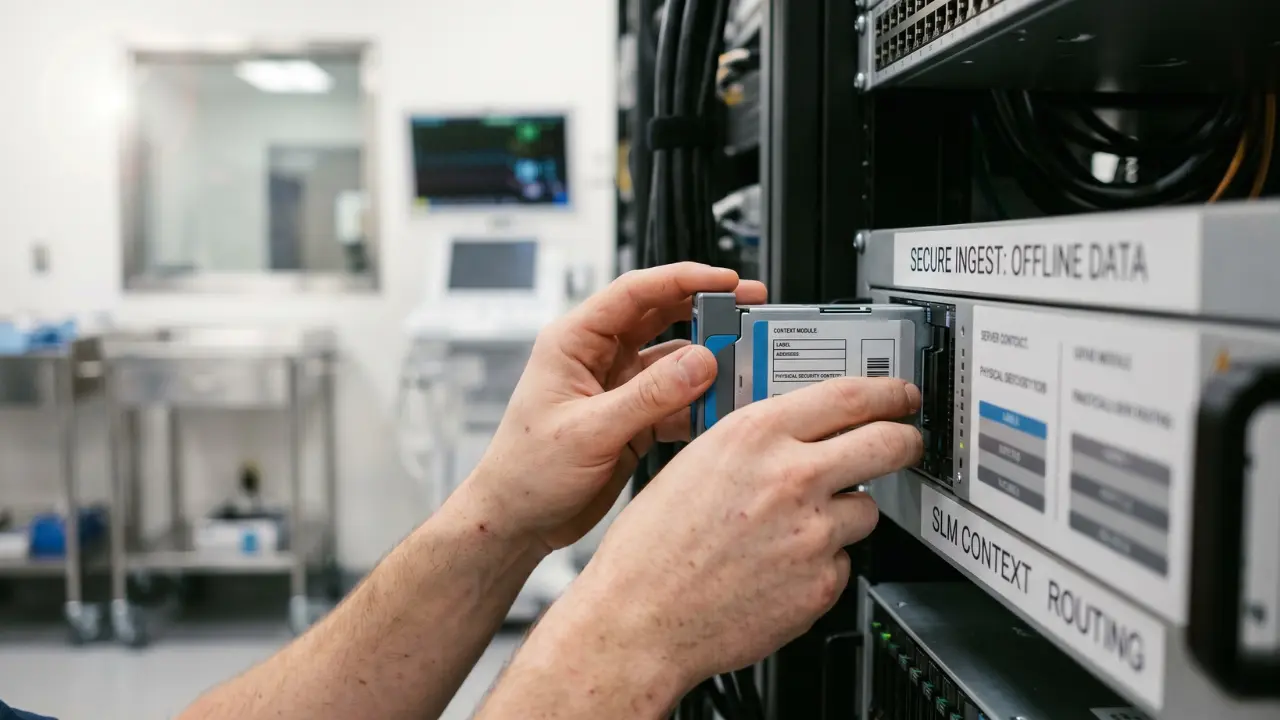
- Zero Data Egress: Air-gapped architectures guarantee that your prompts and proprietary data never leave your physical network perimeter.
- HIPAA & FINRA Compliance: Localized inference satisfies strict data residency and supervisory requirements across US healthcare and financial sectors.
- The RBI 2026 Mandate: Indian fintechs utilizing cloud LLMs for authentication workflows must pivot to in-perimeter SLMs to meet the April 2026 regulatory deadline.
- Model Selection: Deploying models specifically optimized for offline environments is critical for maintaining high tokens-per-second without relying on cloud compute.
Your cloud LLM API calls are a massive compliance breach waiting to happen.
For regulated entities in healthcare and finance, sending sensitive patient or transaction data over the public internet to a third-party hyperscaler is no longer a legally viable architecture.
To survive the incoming wave of strict data privacy regulations, high-performing engineering teams are bringing their intelligence entirely in-house using small language models.
If your infrastructure pod is currently building isolated environments from the ground up, referencing an ai developer toolkit guide for India is an essential first step for standardizing your local dependencies and ensuring secure offline package management.
The Imperative for Air-Gapped SLM Deployments
Enterprise procurement teams often mistakenly view AI as a simple software subscription.
However, in heavily regulated industries, AI is a profound data governance risk.
When a clinician summarizes a patient chart or a broker screens a flagged transaction, passing that text through an external API constitutes a data transfer.
Auditors and regulators are aggressively cracking down on these blind spots.
By deploying an SLM directly onto your own isolated bare-metal servers, you completely eliminate the third-party risk surface.
HIPAA Data Residency Requirements
Healthcare organizations lead the charge in offline AI adoption. Clinical decision support systems, note summarization tools, and prior-authorization automations directly handle Protected Health Information (PHI).
Air-gapped SLM deployments are rapidly becoming the gold standard in major US health systems because they natively satisfy HIPAA’s stringent data residency and access control mandates.
Navigating Financial Regulations with Edge AI
Financial services operate under equally severe scrutiny. FINRA-supervised broker-dealers and regulated retail banks cannot afford the compliance nightmare of conversational logs residing on external cloud servers.
SLMs are the only economically viable path to deploying generative AI in these environments.
Furthermore, if your deployment requires processing financial data in multiple regional dialects, you must ensure your architecture supports it.
Review our Qwen 2.5 multilingual SLM review to understand how smaller models can securely handle Arabic or Hindi offline.
FINRA and the RBI 2026 Authentication Mandate
For Indian fintechs, the regulatory clock is ticking loudly.
The Reserve Bank of India (RBI) authentication mandate, effective April 2026, directly implicates any AI system involved in transaction authorization or fraud screening.
The cleanest, most legally defensible posture is strict in-perimeter inference.
If your roadmap relies on external API calls inside the authentication path, that architecture is fundamentally on borrowed time.
Implementation Architecture for High-Risk Environments
Building an air-gapped environment requires treating your AI model like secure, compiled code rather than a dynamic web service.
You must physically or logically isolate the GPU clusters handling inference from the broader public internet.
This prevents both accidental data leaks and targeted external exfiltration.
Patching and Updating Offline Models
The primary engineering challenge in an air-gapped system is securely updating the model weights.
You cannot simply run a pull request over the internet.
Updates must be downloaded to a secure, external staging drive, scanned aggressively for malware or poisoned weights, and physically transferred across the air gap.
Using mature deployment frameworks like vLLM or TensorRT-LLM ensures that once the new weights are introduced, the internal serving infrastructure spins up reliably without external dependency checks.
Conclusion & CTA
Compliance is no longer an afterthought; it is the fundamental baseline of modern AI architecture.
Attempting to force regulated workloads through consumer-grade APIs is a systemic failure.
Secure your infrastructure, review your regional mandates, and transition your high-risk data processing to a fully isolated SLM environment today.

Frequently Asked Questions (FAQ)
You must download the model weights, dependencies, and inference engine (like vLLM) onto a secure, portable medium. This is then physically transferred and installed onto local, isolated servers that have zero network routes to the public internet.
While HIPAA does not explicitly mandate an "air gap," it strictly enforces data privacy, access controls, and auditing. An air-gapped SLM is the cleanest, most legally defensible architecture to guarantee that Protected Health Information (PHI) never leaks to a third-party API.
Yes. Once the model weights and the inference environment are loaded onto the hospital's local secure servers, the SLM can process clinical notes and triage data entirely offline without ever requiring an internet connection.
FINRA strictly regulates electronic communications, data security, and supervisory control systems. Using external LLM APIs introduces immense third-party vendor risk. Air-gapped SLMs ensure that all broker-dealer communications and algorithmic analyses remain strictly within supervised, auditable environments.
The RBI's April 2026 authentication mandate severely restricts how transaction authorization data is processed. Indian banks and fintechs must utilize in-perimeter inference—specifically SLMs running on internal infrastructure—to comply cleanly with these new security requirements.
Open-weight models with permissive commercial licenses are ideal. Mistral 7B, Google Gemma 2 9B, and Meta Llama 3.2 are highly capable models that can be downloaded entirely and run on internal enterprise workstation or server GPUs without external pinging.
Updates must be handled via a secure "sneakernet" process. Security teams download the new model weights or fine-tuned LoRA adapters externally, run rigorous malware scans, and physically transfer the files to the isolated network via encrypted USB or secure one-way data diodes.
Yes. Ollama is excellent for local, isolated hosting. However, for large-scale enterprise deployments handling thousands of concurrent clinical or financial requests, engineering teams typically transition to robust, high-throughput production engines like vLLM or TensorRT-LLM.
HIPAA requires strict logging of who accessed PHI and when. Even though the SLM is offline, the internal application interfacing with it must log every prompt submitted, the resulting output, and the exact user ID of the clinician executing the query.
The EU AI Act categorizes specific use cases (like biometric categorization or critical infrastructure) as high-risk. While it doesn't strictly force air-gapping, utilizing an isolated SLM drastically reduces the scope of your Data Protection Impact Assessment (DPIA) by proving zero data egress.