OpenAI Launches GPT-Rosalind: The Frontier AI Rewriting Drug Discovery
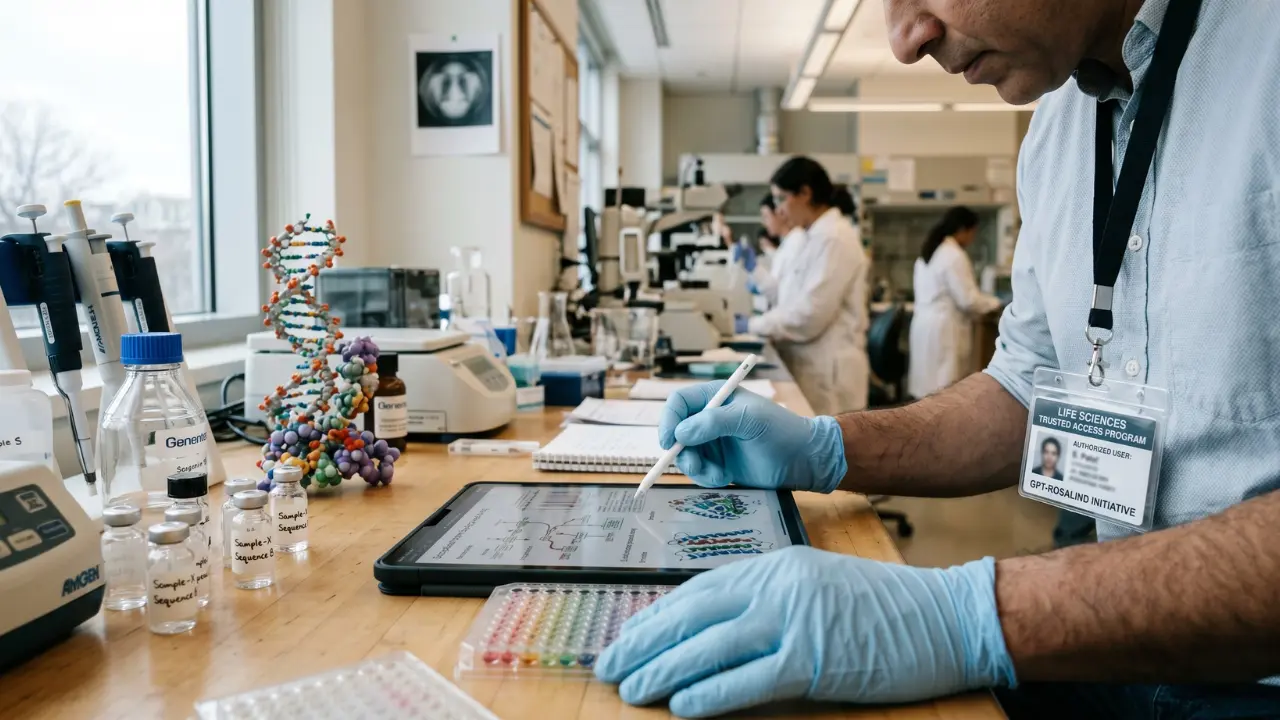
OpenAI has officially entered the highly competitive life sciences sector with the release of GPT-Rosalind, its first purpose-built frontier reasoning model tailored for biology, drug discovery, and translational medicine. Named after the pioneering British chemist Rosalind Franklin, whose X-ray crystallography was critical to unraveling the DNA double-helix, the model represents a massive shift from generalized text prediction to deep, domain-specific scientific synthesis.
Developing a new drug traditionally spans 10 to 15 years and suffers from notoriously high failure rates. GPT-Rosalind is engineered to compress this timeline by acting as an intelligence layer during the earliest, most hypothesis-driven stages of research. It allows scientists to rapidly parse massive volumes of specialized literature, query complex biological databases, and interact with computational tools within a single interface to accelerate target discovery and mechanism understanding.
The model is currently available as a research preview within ChatGPT Enterprise, Codex, and the OpenAI API, but it comes with strict guardrails. Due to the severe dual-use risks inherent in biological AI—such as the potential generation of harmful pathogens—OpenAI has restricted GPT-Rosalind to a vetted "trusted-access" program. Launch partners currently exploring its capabilities include global biotech and pharmaceutical giants like Amgen, Moderna, Genentech, Thermo Fisher Scientific, and the Allen Institute.
Architecting the Scientific Agent: Codex Integrations and Biological Reasoning
From a software engineering and bioinformatics perspective, GPT-Rosalind abandons standard chatbot mechanics in favor of complex, multi-step agentic workflows. Alongside the model, OpenAI rolled out a Life Sciences research plugin for Codex, granting developers and computational biologists programmatic access to over 50 scientific tools and public multi-omics data sources.
This allows the model to autonomously execute long-horizon, tool-heavy workflows that bridge the gap between abstract hypotheses and concrete experimental planning. Early benchmark data underscores a significant leap in specialized logic. On BixBench, a metric designed by Edison Scientific for real-world bioinformatics tasks, GPT-Rosalind achieved a 0.751 pass rate.
Furthermore, on LABBench2, the model outperformed the flagship GPT-5.4 on six out of eleven scientific tasks, showing notable dominance in CloningQA—a highly complex task requiring the end-to-end design of reagents for molecular cloning protocols.
The most striking validation of the model's capabilities came from a third-party evaluation by gene therapy company Dyno Therapeutics. Using unpublished, uncontaminated RNA sequences to prevent benchmark memorization, GPT-Rosalind was tested on sequence-to-function prediction and sequence generation. The model ranked above the 95th percentile of human experts on the prediction task, proving that specialized reasoning models can effectively navigate the vast search spaces of modern biochemistry and protein engineering.
The Enterprise Mandate: Trusted Access, Bio-Risks, and the Impact on Global Pharma GCCs
For Chief Technology Officers and enterprise leaders, the rollout of GPT-Rosalind signals a new era of highly governed, vertical-specific AI infrastructure. OpenAI is delivering the model with stringent enterprise security controls, including Role-Based Access Controls (RBAC), SOC 2 Type 2 compliance, and HIPAA-aligned standards.
Organizations must undergo rigorous qualification reviews to prove their research holds a clear public benefit and that they maintain dedicated oversight to prevent insider risk or the mishandling of sensitive biochemical data. This shift toward autonomous biological reasoning also poses an existential threat to the traditional offshore billing model.
Indian Global Capability Centers (GCCs) currently process massive amounts of pharmacovigilance, clinical trial data, and medical literature synthesis for Western pharma companies. As organizations like Amgen and Moderna deploy GPT-Rosalind to automate evidence synthesis and omics interpretation, the demand for manual data processing will plummet.
To survive this transition, GCCs will be forced to rapidly pivot their workforce. Instead of utilizing massive teams for manual literature reviews, outsourcing hubs must train engineers and scientists to orchestrate and govern these advanced models. For enterprise leaders navigating this transformation, understanding the broader context of generative AI drug discovery will be critical to maintaining competitive margins and maximizing the ROI of AI-augmented clinical trials.
Frequently Asked Questions
What is OpenAI GPT-Rosalind?
GPT-Rosalind is OpenAI's first domain-specific frontier reasoning model, specifically designed for life sciences research, target biology, and drug discovery. It is capable of deep scientific reasoning, literature synthesis, and connecting to over 50 specialized computational tools via Codex.
How can my organization get access to GPT-Rosalind?
Access is currently restricted to eligible U.S. enterprise customers through a trusted-access program. Organizations must complete an intake process demonstrating legitimate scientific research goals, strong governance, and robust security controls to prevent the misuse of biological data.
Is GPT-Rosalind HIPAA compliant?
Yes, GPT-Rosalind is delivered through ChatGPT Enterprise, Codex, and the OpenAI API with enterprise-grade security controls. The platform supports deployments with Regulated Workspaces, Business Associate Agreements (BAAs), and is aligned with SOC 2 Type 2 and HIPAA standards.
Sources and References
- OpenAI Help Center: Introducing GPT-Rosalind for Life Sciences Research
- Economic Times: OpenAI unveils GPT-Rosalind
- The Next Web: OpenAI GPT-Rosalind Life Sciences AI Model
- Financial Express: What is OpenAI's GPT-Rosalind
- VentureBeat: OpenAI debuts GPT-Rosalind
- OpenAI Form: Life Sciences Trusted Access