The 30-Day Cure: How Generative AI is Finding Drugs Big Pharma Missed
Key Takeaways: The Speed of AI Drug Discovery
- Speed: AI has compressed drug discovery timelines from 4-5 years down to just 30 days for initial candidate selection.
- The AlphaFold Breakthrough: Google DeepMind’s AI can now predict the structure of nearly all known proteins, unlocking "undruggable" diseases.
- Cost Collapse: Traditional R&D costs billions; AI models are slashing this by predicting failures before human trials begin.
- Generative vs. Predictive: We aren't just analyzing data anymore; AI is now inventing new molecules from scratch.
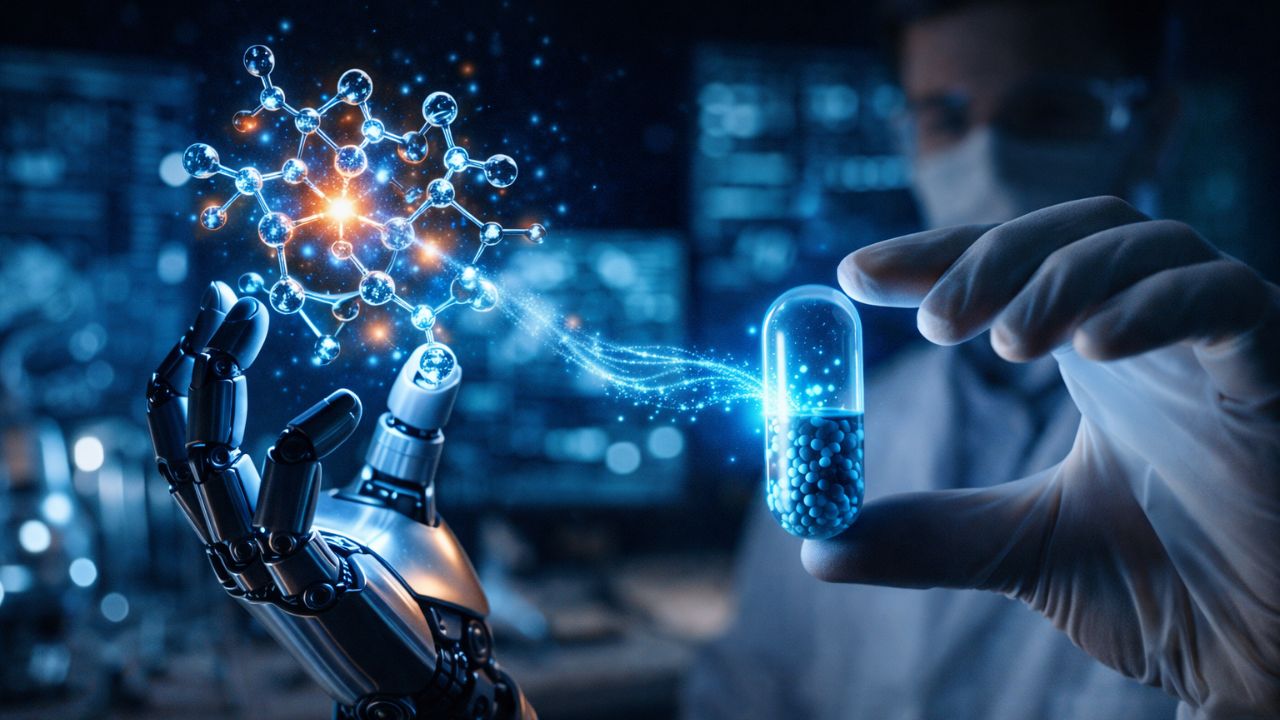
The End of the "10-Year Wait"
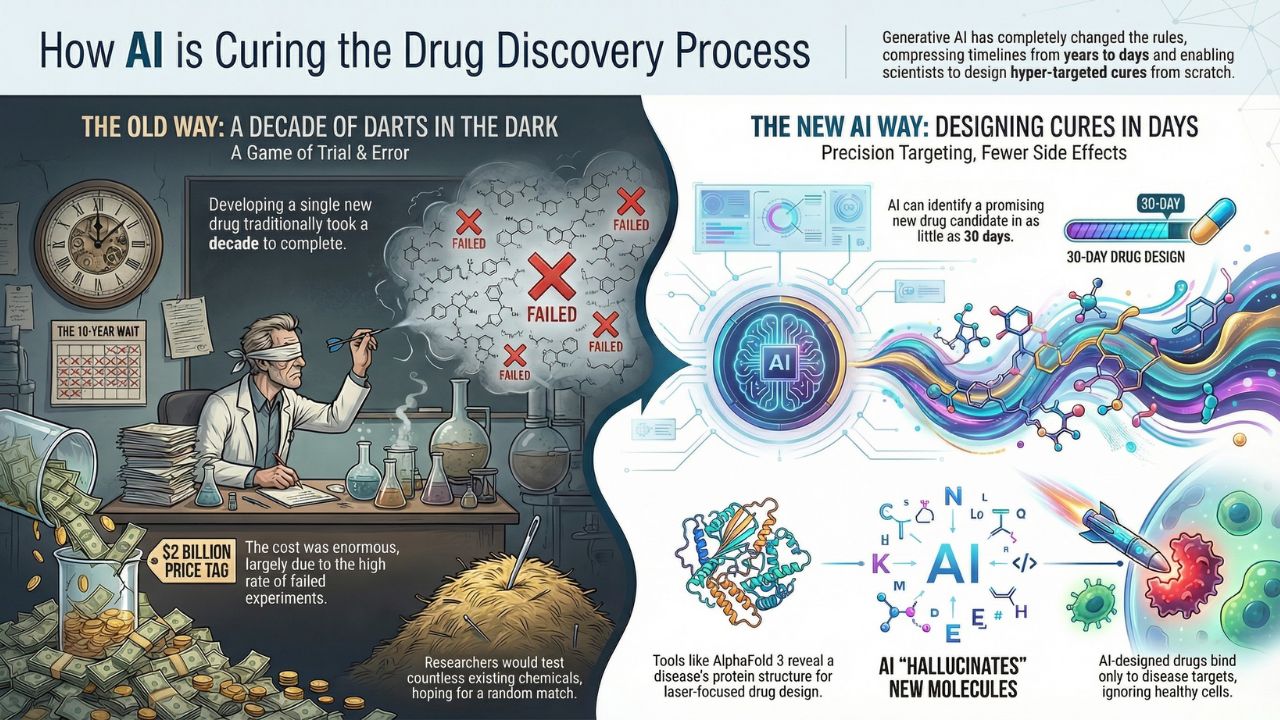
For decades, the pharmaceutical industry had a golden rule: finding a new drug takes 10 years and $2 billion.
It was a slow, painful game of trial and error. Most experiments failed.
Generative AI has flipped the board.
Instead of testing random chemicals in a lab, algorithms now simulate billions of molecular interactions in seconds.
This exploration of accelerated healing is a central pillar of our comprehensive guide: The Clinical AI MedTech Revolution: How Algorithms Are Saving Lives.
How Generative AI "Hallucinates" Cures?
You have heard of ChatGPT writing poetry. Now, imagine that same technology writing chemical code.
Generative AI drug discovery works by treating chemistry like a language.
Atoms are letters. Molecules are words. Chemical reactions are grammar.
The AI doesn't just search a database of existing drugs.
It hallucinates entirely new molecular structures that human scientists never imagined.
The Insilico Medicine Breakthrough: In a landmark case, the company Insilico Medicine used AI to discover a candidate drug for Pulmonary Fibrosis in under 18 months, a process that usually takes years.
AlphaFold 3: The Map to Human Biology
If you want to design a key (the drug), you first need to know the shape of the lock (the disease protein).
For 50 years, figuring out these "locks" was nearly impossible.
Enter AlphaFold 3.
Developed by Google DeepMind, this AI can predict the 3D structure of biological molecules, proteins, DNA, and RNA, with incredible accuracy.
Why does this matter?
- Precision: We can now see the "shape" of diseases like Alzheimer's or Cancer at an atomic level.
- New Targets: It exposes weak points in viruses that were previously invisible to researchers.
While AI Radiology Tools are revolutionary for finding the disease early, AlphaFold provides the blueprint to actually kill it.
From "Hit or Miss" to "Design and Deploy"
Traditional drug discovery is like throwing darts in the dark.
AI in Pharma R&D turns the lights on.
It allows for De Novo Design (designing from scratch). The AI builds a molecule specifically tailored to bind only to the disease target, ignoring healthy cells.
The Safety Benefit This precision reduces side effects.
Old drugs often hit healthy organs (collateral damage).
AI-designed drugs are laser-focused.
Conclusion: The Age of Digital Biology
We are moving from "discovering" biology to engineering it.
The concept of a "30-Day Cure" is no longer hype; for the initial design phase, it is a benchmark.
As Generative AI matures, the gap between a new virus emerging and a cure being deployed will shrink, saving millions of lives in the process.
Frequently Asked Questions (FAQ)
Yes. AI only accelerates the discovery phase. The drug must still pass the exact same rigorous FDA human clinical trials as any other medication before it reaches your pharmacy.
Likely. A huge part of high drug prices is recovering the cost of failed experiments.
By reducing the failure rate, AI should theoretically lower the R&D costs passed on to patients.
That is the goal. By analyzing biology faster than any human, AI is currently attacking complex conditions like ALS (Lou Gehrig's disease) and Huntington's, which have baffled scientists for decades.