The AI Threat to GCCs: Why Google's $10M Factory Push Wins
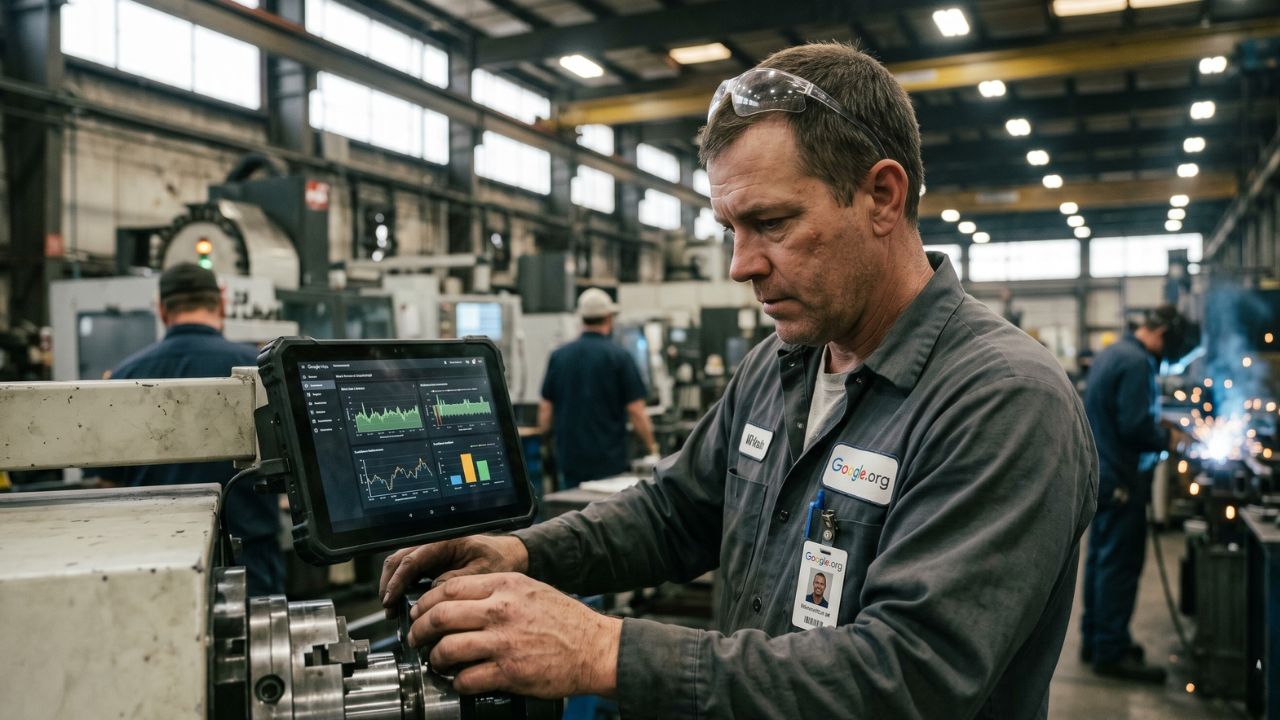
Google.org just deployed a $10 million grant to transform 40,000 U.S. manual laborers into highly efficient artificial intelligence operators on the shop floor.
This massive domestic upskilling initiative is a direct threat to the traditional labor arbitrage model, forcing enterprise CTOs to immediately audit their offshore engineering strategies before they become obsolete.
Quick Facts
- The $10M grant flows from Google.org directly to the Manufacturing Institute to modernize the American industrial workforce.
- 40,000 factory employees will learn to operate autonomous systems, actively bypassing traditional technology pipelines.
- Indian GCCs face immediate disruption as localized AI operators handle tasks that previously required basic offshore engineering support.
- New curriculum designs like "AI 101 for Manufacturing" teach manual laborers practical applications rather than theoretical coding.
The $10M Google Grant That Reshapes Global Outsourcing
Tech companies no longer view the factory floor as a secondary target for software deployment.
Google is bypassing standard software adoption curves by retraining the specific individuals standing next to the machinery.
By funding the Manufacturing Institute, Google ensures that 40,000 workers will soon possess the technical capability to manage sophisticated data workflows locally.
This immediate injection of capital and curriculum fundamentally alters enterprise cost dynamics.
Large manufacturers traditionally relied on Global Capability Centers (GCCs) to run basic data analysis and manual engineering support from a distance. That strategy is now inherently flawed.
"We know that true innovation happens when the people on the shop floor have access to the technological tools and training they need to succeed."
— Maggie Johnson, Global Head of Google.org.
Why Domestic AI Operators Beat Offshore Manual Engineering
Google's funding creates highly specific educational tracks, including the AI 101 for Manufacturing and Advanced AI for Manufacturing Technicians courses.
These programs empower front-line employees to solve complex production issues in real-time.
When a machinist can query a predictive maintenance language model directly at the workstation, the need to file a ticket with an offshore engineering team vanishes.
The Federation for Advanced Manufacturing Education (FAME USA) is expanding into 15 new regions specifically to embed these capabilities into apprenticeship programs nationwide. The domestic workforce is becoming self-sufficient.
The ROI Shift: Localized AI vs. Offshore Labor Arbitrage
Enterprise CTOs must recognize that the math behind offshore labor arbitrage is actively breaking.
Google is proving that it is cheaper to upskill a domestic welder with AI tools than to pay an entire remote engineering team to monitor the welder's output.
You can review the foundational details of this massive capital injection in our earlier report on the Google manufacturing institute AI training funding initiative.
When the individuals turning the wrenches can also manage the data flow, the traditional outsourcing pyramid collapses.
Calculating the Compute Cost of Industrial Agent Swarms
The new financial metric is compute cost, not hourly labor rates.
Modern factories will rely on localized swarms of intelligent agents managed by the people on the floor.
CTOs must reallocate their budgets from offshore headcount to cloud infrastructure and token generation. The companies that realize this fastest will secure a massive competitive advantage.
The Strategic Pivot for Indian GCCs
Indian GCCs cannot survive on low-cost engineering support moving forward.
As the U.S. workforce becomes AI-fluent, these remote centers must pivot their offerings.
They must transform into high-level orchestration hubs. Instead of answering basic technical queries, GCCs must design the overarching autonomous systems that the factory workers deploy.
From Manual Support to Autonomous Systems Orchestration
The transition requires ruthless honesty regarding internal GCC cost savings vs value creation metrics.
Centers that fail to move up the value chain will be shut down.
GCC leadership must immediately train their engineers to build natural language interfaces and secure IoT network architectures. The era of manual data processing is over.
Why It Matters
Google’s $10 million investment is the definitive signal that manual labor and technical execution are merging into a single discipline.
The future factory floor belongs to the blue-collar operator equipped with an intelligent technical stack.
Competitors will be forced to match Google's grassroots investments to ensure their software is adopted.
For CTOs, the mandate is clear: localized upskilling will systematically replace offshore manual engineering, and enterprise architecture must evolve today to match this new reality.
Frequently Asked Questions
1. How does AI affect manufacturing outsourcing to India?
AI significantly reduces the need for manual offshore engineering support. As domestic factory workers become capable of operating intelligent systems locally, Indian GCCs must transition from providing basic labor arbitrage to offering high-value autonomous supply chain architecture.
2. What is the ROI of AI training for factory workers?
The ROI stems from massive productivity gains and the elimination of redundant offshore support tasks. Workers equipped with AI can perform predictive maintenance and solve production bottlenecks in real-time without filing external technical tickets.
3. How should CTOs adjust their GCC strategy for manufacturing?
CTOs must immediately audit their offshore operations and pivot their GCCs away from low-cost manual engineering support, demanding instead that remote teams focus entirely on localized, high-level AI agent orchestration.
4. What are the hidden costs of scaling industrial AI?
The financial focus shifts from offshore hourly wages to cloud infrastructure expenses, token generation, and the localized compute costs required to run intelligent industrial agent swarms continuously.
5. Will domestic AI upskilling replace offshore engineering teams?
Basic remote engineering support will be entirely replaced by AI-fluent domestic workers. However, offshore teams that successfully pivot to designing complex, autonomous systems architecture will remain highly valuable.