GCC cost savings vs value creation metrics: The Fatal Trap Sinking Offshore ROI
Quick Summary: Key Takeaways
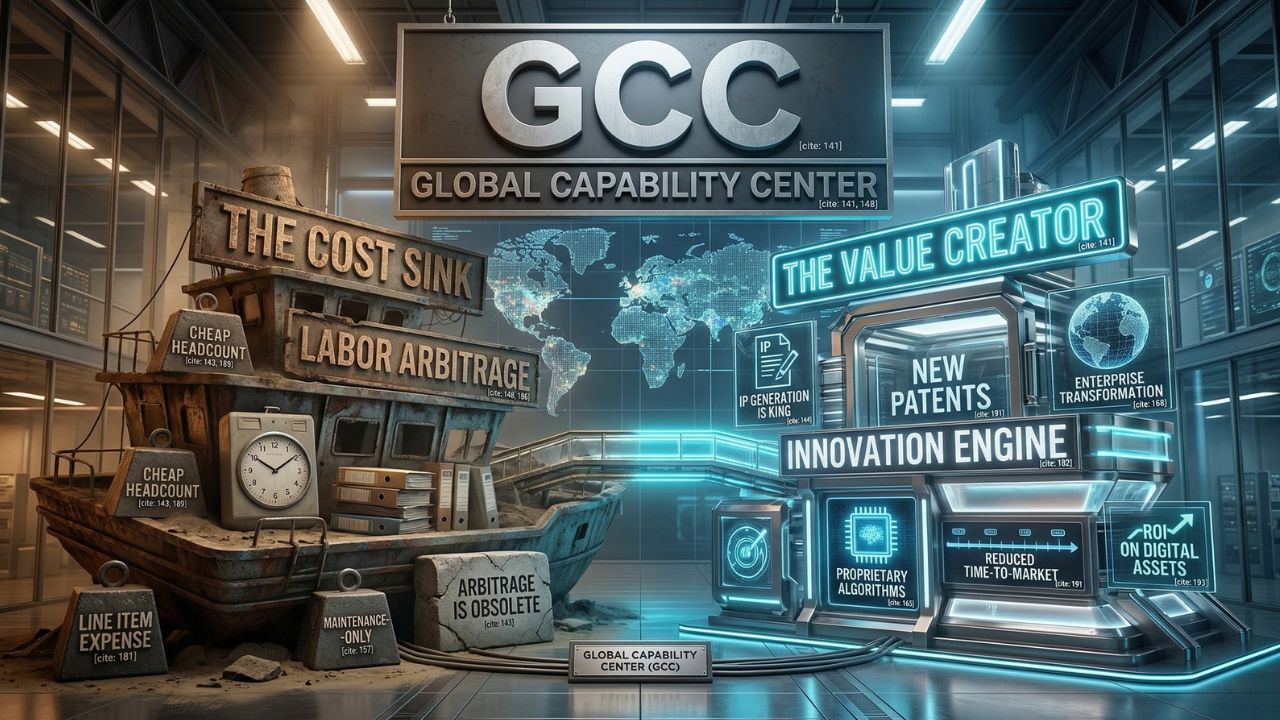
- Arbitrage is obsolete: Measuring success strictly by how much money you save on headcount is a failing strategy.
- IP generation is king: Your center must be evaluated on the new intellectual property and digital assets it produces.
- Profit over savings: Transitioning from a cost center to a profit center requires a total overhaul of your measurement frameworks.
- Automation shifts the baseline: As AI handles routine tasks, human capital must be directed toward measurable enterprise transformation.
- Board-level alignment: Value creation metrics speak the language of corporate growth, securing long-term stakeholder buy-in.
If you only track labor arbitrage, your offshore center is operating like a dinosaur.
To transition from basic cost management to true innovation leadership, you must urgently update your measurement frameworks.
You need to master the GCC cost savings vs value creation metrics to future-proof your center and protect your ROI.
This deep dive is part of our extensive guide on GCC performance KPIs: The $100M Mistake Sinking Offshore Value in 2026.
The Death of Simple Labor Arbitrage
For decades, the global capability model was built on a very simple premise: cheaper talent equals corporate success.
Today, inflation, rising global salaries, and advanced automation have completely shattered that basic cost-saving equation.
If your executive reports only highlight how many dollars were saved per headcount, you are missing the bigger picture.
Why Cost-Cutting is a Fatal Trap?
Focusing entirely on shrinking budgets forces offshore teams into a "maintenance-only" mindset.
When teams are only incentivized to be cheap, they stop proposing innovative, revenue-generating solutions.
This leads to a stagnant operational environment where true digital transformation becomes impossible.
Transitioning to Innovation Leadership
The smartest global CIOs are pivoting their metrics to track how much new value the offshore center is injecting back into the enterprise.
This means measuring the exact financial impact of new product features, automated workflows, and accelerated go-to-market strategies.
To ensure you are tracking the right baseline data for this shift, review our foundational guide on Key KPIs for Global Capability Centers performance measurement.
Tracking Intellectual Property
Your developers should be creating reusable code repositories, proprietary algorithms, and advanced automation scripts.
You must assign a tangible dollar value to these assets to prove your center is a high-yield investment.
When you track IP generation, you change the narrative from "what you cost" to "what you create."
Driving Enterprise Transformation
A mature capability center leads global transformation initiatives rather than just taking orders from headquarters.
Track how many legacy systems your offshore team has modernized or retired within a given fiscal year.
Proving this impact requires shifting from tracking "hours logged" to "business outcomes delivered."
Visualizing the Shift for Stakeholders
You cannot convince your board of directors to change their perspective without hard, visualized data.
You must display innovation output side-by-side with operational costs to show the net-positive gain of your offshore footprint.
If you need a framework for this executive reporting, download our Global Capability Center key metrics dashboard template.
Balancing Efficiency with Innovation
Achieving high-value creation does not mean you abandon financial efficiency entirely.
It means setting a baseline for operational costs, and dedicating all surplus capital toward high-growth tech initiatives.
Mastering this balance is the hallmark of a world-class global business services hub.
Conclusion
Stop treating your highly skilled offshore professionals as mere line items on an expense spreadsheet.
By fully adopting and tracking GCC cost savings vs value creation metrics, you transform your center into a vital engine for corporate growth.
Make the pivot today, before your outdated measurement models render your offshore operations obsolete.
Streamline your AI Feedback loops. Try HeyGen AI
We may earn a commission if you buy through this link. (This does not increase the price for you)
Frequently Asked Questions (FAQ)
Cost savings metrics track the reduction in operational expenses (like labor arbitrage), while value creation metrics measure new revenue, intellectual property, and business transformation generated by the center.
Global salary inflation and the rise of AI have narrowed the cost gap; to remain viable, centers must contribute strategic innovation rather than just cheap labor.
Innovation output is measured by tracking the number of new patents, the value of proprietary code developed, and the reduction in time-to-market for enterprise products.
Key examples include ROI on newly developed software, percentage of revenue derived from GCC-led initiatives, and quantifiable hours saved through offshore automation.
Calculate ROI by taking the net financial gain (or cost avoidance) generated by the new IP, minus the fully loaded development cost, divided by that same development cost.
A GCC becomes a profit center by developing marketable digital products, optimizing global supply chains, and acting as a primary driver for enterprise-wide digital transformation.
Metrics include the number of legacy systems modernized, enterprise-wide adoption rates of GCC-developed tools, and improvements in global customer satisfaction scores.
Report these metrics using real-time, executive-level dashboards that clearly contrast baseline operational costs against the measurable financial impact of GCC innovations.
Automation initially drives cost savings by eliminating manual tasks, but its true impact is value creation by freeing up talent to focus on high-level, strategic engineering.
Establish strict SLA baselines to control operational costs, then ring-fence a dedicated percentage of the budget specifically for experimental technologies and upskilling.
Sources & References
- IFRS S1 and S2 - Sustainability & Value Creation Disclosures
- GCC performance KPIs: The $100M Mistake Sinking Offshore Value in 2026
- Key KPIs for Global Capability Centers performance measurement
- Global Capability Center key metrics dashboard template
External Industry Standards:
Internal Deep Dives: