Why HSBC's 20K AI Layoffs Will Save Indian GCCs
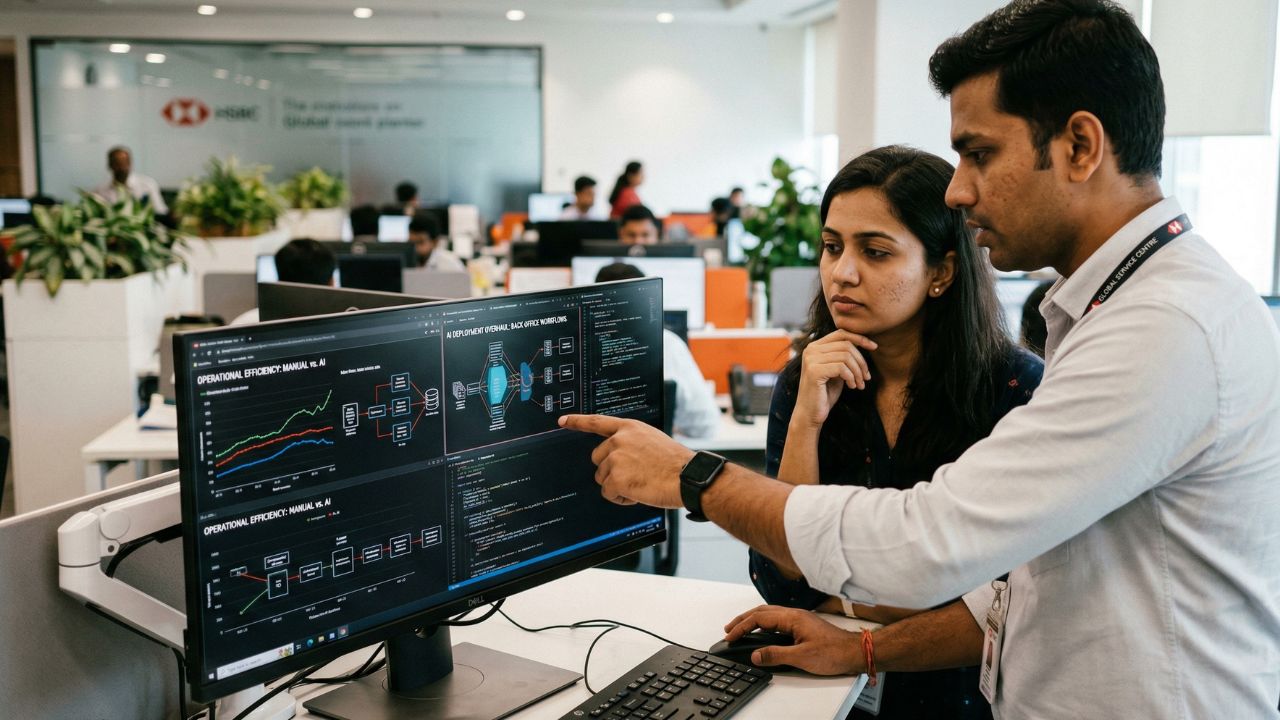
HSBC is preparing to slash up to 20,000 back-office roles in a massive artificial intelligence overhaul under CEO Georges Elhedery. While Western media frames HSBC’s 20,000 headcount reduction as a Wall Street tragedy, it is actually an extinction event for traditional Indian BPO and labor-arbitrage models.
Quick Facts
- The massive purge: HSBC is weighing cuts for roughly 10% of its 210,000-person global workforce to fund its technology transformation.
- The direct target: Non-client-facing roles in global service centers face the highest risk as algorithms absorb transaction monitoring and compliance.
- The forced pivot: Global Capability Centers (GCCs) must immediately pivot from providing "human middleware" for back-office tasks to orchestrating autonomous AI agents, or face identical purges from their enterprise clients.
HSBC is quietly dismantling the era of human-powered back-office banking.
CEO Georges Elhedery is engineering a multi-year restructuring plan that targets up to 20,000 roles across the bank's global service centers. The mandate is entirely clear. The bank is betting heavily on artificial intelligence to shrink its middle and back-office footprint.
This is not a theoretical forecast for the distant future. It is happening right now in 2026. The job cuts primarily target operations, compliance, and IT support teams situated away from major financial hubs.
The Death of Human Middleware
The ripple effects of this decision will hit Indian IT services and Global Capability Centers the hardest. For decades, the outsourcing industry thrived on a simple premise. Enterprise giants shipped repetitive, data-heavy tasks offshore to capitalize on cheaper labor.
"The real shift where we are doing in terms of our investment is really trying to drive operating leverage whether it's by focusing on scale businesses or indeed focusing on the benefits we can get through AI."
— Pam Kaur, HSBC CFO
That cost advantage is suddenly irrelevant. CFO Pam Kaur confirmed the bank sees immediate opportunities to deploy artificial intelligence in customer service centers and know-your-customer teams.
An AI agent does not require a salary, benefits, or a desk. It simply requires compute power and API tokens. When an algorithm can flag suspicious transactions or onboard a new client in milliseconds, maintaining a massive overseas workforce becomes a financial liability.
The transition from manual processing to automated systems marks a permanent shift in how global banks operate.
The Survival Blueprint for GCCs
The HSBC bloodbath isn't just an operations story, it's a massive warning shot for software engineers building "glue code."
Global Capability Centers can no longer survive by throwing cheap human capital at operational bottlenecks. The path forward requires a brutal but necessary evolution. Facilities that adapt will thrive.
They must abandon the traditional BPO identity entirely. The new engineering mandate is building agentic orchestration layers, not data pipelines.
Centers must position themselves as elite intelligence hubs where engineers monitor, train, and manage highly autonomous systems. If your daily workflow consists of writing stateless APIs that simply shuttle data between middle-office databases, an AI agent is already interviewing for your job.
Why It Matters?
The enterprise artificial intelligence wave is officially moving from the experimentation phase to the execution phase. As other banking giants explore similar technology-driven headcount reductions, the global outsourcing market faces a permanent contraction.
Facilities that cling to the old model of labor arbitrage will go bankrupt. Those that successfully transition into command centers will command higher premiums. They will transform a potential crisis into the greatest margin-expansion opportunity of the decade.
Frequently Asked Questions (FAQs)
1. How will HSBC's AI layoffs affect Indian IT services?
HSBC's decision signals a permanent shift away from traditional offshore operations. Indian IT services must execute a GCC pivot from labor arbitrage to intelligence hub to survive the impending loss of basic back-office contracts.
2. What back-office banking jobs are being replaced by AI?
Algorithms are rapidly absorbing routine compliance and data-heavy tasks. Roles dedicated to transaction monitoring, identity verification, and basic IT support within global service centers carry the highest risk of elimination.
3. How can Indian GCCs survive the 2026 AI automation wave?
Facilities must transition away from basic business process outsourcing. The new survival metric depends entirely on architecting autonomous backend systems and training the existing workforce to oversee multi-agent deployments.
4. What is Georges Elhedery's AI strategy for HSBC?
Since assuming control in 2024, CEO Georges Elhedery has systematically targeted middle and back-office bloat. He is deploying automated systems to boost raw productivity and aggressively reduce headcount across global service centers.
5. Are AI agents cheaper than offshore labor in India?
Algorithms execute data-processing tasks at a fraction of the cost of human labor. However, technology leaders must carefully calculate the true AI infrastructure ROI to account for hidden API token costs and multimodal compute expenses.
6. How do Global Capability Centers transition to an AI-first model?
Centers must retrain their engineering staff to focus on agentic workflows rather than manual data entry. This requires building custom orchestration layers and establishing strict frameworks for human-in-the-loop oversight.
7. What skills do GCC employees need to avoid AI layoffs?
Employees need specialized skills in system orchestration, API management, and machine learning oversight. If your daily workflow consists of writing stateless APIs that simply shuttle data between middle-office databases, an AI agent is already interviewing for your job.
8. Will AI completely replace middle-office banking roles?
Automation will not eliminate every single role, but it will drastically reduce the volume of humans required. A single systems engineer managing a fleet of automated agents will replace entire floors previously dedicated to manual processing.
9. How does AI impact the labor arbitrage advantage of outsourcing?
The technology neutralizes the geographic cost advantage that built the outsourcing industry. When an algorithm processes banking data instantly for pennies, shipping the same data to an offshore facility for human intervention makes absolutely no financial sense.
10. What is the future of business process outsourcing (BPO) with AI?
The traditional business process outsourcing model faces a rapid extinction event. The future belongs exclusively to highly specialized intelligence hubs that offer technology-as-a-service and manage complex enterprise deployments.