The Backend Code HSBC's AI Just Rendered Obsolete
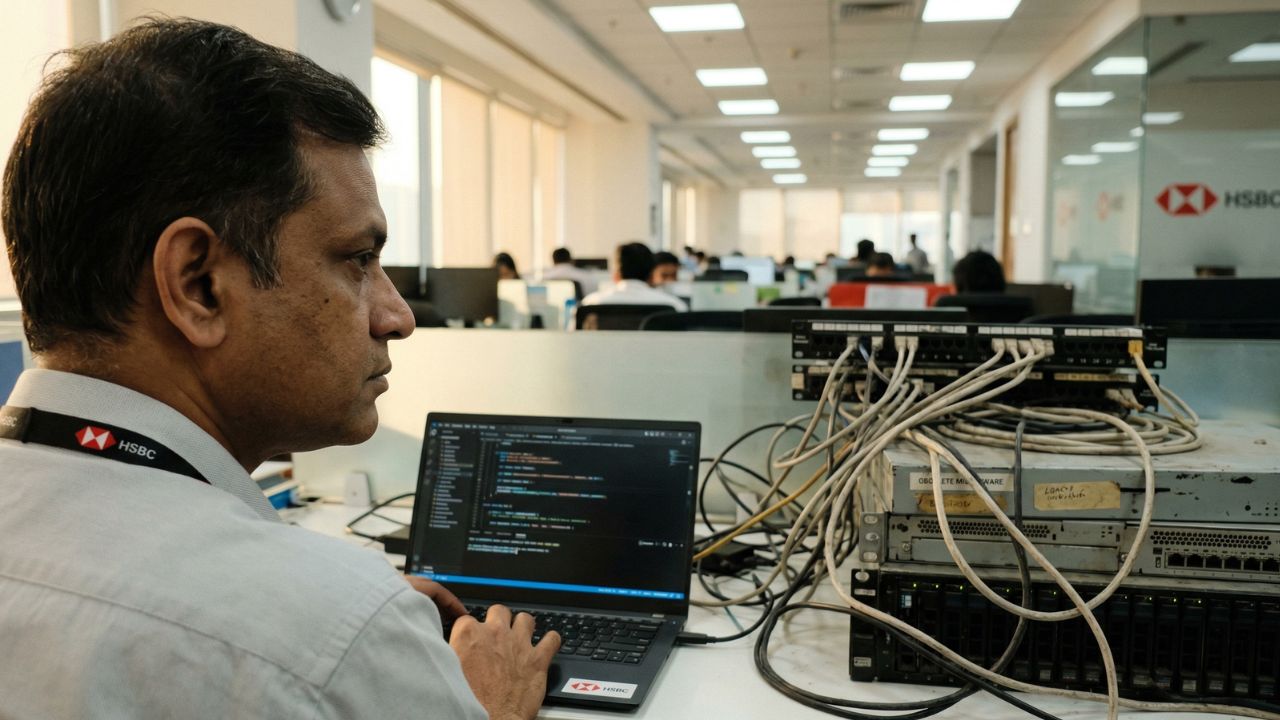
HSBC is quietly preparing to purge up to 20,000 roles in a massive artificial intelligence overhaul ordered by CEO Georges Elhedery.
While financial analysts celebrate the anticipated operational cost savings, this multi-year restructuring is a direct execution order for software engineers building basic data pipelines.
Quick Facts
- The 20,000 headcount slash: HSBC is targeting roughly 10% of its global workforce, heavily focusing on non-client-facing roles in its global service centers.
- The obsolete stack: Developers whose primary output consists of writing stateless APIs to shuttle data between middle-office databases are facing immediate replacement.
- The survival architecture: The engineering mandate across enterprise banking is shifting entirely toward agentic coding, requiring developers to build multi-agent orchestration layers rather than simple glue code.
The Death of the Middleware Developer
The writing is on the wall for traditional backend engineering in the banking sector.
Since taking the helm in 2024, Elhedery has aggressively pushed to shrink HSBC's middle and back-office operations.
The real target isn't just data entry clerks. It is the vast army of developers maintaining the sprawling, legacy infrastructure of modern finance.
"The real shift where we are doing in terms of our investment is really trying to drive operating leverage whether it's by focusing on scale businesses or indeed focusing on the benefits we can get through AI."
— Pam Kaur, HSBC CFO
For years, highly paid engineers have acted as human middleware.
They wrote thousands of lines of code to move information from a risk assessment database to a compliance dashboard.
Today, an autonomous AI agent can map that data schema, write the integration, and execute the transfer in seconds.
Transitioning to Agent Orchestration
This is a massive warning shot for the global tech talent pool.
The HSBC AI layoffs impact on Indian GCCs and other offshore tech hubs will be severe for engineering teams that fail to adapt quickly.
An enterprise bank no longer needs a team of ten engineers to maintain an API gateway for transaction monitoring.
They need one elite systems architect to govern a fleet of highly specialized AI agents.
The new technical hierarchy rewards those who can manage machine autonomy.
Engineers must transition from writing deterministic, step-by-step logic to building environments where AI models can securely reason and execute tasks.
Why It Matters?
Replacing basic engineering tasks with AI agents triggers a profound shift in corporate strategy.
While executives are eager to eliminate salaries, they are actively trading human payroll for massive cloud compute bills.
The transition requires careful management of enterprise AI infrastructure costs to prevent endless loops of agent-to-agent communication from destroying the anticipated financial gains.
Software engineers who can optimize these autonomous architectures and control API token consumption will become the most valuable assets in the enterprise sector.
Frequently Asked Questions (FAQs)
1. What software engineering jobs are at risk from AI in 2026?
Backend developers focused on writing simple middleware, stateless APIs, and data integration scripts face immediate risk as AI agents absorb these repetitive coding tasks.
2. How does HSBC's AI overhaul change backend development?
The bank's restructuring signals a shift away from maintaining large teams for manual data routing. Backend development is transitioning into managing autonomous systems that handle operations without human intervention.
3. What is agentic software architecture?
It is a system design where autonomous AI agents communicate, reason, and execute complex workflows independently, rather than relying on strict, human-coded deterministic rules.
4. Are stateless APIs becoming obsolete due to AI agents?
Yes. Traditional stateless APIs that simply shuttle information between databases are easily replaced by AI agents that can dynamically map schemas and transfer data on demand.
5. How can software developers adapt to AI-led banking operations?
Developers must pivot from writing glue code to building orchestration layers. They need to focus on system governance, prompt engineering, and managing the security of multi-agent deployments.
6. What is the difference between glue code and agent orchestration?
Glue code is rigid, manually written logic used to connect incompatible systems. Agent orchestration involves creating frameworks where AI models can dynamically interpret data and execute integrations autonomously.
7. How do autonomous AI agents interact with legacy banking systems?
They utilize specialized wrappers and secure API gateways to read legacy data, using large language models to understand the context and execute actions without needing hardcoded integration scripts.
8. What coding skills are needed for the AI era?
Engineers must master systems architecture, machine learning integration, secure API management, and the orchestration frameworks required to safely deploy autonomous models.
9. Why are enterprise companies firing middle-office developers?
Companies are firing these developers because the cost of maintaining human teams to write basic integration logic is vastly higher than deploying AI systems that can automate middle-office data routing instantly.
10. How to transition from a backend developer to an AI architect?
A developer must stop focusing on individual microservices and start building multi-agent systems. This requires understanding LLM token optimization, agentic reasoning loops, and enterprise security guardrails.