The Secret Reason OpenAI Bought Astral
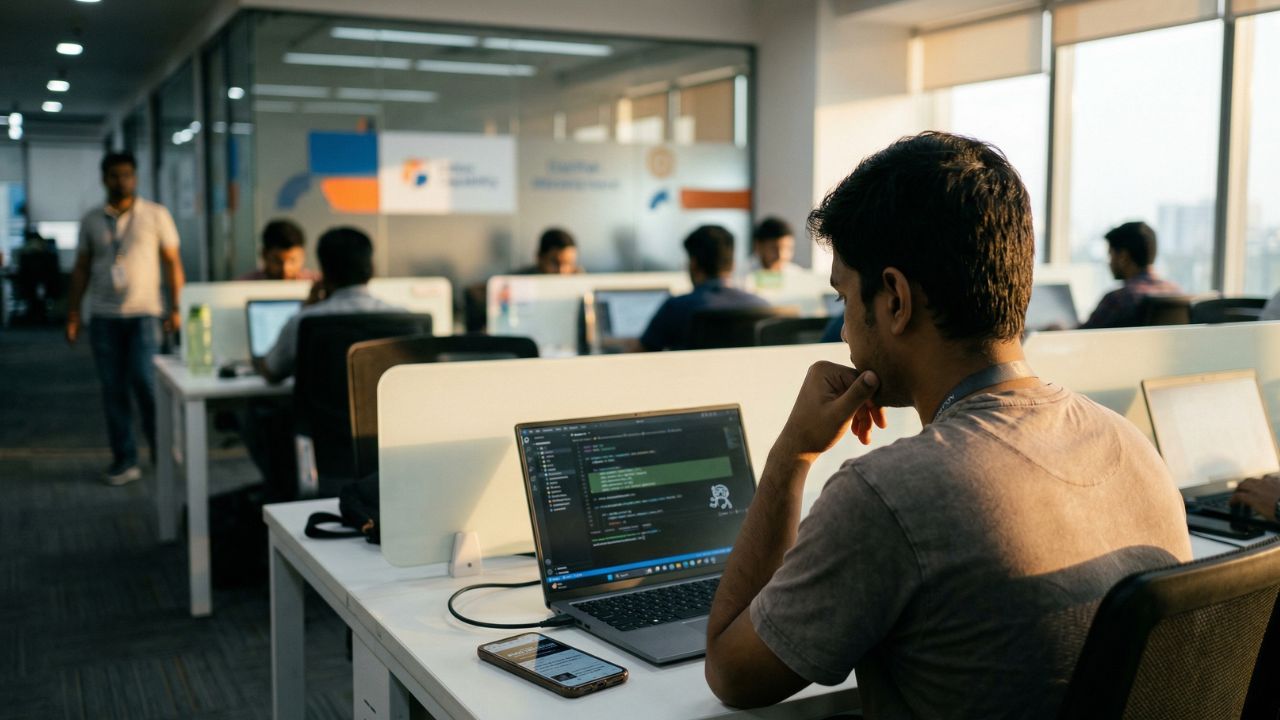
The traditional Indian GCC model of billing thousands of hours for manual Python environment setup, dependency management, and basic debugging is dead. OpenAI’s quiet acquisition of Astral isn’t just about making Codex a better coding assistant; it is a targeted strike to fully automate the boilerplate tasks that millions of junior offshore developers currently rely on for their livelihoods.
By wiring Astral's hyper-fast tools (uv, Ruff) directly into Codex, OpenAI is forcing offshore IT leaders into a brutal ultimatum: pivot to agentic workflow orchestration immediately, or watch your billable revenue collapse overnight.
Quick Facts
- The Astral buyout integrates the lightning-fast uv and Ruff tools straight into OpenAI's Codex architecture.
- Manual Python debugging and environment setup are now fully automated, eliminating millions of compute minutes and human labor hours.
- Labor arbitrage models face an immediate threat as agentic workflows replace standard billable hours.
- Global capability centers must pivot to high-level orchestration or risk catastrophic revenue collapse.
The acquisition of Astral by OpenAI is not just a standard tooling upgrade.
It is a calculated strike against the traditional offshore development pipeline.
Astral founder Charlie Marsh built uv and Ruff to make Python development exponentially faster.
By bringing these Rust-based utilities into the Codex ecosystem, OpenAI is granting its AI native, autonomous control over the most tedious parts of software engineering.
Standard autocomplete is officially obsolete. Codex can now orchestrate its own environment, handle dependency management, and execute basic debugging without human intervention.
For years, massive IT firms and internal development hubs have relied on armies of junior engineers to manage these exact boilerplate tasks.
Writing syntax and fixing linting errors formed the bedrock of entry-level billable work.
The Collapse of Labor Arbitrage
This technological leap forces a massive reckoning for offshore hubs.
The traditional model of throwing human headcount at environment setup is financially unviable when an AI agent handles it instantly.
"Our goal with Codex is to move beyond AI that simply generates code and toward systems that can participate in the entire development workflow, helping plan changes, modify codebases, run tools, verify results, and maintain software over time."
— OpenAI Official Statement
Firms clinging to manual Python debugging are bleeding money. The new reality dictates that junior developers must instantly level up.
They are no longer syntax writers; they are system orchestrators managing autonomous pipelines.
To survive this shift, organizations must adopt outcome-based billing models for AI agent workforce.
You can no longer charge for time spent configuring a virtual environment when Astral's uv does it 100 times faster.
The Pivot to Autonomous Pipelines
Forward-thinking technology leaders are already tearing down their legacy structures.
They recognize that integrating these open-source tools into Codex creates fully autonomous Python development workflows.
The developer's role is shifting from typing code to directing swarms of specialized agents.
This requires a fundamental retraining of the workforce to focus on architecture, logic validation, and complex problem-solving.
Relying entirely on one vendor's ecosystem carries risk. While the efficiency gains are undeniable, tech executives must stay vigilant against OpenAI enterprise vendor lock-in as token consumption scales up across these automated loops.
The Future of Enterprise Development
The Astral acquisition signals the death of the low-level coding factory.
As Codex absorbs the entire Python tooling stack, the floor for what constitutes valuable software engineering has been permanently raised.
Companies that adapt will build incredibly lean, high-output teams capable of shipping software at impossible speeds.
Those that stubbornly defend their billable hours for boilerplate tasks will simply be automated out of existence.
Frequently Asked Questions
1. How does OpenAI acquiring Astral affect software outsourcing?
It automates the entry-level environment setup and linting tasks that offshore teams typically charge for, forcing a shift away from hourly billing for boilerplate work.
2. What is the impact of Codex autonomous agents on Indian IT jobs?
Entry-level roles focused on syntax correction and manual debugging will vanish. Workers must upgrade their skills to manage and direct AI systems instead of writing code line-by-line.
3. Will Astral’s Ruff and uv tools remain open source after the OpenAI buyout?
Yes. OpenAI and Astral leadership have confirmed that UV, Ruff, and ty will remain open-source and under permissive licenses, even as they are integrated into Codex.
4. How can GCCs transition to outcome-based billing for AI agents?
Firms must stop tracking billable hours and start charging for completed features, stable deployments, and overall system performance orchestrated by their AI tools.
5. What are the new roles for Python developers in the agentic AI era?
Developers are transforming into AI workflow orchestrators. They will design the architecture, set the constraints, and review the final output of autonomous agents rather than typing out the software themselves.
6. How does the OpenAI Astral deal change enterprise Python development?
It consolidates the tooling stack. Enterprises will likely use Codex not just to generate scripts, but to automatically install dependencies, format code, and check types instantly.
7. What is the difference between standard Codex and Astral-integrated Codex?
Standard Codex primarily generates code snippets based on text prompts. The Astral-integrated version can actively test that code, fix its own syntax errors, and manage the required packages to make it run.
8. How to train Indian developers for AI agent orchestration?
Training programs must pivot from basic syntax memorization to system design, prompt engineering, logic validation, and managing multi-agent frameworks.
9. What are the hidden costs of relying on manual Python debugging in 2026?
Manual debugging wastes immense compute time and human labor. Companies relying on it are losing out to competitors who ship features faster and cheaper using automated pipelines.
10. How will the OpenAI acquisition change Python dependency management?
With uv embedded into Codex, dependency resolution becomes an invisible