How OpenAI’s Free Safeguard is Reshaping Offshore Outsourcing
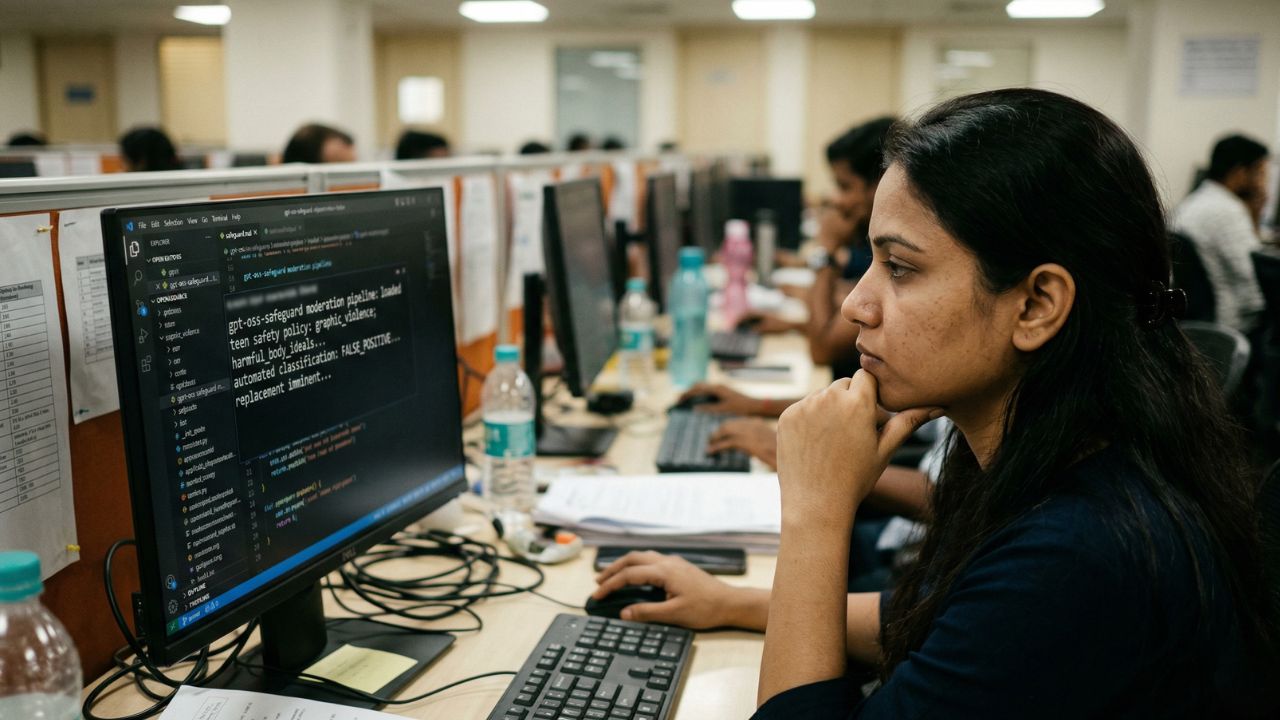
OpenAI just released an open-source suite of teen safety moderation prompts for its gpt-oss-safeguard model, instantly automating the exact content review tasks that Indian offshore centers currently charge millions to execute.
Triggered by the newly announced Japan Teen Safety Blueprint and mounting international lawsuits, this free developer tool acts as an extinction-level event for manual Trust and Safety billing.
Quick Facts
- The new reality: OpenAI's prompt-based safety policies directly integrate with the open-weight gpt-oss-safeguard model to entirely automate content moderation.
- The global catalyst: The release follows the March 2026 Japan Teen Safety Blueprint, which aggressively prioritizes minor safety over platform convenience.
- The business threat: Traditional BPOs and Global Capability Centers (GCCs) face immediate obsolescence for human-in-the-loop manual review contracts.
- The legal pressure: OpenAI accelerated these open-source tools following multiple wrongful death lawsuits concerning its AI chatbots.
The Extinction of Manual Review
The quiet release of OpenAI's new safety tools looks like a massive win for software developers, but it represents a direct attack on the offshore Trust and Safety industry.
BPOs in India have built a highly profitable economy around manually reviewing generative AI outputs.
Those operations are now entirely replaceable by a free GitHub repository.
On March 24, 2026, OpenAI deployed prompt-based safety policies tailored to protect teenage users. These policies plug directly into gpt-oss-safeguard, the company's open-weight reasoning model.
They target explicit risks like graphic violence, sexual content, and harmful body ideals. Instead of paying human moderators in a GCC to flag edge cases, engineering teams can now automate the process at the model level.
The shift toward open-source moderation stems from severe legal and social pressure surrounding the safety of minors interacting with AI. The Japan Teen Safety Blueprint, launched days earlier, established a strict new standard.
It mandates that safety must override convenience and freedom of use for underage users.
The Liability Catalyst
Faced with mounting litigation, including the tragic wrongful death lawsuit involving 16-year-old Adam Raine, OpenAI recognized that high-level safety guidelines were failing.
Developers needed operational rules. By working with Common Sense Media and everyone.ai, OpenAI created structured prompts that serve as an automated, highly accurate moderation layer.
"One of the biggest gaps in AI safety for teens has been the lack of clear, operational policies that developers can build from. These prompt-based policies help set a meaningful safety floor across the ecosystem."
— Robbie Torney, Common Sense Media
This development forces a violent restructuring of offshore IT hubs. The old model relied on billing thousands of hours for basic compliance wrappers.
Enterprise leaders are now questioning why they should pay millions when an open-source model handles the same workload.
The GCC Pivot
To survive, Indian IT firms must abandon manual moderation and transition toward complex AI orchestration.
This requires engineering a generative AI governance framework for GCC compliance that integrates models like gpt-oss-safeguard while managing the specific operational challenges they introduce.
Local teams will need to shift their focus away from reading flagged text and toward optimizing the underlying infrastructure.
Deploying dual-LLM architectures is not entirely free of friction. While the open-source software eliminates manual labor costs, it introduces new technical hurdles.
Developers are already struggling with implementing openai open source safeguard latency when forcing every user request through a secondary moderation check.
Chief Technology Officers must also audit the compute costs of local AI moderation models. Running gpt-oss-safeguard requires dedicated VRAM and processing power.
Offshore centers that successfully pivot will be the ones helping Western enterprises balance this new infrastructure tax against the massive savings from automated compliance.
Why It Matters?
The automation of Trust and Safety represents a permanent shift in the global technology supply chain.
As models become entirely capable of policing themselves, the value of human labor in the moderation loop drops to zero.
Western enterprises will see compliance costs plummet, but offshore centers face a brutal reality.
The centers that survive will be those that stop selling human hours and start selling AI infrastructure expertise.
Frequently Asked Questions
How do OpenAI's open-source safeguard tools affect outsourcing?
They automate the manual content moderation layer, completely replacing the primary business model of many Trust and Safety outsourcing hubs with a free developer tool.
What is the future of Trust and Safety jobs in Indian GCCs?
The focus will move entirely away from human content review and toward AI orchestration, policy management, and managing the technical deployment of moderation models.
How can Indian IT firms pivot from manual moderation to AI orchestration?
Firms must upskill their workforce to specialize in prompt engineering, dual-LLM architecture deployment, and latency optimization rather than manual data labeling.
Are human-in-the-loop content moderators obsolete in 2026?
For standard content checking, yes. Humans will only be retained for highly ambiguous edge cases or to fine-tune the grading criteria for models like gpt-oss-safeguard.
How does the Japan Teen Safety Blueprint change global compliance?
It establishes a strict international baseline that prioritizes minor safety over system performance, forcing developers worldwide to adopt more aggressive, age-aware moderation models.
What is the financial impact of automated AI moderation on BPO margins?
BPOs relying on high-headcount manual review will see massive revenue drops, but firms that transition to consulting on AI safety infrastructure can capture new, high-margin contracts.
How to deploy OpenAI's OSS safeguard in an enterprise environment?
Engineering teams download the gpt-oss-safeguard model from Hugging Face and integrate the specific prompt-based policies provided via the ROOST Model Community GitHub repository.
Can open-source moderation models replace human context checking?
They can replace the vast majority of it. While OpenAI notes these tools are a starting point, they are highly capable of inferring intent and classifying safe versus unsafe outputs in real-time.
What skills do Trust and Safety analysts need in the AI era?
Analysts must learn to translate broad legal requirements into operational prompts, run adversarial testing on models, and manage the infrastructure of automated safety pipelines.
How do sovereign data laws in India conflict with OpenAI's new safety tools?
Data localization requirements may force enterprises to run gpt-oss-safeguard entirely on local, on-premise hardware rather than relying on cloud-based APIs, increasing local compute costs.
Sources and References
- OpenAI Announcement: Helping developers build safer AI experiences for teens
- OpenAI Japan Teen Safety Blueprint: OpenAI Japan announces Japan Teen Safety Blueprint to put teen safety first
- Cybernews: OpenAI open sources safety filters to help monitor teen AI interactions
- StartupHub on Safety Policy Prompts: OpenAI Offers Teen Safety Policy Prompts