The End of Legacy SQL: What Oracle’s AI Pivot Means for Devs
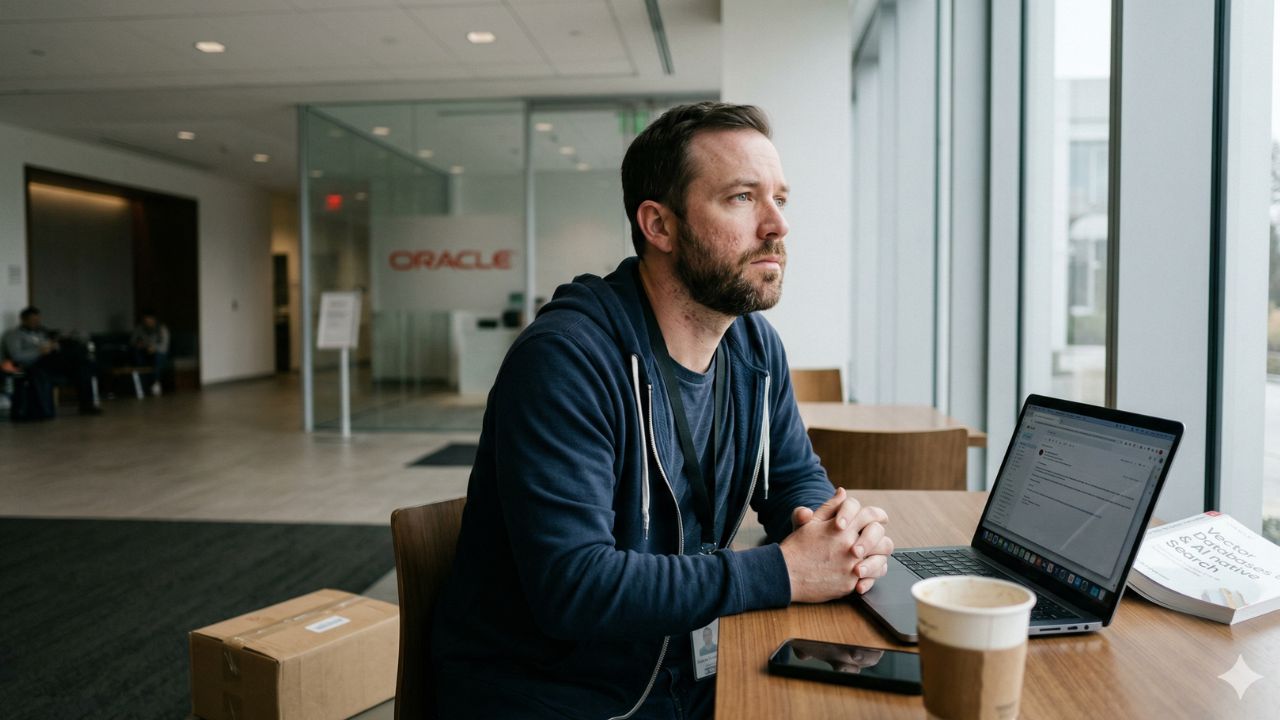
Oracle just fired nearly 30,000 employees globally to finance a $300 billion artificial intelligence infrastructure pact with OpenAI, abruptly signaling the death of the traditional relational database era.
For software engineers, this massive capital reallocation means pivoting to vector architectures and GPU orchestration is no longer optional, it is a matter of immediate career survival.
Quick Facts
- The brutal reality: Oracle eliminated 18% of its global workforce overnight to free up billions for AI data center expansion.
- The compute shift: The company is taking on nearly $58 billion in debt to buy Nvidia GPUs and power, aggressively abandoning legacy software overhead.
- The leadership mandate: Co-CEOs Mike Sicilia and Clay Magouyrk are actively shifting corporate focus from standard SQL products to high-performance AI hardware.
- The developer ultimatum: Software architectures must immediately transition from relational tables to AI-native vector search to remain relevant.
Why Relational Databases Are Losing Capital
Oracle's sudden termination of 30,000 workers is a direct financial response to the generative AI arms race.
The software giant recently committed to a $300 billion, five-year cloud computing agreement with OpenAI.
Meeting the physical demands of this massive contract requires gigawatts of power and hundreds of thousands of Nvidia GPUs.
To fund this massive hardware procurement, Oracle has absorbed nearly $58 billion in debt.
Legacy engineering teams became the immediate casualty of this balance sheet crisis.
Management revoked system access for thousands of developers within minutes of sending out early-morning severance emails.
This aggressive restructuring proves that maintaining traditional relational database systems is a stagnant business model.
Tech megacaps are redirecting their entire budgets toward raw processing power.
"The use of AI coding tools inside Oracle is enabling smaller engineering teams to deliver more complete solutions more quickly."
— Mike Sicilia, Oracle Co-CEO.
Re-Architecting for AI: From Tables to Vector Search
The era of relying entirely on standard SQL queries is effectively over.
Modern enterprise applications require the ability to process unstructured data, high-latency multimodal streams, and continuous generative models.
This demands a fundamental shift in how developers store and retrieve information.
Engineers must urgently learn to implement vector databases. These systems store data as mathematical representations, allowing large language models to perform similarity searches instantly.
Relying purely on relational tables for AI workloads creates massive bottlenecks and unacceptable latency.
This transition requires building a robust Agentic AI Architecture. Developers need to seamlessly integrate these vector search capabilities with whatever legacy cloud systems their enterprise still operates.
The New Baseline: GPU Workload Orchestration
The hardware running the code is changing just as fast as the databases.
Traditional software development focused on optimizing CPU utilization for standard web applications.
The new paradigm requires deep expertise in GPU workload orchestration.
Developers must understand how to distribute massive inference and training tasks across extensive GPU clusters.
If you cannot manage hardware acceleration, your skill set is obsolete.
The sheer scale of Oracle's pivot highlights this reality. As detailed in our main breakdown of the Oracle AI infrastructure job cuts, the company is willing to sacrifice its human capital to acquire silicon.
Engineers who fail to master these new infrastructure demands will find themselves replaced by the very AI systems they refused to adopt.
Why It Matters
Oracle's ruthless workforce reduction is the canary in the coal mine for the global software engineering industry.
The proprietary cloud market is actively shedding traditional development roles to finance the physical infrastructure of artificial intelligence.
For developers, the mandate is clear. You must evolve from writing standard queries to managing complex, AI-native data pipelines.
Those who adapt to vector databases and GPU orchestration will command the next decade of enterprise tech.
Those who cling to legacy SQL will become expendable overhead.
Frequently Asked Questions
1. How does Oracle's AI infrastructure pivot affect software engineers?
Oracle's pivot forces software engineers to abandon legacy relational database management and immediately learn AI-native skills. Developers must transition to managing vector databases, orchestrating GPU workloads, and building systems that support continuous generative AI models.
2. What are the best database architectures for AI workloads?
Vector databases are currently the superior architecture for AI workloads. They store information as high-dimensional vectors, allowing large language models to quickly execute similarity searches across massive datasets of unstructured text, images, and audio.
3. How to integrate vector databases with legacy Oracle systems?
Developers can integrate vector databases with legacy systems by utilizing modern API gateways and building data pipelines that sync structured SQL data into vector embeddings. This hybrid approach allows enterprises to maintain their existing records while powering new AI features.
4. Are traditional DBA jobs being replaced by AI infrastructure?
Yes, traditional Database Administrator roles are highly vulnerable. Cloud providers are actively cutting legacy DBA and standard engineering positions to reallocate that budget toward buying physical AI hardware and GPU clusters.
5. How do developers orchestrate GPU and CPU workloads for enterprise AI?
Developers orchestrate these workloads using specialized frameworks like Kubernetes with GPU operators. This allows them to assign heavy training and inference tasks to the GPUs while reserving the CPUs for standard application logic and data preprocessing.
Sources and References
- The Economic Times: Oracle begins job cuts globally, likely impacting 12,000 employees in India: Reports
- CTech: Safra Catz exits as Oracle CEO after 11 years
- Times of India: Curse Of Chatgpt How Oracle Has Lost 300 Billion In Market Value Since It Announced Partnership With OpenAI
- CNBC: Oracle cutting thousands in latest layoff round as company continues to ramp AI spending