Implementing MCP Enterprise: The USB Port for AI Agents
What's New in This Update
- Cloudflare Deployment Patterns: Added remote hosting architecture methodologies for distributed teams.
- OAuth Security Audit: Included new findings from Q1 2026 exposing critical token leakage vulnerabilities in public registries.
- Cost Optimization: Updated token-burn models demonstrating the financial impact of MCP Code Execution Mode.
- Registry Governance: Added strategies for Fortune 500 organizations building private MCP server directories.
Key Takeaways
- Standardized Connectivity: MCP replaces fragmented, custom-built API integrations with a single, universal JSON-RPC standard for AI agents.
- Architectural Decoupling: Isolating the data source from the specific LLM interface prevents vendor lock-in, allowing teams to swap Claude, Gemini, or local models effortlessly.
- Enterprise Security: Transitioning to a private registry model ensures autonomous agents cannot exfiltrate proprietary data through unvetted third-party tools.
- Token Economics: Leveraging advanced MCP features like Code Execution Mode drastically reduces LLM context-window overhead, yielding massive cost savings.
Enterprise software architecture has fundamentally changed. As language models evolve from simple chat interfaces into autonomous agents embedded deeply within workflows, the friction of wiring these models to disparate data sources—databases, CRMs, internal wikis, and project management tools—has emerged as a massive operational bottleneck.
The Model Context Protocol (MCP), pioneered by Anthropic and rapidly adopted across the industry, solves this by providing a universal, open standard for AI agents to securely connect to data sources. It eliminates the need for fragmented, custom-built API wrappers. If your engineering team continues to rely on legacy REST integrations for agentic workflows, analyzing your MCP Server vs Custom Integration ROIwill quickly expose the financial and technical drain of your current architecture.
What is the Model Context Protocol (MCP)?
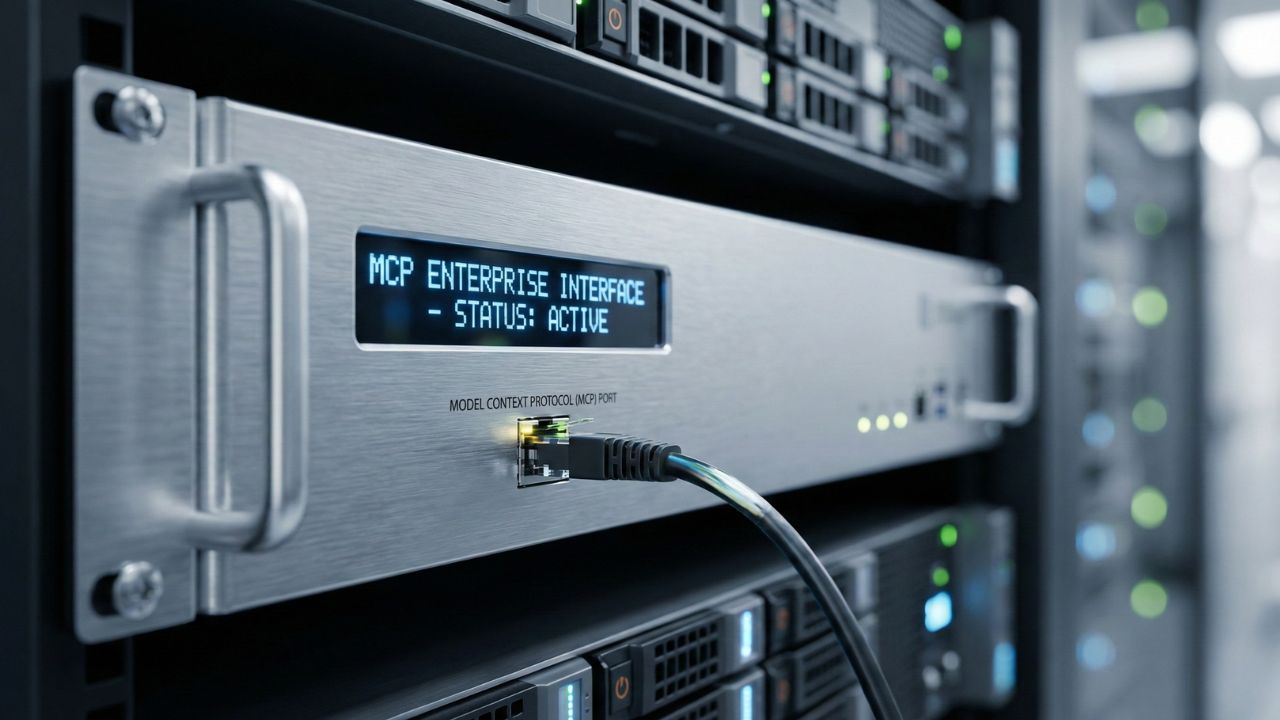
At its core, MCP standardizes how artificial intelligence models request context and execute actions across external systems. You can conceptualize it as a universal "USB-C port" for AI. Just as a physical USB-C port allows any peripheral to connect to any computer without requiring custom-built drivers, MCP allows an AI agent to communicate with any enterprise data source that runs an MCP-compliant server.
Instead of tasking developers with writing fifty different API integrations to connect a custom copilot to Slack, Jira, PostgreSQL, and Salesforce, engineering teams deploy a single MCP server for each system. Any MCP-compatible client—whether it is Claude Desktop, Cursor, or a proprietary internal dashboard—can immediately interface with those backend systems natively.
Why Custom Function Calling is Becoming Legacy Code
Historically, enabling a large language model to interact with enterprise data required extensive, bespoke function calling implementations. Developers had to meticulously define JSON schemas, manage the state of the conversation, execute the specific tool manually on the backend, and parse the resulting data back to the model in a format it could understand.
As agentic workflows scale across an organization, this method breaks down. Maintaining hundreds of function definitions across multiple applications creates an insurmountable technical debt burden. A direct comparison of MCP vs function callingreveals that the protocol abstracts this complexity entirely. The MCP server self-reports its available tools, resources, and prompt templates dynamically upon connection. The client application simply consumes them, dramatically reducing the code volume required to maintain the integration.
The Architecture of an Enterprise MCP Implementation
A robust, production-grade MCP deployment relies on three primary components operating in unison:
- MCP Hosts: The application the user directly interacts with. This could be an IDE like Cursor, a chat interface like Claude Desktop, or a custom-built React dashboard.
- MCP Clients: The protocol layer residing within the host application that manages the 1:1 connection, handling the parsing of requests and responses.
- MCP Servers: Lightweight, specialized programs that connect directly to local or remote data sources, exposing them securely to the client via the protocol.
For true enterprise scale, local execution of MCP servers is rarely sufficient. Distributed teams are moving rapidly toward cloud-native deployments. Modern engineering teams routinely deploy a remote MCP server on Cloudflareor similar edge networks to achieve near-zero latency, high availability, and centralized authentication for their global workforce.
Step-by-Step: Setting Up Your First Production MCP Server
Building an MCP server requires adhering strictly to the JSON-RPC messaging standard over standard input/output (stdio) or HTTP Server-Sent Events (SSE). The typical implementation lifecycle follows a clear path:
Step 1: Define boundaries. Determine exactly which database tables or API endpoints the AI requires access to. Limit the scope strictly to what is necessary for the agent's workflow.
Step 2: Choose the SDK. The official Python and TypeScript SDKs provide the necessary primitives to handle the protocol's transport layer.
Step 3: Implement Handlers. Map your backend functions to the standard decorators (e.g., `@mcp.tool()` in Python). Expose specific data views as "Resources."
Step 4: Audit security. Ensure no destructive actions (like DROP TABLE commands) can be executed without a human-in-the-loop approval mechanism.
To dive deeply into the exact code requirements and boilerplate setup, follow our comprehensive guide to building a production MCP server in Python, which outlines the deployment process from local testing to edge hosting.
Security, OAuth, and Agent-to-Agent (A2A) Governance
Exposing proprietary databases to autonomous agents introduces severe security challenges. A poorly configured server can inadvertently grant an LLM full write-access to a production schema, resulting in catastrophic data loss if the model hallucinates a destructive command.
Enterprise implementations demand rigid Role-Based Access Control (RBAC) and robust authentication mechanisms. Because the connection acts as a bidirectional data pipe, the agent's context window can potentially leak sensitive information if not strictly bounded. A recent industry audit showed that an improperly configured MCP Server's OAuth setupis the leading cause of token leakage and unauthorized data access in modern AI deployments.
Managing API Token Spend at Scale
A major financial risk of autonomous agent deployment is the sheer volume of API calls generated during complex reasoning tasks. Every time an agent queries an MCP server, ingests the response, and evaluates its next step, it consumes compute tokens.
To mitigate this exponential cost, sophisticated engineering teams are adopting advanced protocol features like MCP Code Execution Mode. This paradigm allows the model to write and execute small, sandboxed scripts to process large datasets locally on the server before returning only the synthesized final output to the main context window. This drastically reduces the context payload and slashes inference costs across the entire operation.
The Private Registry Pattern for Enterprise Teams
The open-source community has rapidly populated public directories with hundreds of experimental MCP servers connecting to everything from GitHub to Google Drive. However, deploying community-built code that acts as a direct bridge between a third-party LLM and your internal infrastructure is a massive compliance violation for regulated industries.
Instead of relying on public repositories, Fortune 500 organizations utilize the private registry pattern. This architecture involves hosting an internal directory of heavily vetted, SOC 2-compliant MCP servers that internal engineering teams can safely consume. The private registry ensures that every tool exposed to an enterprise AI agent has passed strict security audits and complies with corporate data governance policies.
Future-Proofing Your AI Stack
The adoption velocity of the Model Context Protocol is staggering. As Anthropic, Google, and other frontier model providers coalesce around this open standard, continuing to build proprietary, brittle function-calling logic is an inefficient allocation of engineering resources.
Adopting MCP allows technical leaders to completely decouple their internal data infrastructure from the rapid churn of LLM release cycles. By standardizing the integration layer today, your enterprise remains agile, secure, and ready to plug into the next generation of autonomous artificial intelligence.
Scale Securely with Proven Tools. Try Proton AI
We may earn a commission if you buy through this link. (This does not increase the price for you)
Frequently Asked Questions (FAQ)
MCP is an open standard that enables secure, two-way connections between AI models and enterprise data sources. It acts as a universal connector, replacing the need for fragmented, custom API integrations.
It simplifies integration by providing tool-calling standardization. Developers build one MCP server, and any compatible AI agent can instantly understand and interact with the connected data via a unified JSON-RPC protocol.
Setting up involves using available SDKs (like Python or TypeScript) to wrap your database queries in MCP-compliant protocols. This exposes your data safely to the AI agent, allowing you to define exact boundaries on what the model can query.
Yes, MCP creates agnostic agent layers. This allows you to easily connect different platforms, such as pointing both Claude Desktop and custom Gemini agents to the exact same underlying data sources without rewriting code.
MCP is designed with enterprise security in mind. It allows organizations to keep their data local, enforce OAuth authentication, and explicitly control which context windows and specific tools the AI agent can access.
Sources and References
- Anthropic Model Context Protocol Specification (2026).
- AI Dev Day India Technical Integration Benchmarks.
- Enterprise Architecture Patterns for Multi-Agent Systems.