Episodic Memory Systems for AI Agents: Beyond Basic RAG
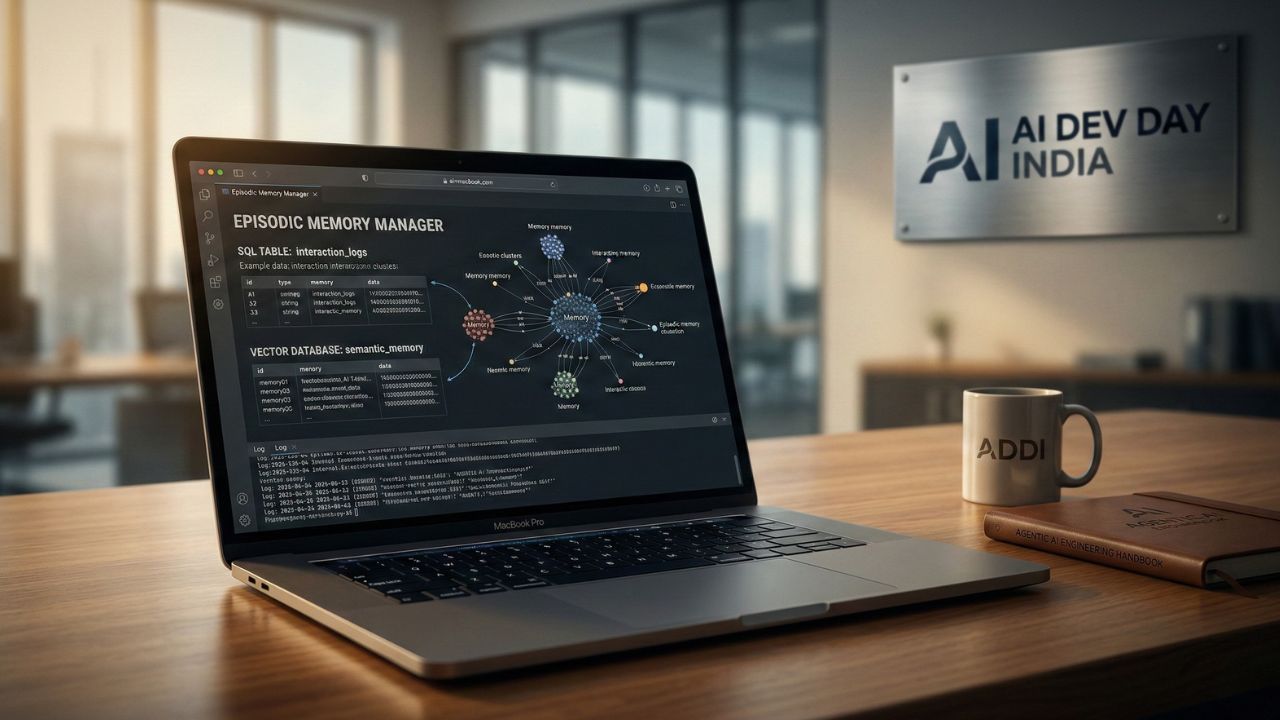
Key Takeaways:
- Beyond Context Windows: Episodic memory allows agents to retain professional experiences beyond the temporary limits of a single session.
- Hybrid Storage: Effective systems combine vector databases for semantic retrieval with structured SQL for exact factual recall.
- Working vs. Episodic: Learn the architecture required to separate immediate task data from long-term "life" experiences of the bot.
- Self-Correcting Loops: Agents use episodic memory to recall past mistakes and avoid repeating them in future workflows.
Introduction
In 2026, the bottleneck for autonomous bots is no longer reasoning power, but the ability to remember. Episodic memory systems for AI agents are the architectural solution to the "amnesia" problem inherent in standard Large Language Models.
Designing a robust memory core is a critical phase outlined in our Agentic AI Engineering Handbook.
This deep dive is part of our extensive guide on Agentic AI Architecture, focusing exclusively on how to give your AI a brain that learns from every interaction.
Understanding Episodic Memory vs. Basic RAG
Standard Retrieval-Augmented Generation (RAG) is a search engine; episodic memory systems for AI agents are a diary.
While basic RAG pulls data from external documents to answer a query, episodic memory records the agent's own past actions, successes, and failures.
Working Memory vs. Episodic Memory
- Working Memory: The immediate context window (e.g., the current code file the agent is editing).
- Episodic Memory: The historical record of previous tasks (e.g., "The last time I edited this file, the build failed because of a version conflict").
The Architecture of an AI "Brain"
1. The Vector Layer (Semantic Retrieval)
Vector databases serve as the "associative" part of the brain.
They allow the agent to find experiences that are similar to the current task.
For instance, when building a Career Digital Twin, the vector layer retrieves professional highlights based on the semantic intent of a recruiter's question.
2. The SQL Layer (Structured Recall)
Relying solely on vectors leads to hallucinations. Episodic memory systems for AI agents must utilize SQL structured databases for exact data.
Use SQL to store:
- Timestamps: Exactly when a task was performed.
- Task IDs: Linking specific outputs to specific goals.
- Outcome Status: A binary "Success" or "Fail" flag for the agent to filter its own history.
3. The Reflection Loop
This is the "metacognition" node. After a task, the agent summarizes what happened and saves it.
This process is vital for complex workflows, such as those found in Deep Research Analyst systems, where the agent must remember which "rabbit holes" led to dead ends.
Building Conversational Memory for Autonomous Bots
To build conversational memory that feels human-like, you must implement Semantic Chunking.
Instead of saving the last 10 messages, the system should extract "Entities" and "Preferences."
- Entity: "The user prefers Python over Java."
- Preference: "Never use abstract art for featured images."
Conclusion
Mastering episodic memory systems for AI agents is the difference between a bot that follows a script and an agent that grows with your business.
By combining vector databases for intuition and SQL for facts, you create a memory core that enables true autonomy.
Designing a robust memory core is a critical phase outlined in our Agentic AI Engineering Handbook.
Scale Securely with Proven Tools. Try Buddy Punch

We may earn a commission if you buy through this link. (This does not increase the price for you)
Frequently Asked Questions (FAQ)
Agents retain memory by saving summaries of their interactions into external databases (Vector or SQL) and retrieving them as context for future prompts.
Working memory is the active context window used for the current task. Episodic memory is a permanent record of past tasks and sessions that the agent can "look back" at.
Pinecone is widely considered the industry standard for scalable agent memory, though Weaviate and Milvus are preferred for high-performance, open-source enterprise needs.
SQL should be used to store metadata and "hard facts" that require 100% accuracy, such as timestamps, user IDs, and specific tool execution logs.
Implement a summarization layer that extracts key facts from a conversation and saves them as "Insights" rather than raw chat history.
Sources & References
- Official GitHub Repository: Agentic AI Architecture: The Engineering Handbook
- Agentic AI Engineering Handbook: The Blueprint for Autonomy
- Industry: Pinecone: Vector Databases for Long-Term AI Memory
- Academic: Stanford University: Generative Agents - Interactive Simulacra of Human Behavior
Open Source Resources:
Internal Sources:
External Sources: