AI Music: How to Sell Your Udio & Suno Tracks
You just typed a prompt into an AI tool, pressed "Generate," and suddenly, you have a hit song. It has a catchy beat, cool lyrics, and a great voice. You love it. Your friends love it.
But now a big question pops into your head: "Can I actually make real money from this?"
In the past, making professional music was hard. You needed expensive guitars, drums, microphones, and a fancy studio. You had to learn music theory for years. But in 2026, the game has changed completely.
With tools like Suno and Udio, anyone can be a music producer from their bedroom. The biggest shift in monetize AI music 2026 is moving from just having "fun" to earning "funds."
This guide is your complete legal guide to AI music. We will teach you exactly how to claim ownership, put your songs on Spotify, understand copyright laws, and get paid for your creativity.
Explore the AI Creator Studio
1. Can I Own My AI Songs? (The Copyright Rules)
Before you try to sell anything, you must understand who actually owns the song. This is the most confusing part of copyright AI generated audio.
Imagine you hire a painter to paint a picture. If you pay them, you usually own the painting. If they do it for free, they might keep it. AI works in a similar way.
Here is the simple rule for 2026:
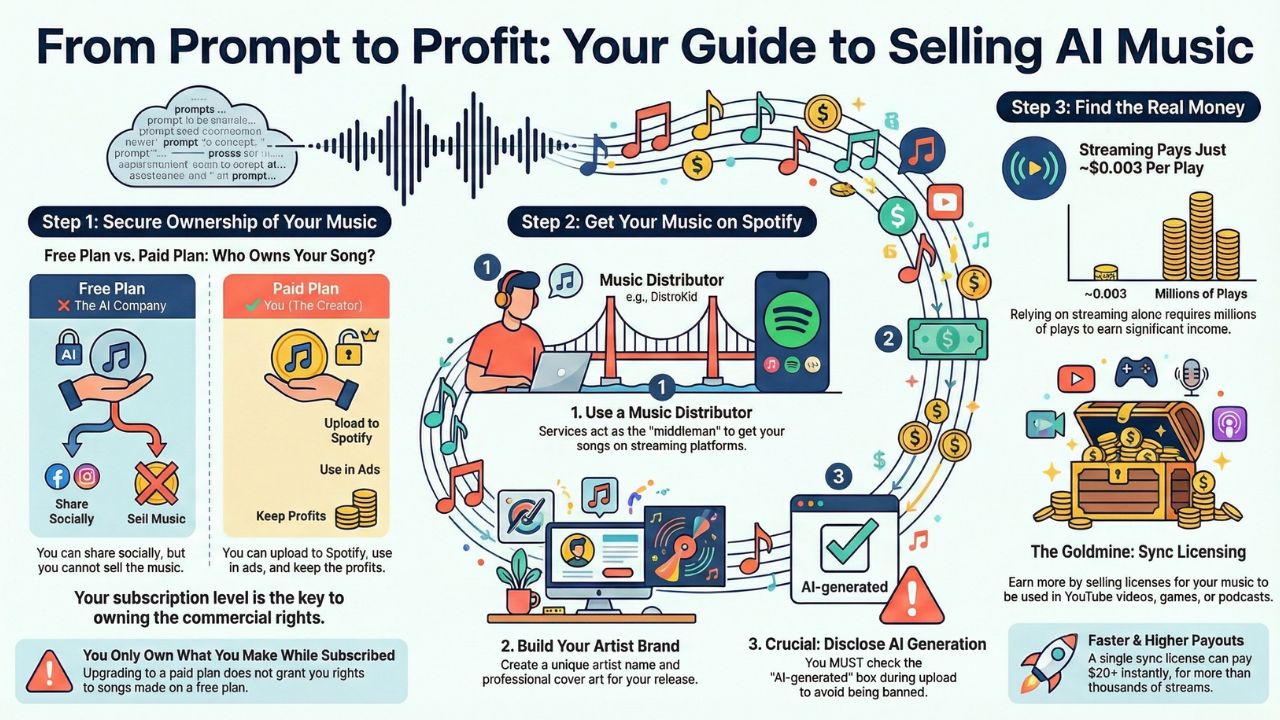
- Free Plan Users (The "For Fun" Crowd): Usually, if you are using the free version of these tools, you do not own the songs. The company (Suno or Udio) owns the commercial rights. You can share them on social media, but you cannot sell them on iTunes or Spotify.
- Paid Plan Users (The "Pro" Crowd): If you pay for a monthly subscription (like the Pro or Premier plans), the company gives you the ownership of the tracks you generate. You become the legal owner of that specific recording.
- Udio Copyright Rules: If you are a subscriber, Udio grants you full commercial rights. This means you can upload your track to Spotify, use it in a YouTube video, or even sell it to a TV commercial.
- Suno Rules: Similarly, Suno gives paid users ownership. Important: If you make a song while you are a Free user, and then you upgrade to Pro later, you usually still do not own the old songs. You only own the new ones you make after you pay.
A Note on "Copyright": The US Copyright Office has a strict rule: Only humans can be authors. You cannot copyright the melody created by the computer. However, you can copyright the lyrics if you wrote them yourself, and you own the rights to the specific sound recording.
2. How to Sell Suno AI Songs on Spotify
You cannot just log into Spotify and upload a file. Spotify only talks to "middlemen" called Distributors. The most popular distributor for independent artists (and AI creators) is DistroKid. It is cheap, fast, and easy to use.
Here is your step-by-step guide to using DistroKid for AI music:
Step 1: Get Your File Ready
Download the highest quality audio file (usually a WAV file) from Suno or Udio. Do not use the MP3; you want the best sound possible.
Step 2: Create Your Artist Identity
Do not use the AI's name. Don't call yourself "Suno Beatmaker." Create a cool artist name, like "Neon Wave" or "Digital Dreamer." This is your brand.
Step 3: The Upload Process
Sign up for DistroKid and click "Upload." You will fill in the song title, genre, and cover art.
Cover Art Tip: You can use AI (like Midjourney) to make your album cover, too! Just make sure it looks professional.
Step 4: The "AI Checkbox" (Crucial Step!)
Spotify, Apple Music, and Amazon Music now have strict rules. They will ask: "Is this content AI-generated?" You must check YES. If you lie, they can ban your account and keep your money. Being honest keeps your music safe.
Step 5: Submit
Once you click "Submit," DistroKid sends your song to the world. In a few days, your AI song will be playable on every major music app.
3. The Hidden Goldmine: AI Music Sync Licensing
Most people think money comes from streams (people playing the song). But streaming pays very little, about $0.003 per stream. You need a million streams just to make rent! The real money is in AI music sync licensing.
What is Sync Licensing?
"Sync" stands for "Synchronization." It means syncing your music to a video.
- A YouTuber needs background music for their vlog.
- A video game designer needs techno music for a racing level.
- A podcaster needs a catchy intro song.
Why AI Music Wins Here
Human music is expensive to license. AI music is often cheaper and faster to produce. You can create 10 different "Happy Background Tracks" in an hour. You can upload your tracks to stock music libraries (websites where people buy music for videos). If a creator buys your "Epic Battle Music" track for $20, you get paid instantly. This is much faster than waiting for Spotify pennies.
4. Earning AI Music Royalties
When people listen to your song, you earn money called AI music royalties. There are two main types you should know:
- Streaming Royalties: This is the money you get when someone presses "Play" on Spotify or Apple Music. It is calculated based on how many times your song is played.
- Mechanical Royalties: This is money you earn when someone "buys" a copy of your song (like on iTunes or Amazon MP3). Even though most people stream now, some still buy files.
Warning: Don't Cheat! Do not try to trick the system. Some people use "bots" (fake computer programs) to listen to their own songs 1,000 times a day to make money. Spotify is very smart and will catch you. If they catch you, they will take down all your music. Build a real audience of real people!
Frequently Asked Questions (FAQs)
Yes! As long as you have a paid subscription to the tool (Suno/Udio) when you generate the song, and you follow the platform's terms, you can sell your songs and keep 100% of the profit.
We recommend DistroKid for AI music because they are affordable (about $20/year for unlimited uploads) and they understand independent artists. Just remember to use the "AI Generated" checkbox.
You usually keep the rights to the songs you made while you were subscribed. If you made a hit song in January (while paid) and cancel in February, you still own that January song forever.
It is complicated. Currently, the government says you cannot copyright the music because a machine wrote it. However, you can copyright the lyrics (if you wrote them) and you own the recording. This is usually enough protection to sell it.
Yes. Many producers use AI to generate a cool drum loop or melody, and then they drag it into other software to add their own instruments. This is a great way to make your song sound unique.