Best AI Wearables 2026: Apple Watch X vs. Oura Ring 5 vs. Whoop
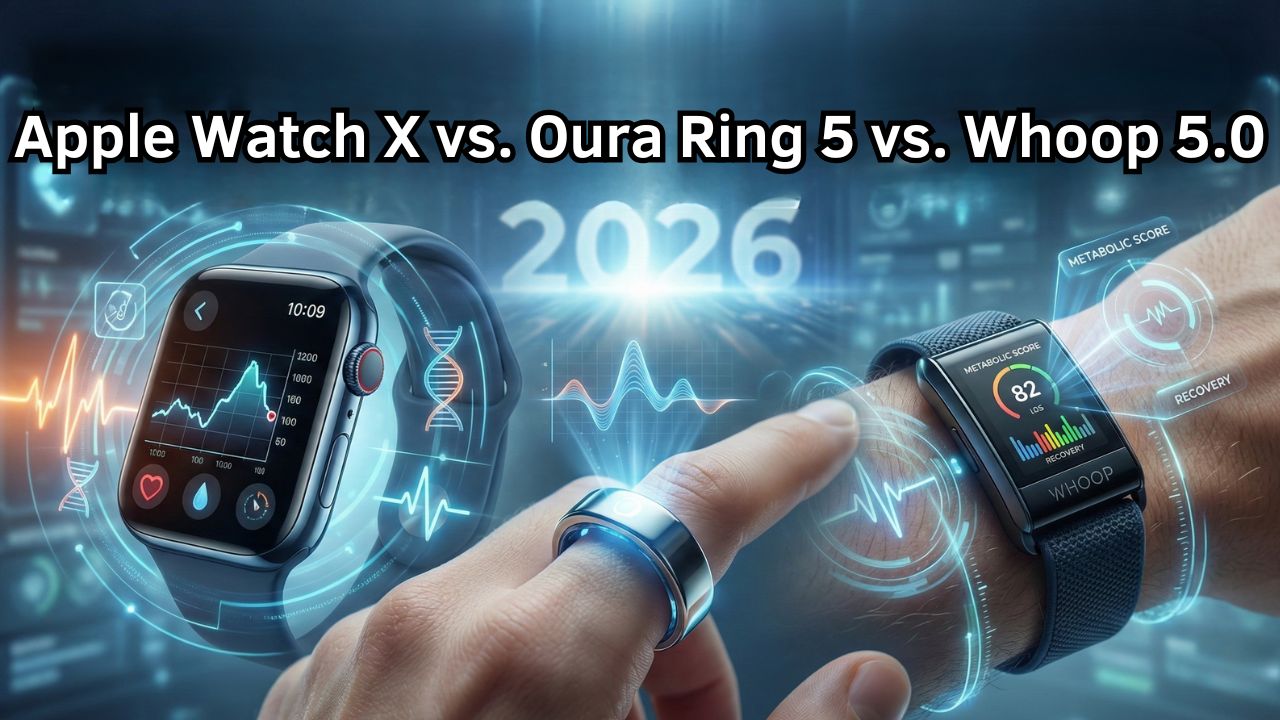
Stop counting steps. Start forecasting your metabolism.
Remember when we thought hitting 10,000 steps was the peak of health? That feels like ancient history now. In 2026, the game has changed entirely. We aren’t just "tracking" what we did yesterday; we are predicting what will happen tomorrow.
The best AI health tracker 2026 isn't a passive recorder. It's an active guardian. We have moved beyond the simple Fitbit era. Today, wearable AI for early disease detection means your device knows you’re getting sick before you even feel a scratchy throat.
The latest sensors act like a clinical lab on your wrist, capable of detecting cortisol spikes, predicting metabolic crashes, and even spotting early signs of stroke days in advance. But with so many high-tech options, which one actually delivers on the promise of "Predictive Health"?
We tested the giants, Apple Watch Series 12 vs Oura Ring 5 vs Whoop 5.0, to find out which device is the true doctor in your pocket.
Explore The AI Health & Longevity Hub
1. Apple Watch Series 12: The Clinical Powerhouse
Best For: Complete health autonomy and non-invasive blood tracking.
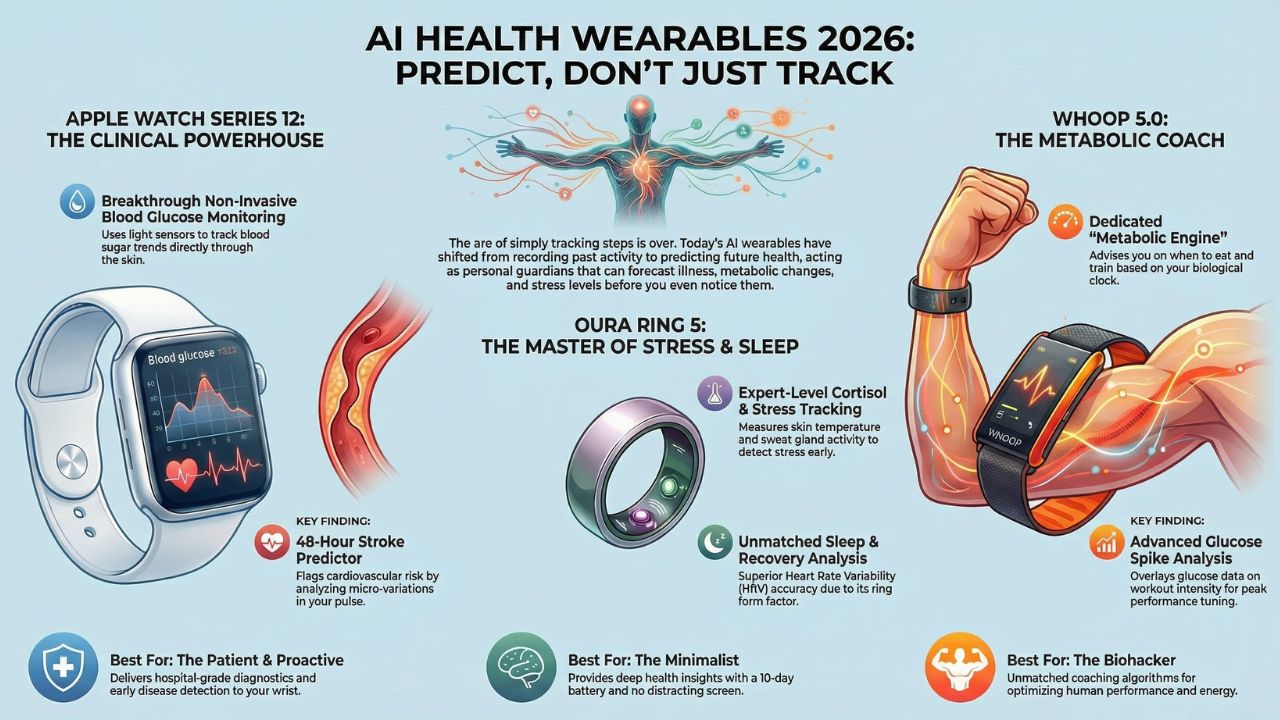
Apple has finally done it. For years, the "holy grail" of wearables was tracking blood sugar without needles. With the Series 12, the non invasive blood glucose monitoring watch is no longer a myth, it’s reality.
Why It Wins: The Series 12 uses advanced photonics (light sensors) to detect glucose trends directly through the skin. It doesn't just tell you your blood sugar; it uses wearable AI for early disease detection to alert you if your insulin resistance is trending toward pre-diabetes.
Key Feature: The "Stroke Predictor." By analyzing micro-variations in your pulse wave velocity, it can flag potential cardiovascular risks up to 48 hours before a potential event.
The Verdict: If you want a hospital-grade monitor on your wrist, this is it.
Rating: ★★★★★ (5/5) for Diagnostic Power
2. Oura Ring 5: The Master of Stress & Sleep
Best For: Mental health, recovery, and invisible tracking.
If the Apple Watch is a hospital, the Oura Ring 5 is a zen master. The debate of smart ring vs smartwatch for sleep tracking is officially over: the ring wins. Because it sits on your finger (where arteries are closer to the surface), the Oura Ring 5 captures heart rate variability (HRV) with near-perfect accuracy.
Why It Wins: This year, Oura went all-in on mental health. It is currently the best wearable for cortisol tracking. By measuring skin temperature deviations and sweat gland activity (EDA), it knows when you are stressed before your brain realizes it.
New Feature: "Mental Battery." Unlike simple energy scores, this predicts your emotional resilience for the day.
Comparison: In the Apple Watch Series 12 vs Oura Ring 5 showdown, Oura takes the crown for comfort and battery life (now 10 days).
Rating: ★★★★☆ (4.5/5) for Sleep & Stress
3. Whoop 5.0: The Metabolic Coach
Best For: Fitness optimizers and biohackers.
Whoop has never cared about screens or notifications. It cares about one thing: human performance. The Whoop 5.0 release date features dropped earlier this year with a massive upgrade, a dedicated "Metabolic Engine."
Why It Wins: Whoop is now a full-blown metabolic health tracker. It doesn't just track strain; it advises you on when to eat. By syncing with your biological clock, it serves as one of the top AI wearables for stress management, telling you to skip that late-night workout because your cortisol is too high.
The Shift: Whoop 5.0 has moved heavily into "preventative" territory. It serves as a continuous glucose monitor for non-diabetics 2026 when paired with compatible sensor patches, overlaying your glucose spikes against your workout intensity.
Rating: ★★★★★ (5/5) for Athletic Coaching
The Frontier: Glucose & Beyond
Why Everyone is Talking About "Metabolic Health"?
You might ask, "I'm not diabetic, why do I care about blood sugar?" In 2026, glucose is the new step count. Stable blood sugar means stable energy, better mood, and longer life. This has led to an explosion in metabolic health tracker reviews.
We are seeing a surge in continuous glucose monitor for non diabetics 2026. These aren't just for managing illness; they are for optimizing focus. Whether you use the Apple Watch’s non-invasive sensor or a paired device like Whoop, understanding your glucose spikes is the single fastest way to biohack your energy levels.
Final Verdict: Which One Should You Buy?
Your choice depends on your "Health Archetype":
- The Biohacker: Get the Whoop 5.0. Its coaching algorithms are unmatched for optimizing human performance.
- The Patient & Proactive: Get the Apple Watch Series 12. The non-invasive blood monitoring is a medical breakthrough that could save your life.
- The Minimalist: Get the Oura Ring 5. It is the best wearable for cortisol tracking and sleep analysis without the distraction of a screen.
The era of "Tracking" is dead. Welcome to the era of "Predicting."

Frequently Asked Questions (FAQ)
It depends on your goal. If you want clinical-grade diagnostics, like non-invasive blood glucose monitoring and stroke prediction, the Apple Watch Series 12 is superior due to its larger sensor array. However, for sleep tracking and recovery, the Oura Ring 5 wins because its form factor (ring) captures heart rate variability (HRV) with less signal noise than a wrist strap, and the battery lasts 10 days compared to Apple's 36 hours.
Yes. In 2026, continuous glucose monitors for non-diabetics have become a standard tool for fitness. Devices like the Whoop 5.0 (when paired with a sensor) or the Apple Watch Series 12 use optical sensors to estimate glucose trends. This helps you understand how specific foods spike your blood sugar, allowing you to avoid "energy crashes" regardless of your diabetic status.
For pure stress management, the Oura Ring 5 is the current leader. It uses a dedicated EDA (Electrodermal Activity) sensor to measure minute changes in skin sweat, which correlates directly with cortisol spikes. While the Apple Watch alerts you after your heart rate rises, Oura’s algorithms are designed to detect the physiological signs of stress (temperature and skin conductivity) before you even feel anxious.