AI Health 2026: The Doctor in Your Pocket & The Longevity Code
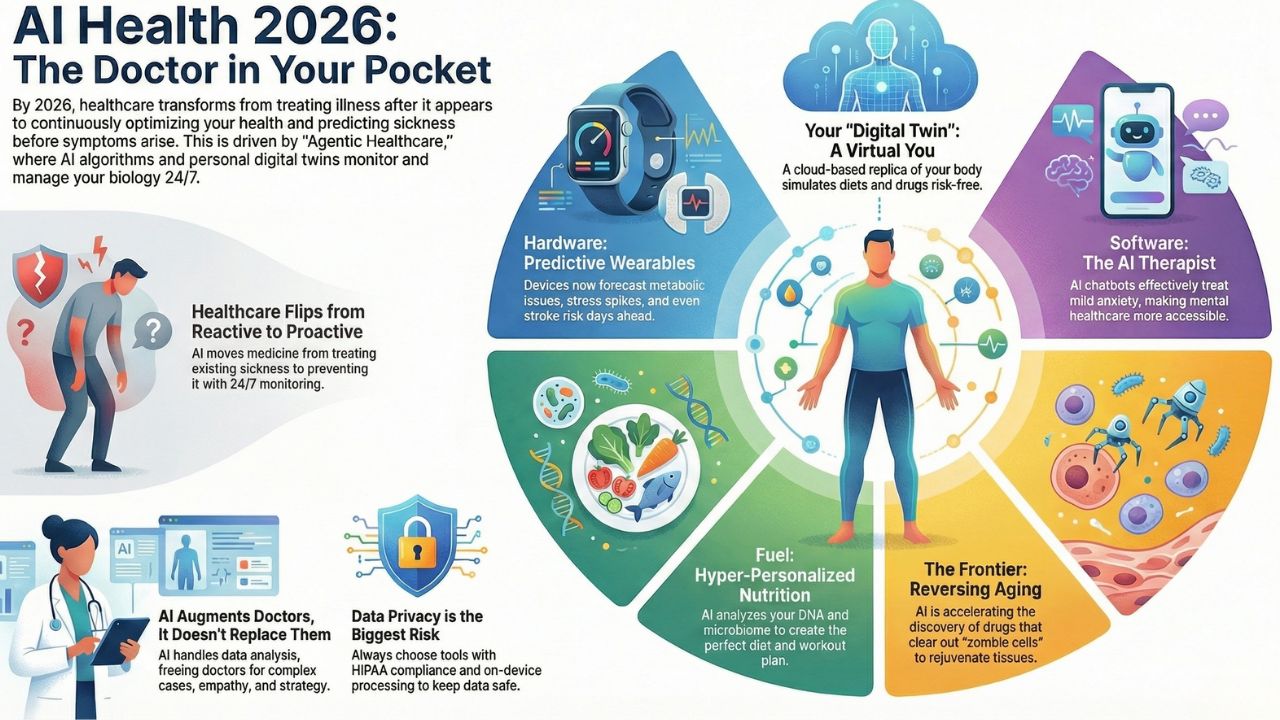
For the last century, medicine has been reactive: you get sick, you see a doctor, you get treated. In 2026, AI has flipped this model. We are entering the era of Agentic Healthcare, where algorithms monitor your biology 24/7, predicting illness before symptoms appear and optimizing your lifespan based on your unique genetic code.
This guide is your longevity technology roadmap, designed to help you navigate the explosion of AI tools, from digital twins to predictive wearables, that are redefining what it means to be healthy.
The Shift: From "Tracking" to "Optimizing"
The "Quantified Self" movement of the early 2020s was about data: knowing how many steps you took or how much you slept. The "Optimized Self" of 2026 is about action.
The core technology driving this shift is Personal Health Digital Twin Technology. Imagine a virtual replica of your biology living in the cloud. It simulates how your body would react to a new medication, a specific diet, or a workout plan before you try it in real life.
This isn't science fiction; it is the future of AI healthcare 2026.
Current & Future Trends (2026 Outlook)
- The End of the Annual Checkup: Continuous monitoring via AI biohacking guides and sensors replaces the static annual blood test.
- Hyper-Personalized Medicine: "One size fits all" dosages are obsolete. AI analyzes your pharmacogenomics to prescribe the exact micro-dose your body needs.
- AI as the First Line of Defense: Before you ever see a human GP, an AI triage agent will analyze your vitals, history, and voice biomarkers to provide a preliminary diagnosis with higher accuracy than human averages.
1. The Hardware: Wearables That Predict the Future
Stop counting steps. Start forecasting your metabolism. In 2026, the best wearables don't just record what happened; they predict what will happen.
The latest sensors can detect cortisol spikes (stress), glucose fluctuations (metabolism), and even early signs of stroke days in advance. We have moved beyond the Fitbit era into clinical-grade monitoring at home.
- The Review: We compare the giants, Apple Watch Series 12 vs. Oura Ring 5 vs. Whoop 5.0, to see which device offers the best "Predictive Health" score.
- New Tech: Exploring the rise of continuous glucose monitors for non-diabetics and non-invasive blood sensors.
Read the Full Review: Best AI Wearables 2026: Apple Watch X vs Oura vs Whoop
2. The Software: Mental Health & The AI Therapist
Can a chatbot actually fix a broken heart? The mental health crisis meets the AI revolution. With human therapists costing hundreds of dollars an hour and having months-long waiting lists, AI therapy apps have filled the gap.
But is "Emotional AI" safe? We dive deep into the efficacy of tools like Woebot and Wysa, analyzing whether an algorithm can truly provide empathy or just simulate it.
- Privacy First: A critical look at mental health privacy in AI apps, who owns your deepest secrets?
- The Verdict: Comparing the best AI therapy apps free vs. paid clinical subscriptions.
Explore the Analysis: AI Therapy & Mental Health: Can a Bot Replace Your Psychologist?
3. The Fuel: Hyper-Personalized Nutrition
The "Generic Diet" is dead. Eat for your DNA. Why does one person lose weight on Keto while another gains? The answer lies in your microbiome and genetics.
The AI Diet uses metabolic health AI tools to analyze your biological data and generate a hyper-personalized nutrition plan. No more guessing; just data-driven fueling.
- Genomics: How to use an AI meal planner based on DNA to optimize for your specific genetic mutations (like MTHFR).
- Fitness: Reviews of the best AI workout generator apps that adapt in real-time to your recovery scores.
Get Your Plan: The AI Diet: Hyper-Personalized Nutrition & Workout Plans
4. The Frontier: Longevity & Reversing Aging
Is death just a technical problem waiting for a solution? This is the most ambitious sector of all. Preventative medicine trends 2026 are focused not just on keeping you alive, but on keeping you young.
We explore how AlphaFold and generative biology are accelerating AI drug discovery for aging and identifying "Senolytics", drugs that clear out "zombie cells" to rejuvenate tissues.
- The Science: Updates on AlphaFold 3 impact on medicine and the race to cure cancer.
- The Timeline: Realistic predictions on can AI reverse aging and when these therapies will hit the market.
See the Future: Live to 150? How AI is Cracking the Aging Code
Frequently Asked Questions (FAQ)
A Personal Health Digital Twin is a virtual model of your unique physiology created using AI. It integrates data from your DNA, blood work, and wearables to simulate how your body responds to lifestyle changes, drugs, or diseases, allowing for risk-free trial and error in a virtual environment before application in the real world.
Unlikely. AI will replace the tasks of doctors (diagnostics, data entry, pattern recognition), but not the role itself. The future model is "Human + AI," where AI acts as a super-intelligent assistant that handles 80% of the routine analysis, leaving doctors to focus on complex cases, empathy, and ethical decision-making.
Studies in 2026 show that for mild to moderate anxiety and depression, AI chatbots (using Cognitive Behavioral Therapy principles) are as effective as human therapists. However, for severe clinical disorders or crisis situations, they remain a support tool rather than a replacement for professional human intervention.
This is the biggest risk factor. "Medical Privacy" is the new battleground. When choosing AI biohacking guides or apps, always look for HIPAA-compliant (or GDPR-compliant) certifications and "On-Device Processing," where your health data stays on your phone and is not uploaded to a central cloud server.
Sources and References
- Digital Twin & AI Healthcare
- Wearable sensors enable personalized predictions of clinical laboratory measurements (Dunn et al., 2021) - Nature Medicine
- Illness Detection via Wearables (Replacement)
- Personalized Nutrition & Glycemic Response
- AlphaFold 3 Impact on Drug Discovery
- Efficacy of Chatbots: Woebot Clinical Results
- Wysa Clinical Evidence & Research
- MTHFR Gene & Personalized Nutrition - NIH
- The Microbiome & Weight Loss - Harvard T.H. Chan School of Public Health
- Senolytics: A New Class of Drugs for Aging Research - National Institute on Aging