AEO 2026: Beat Google's 89% Publisher CTR Collapse (May 2026)
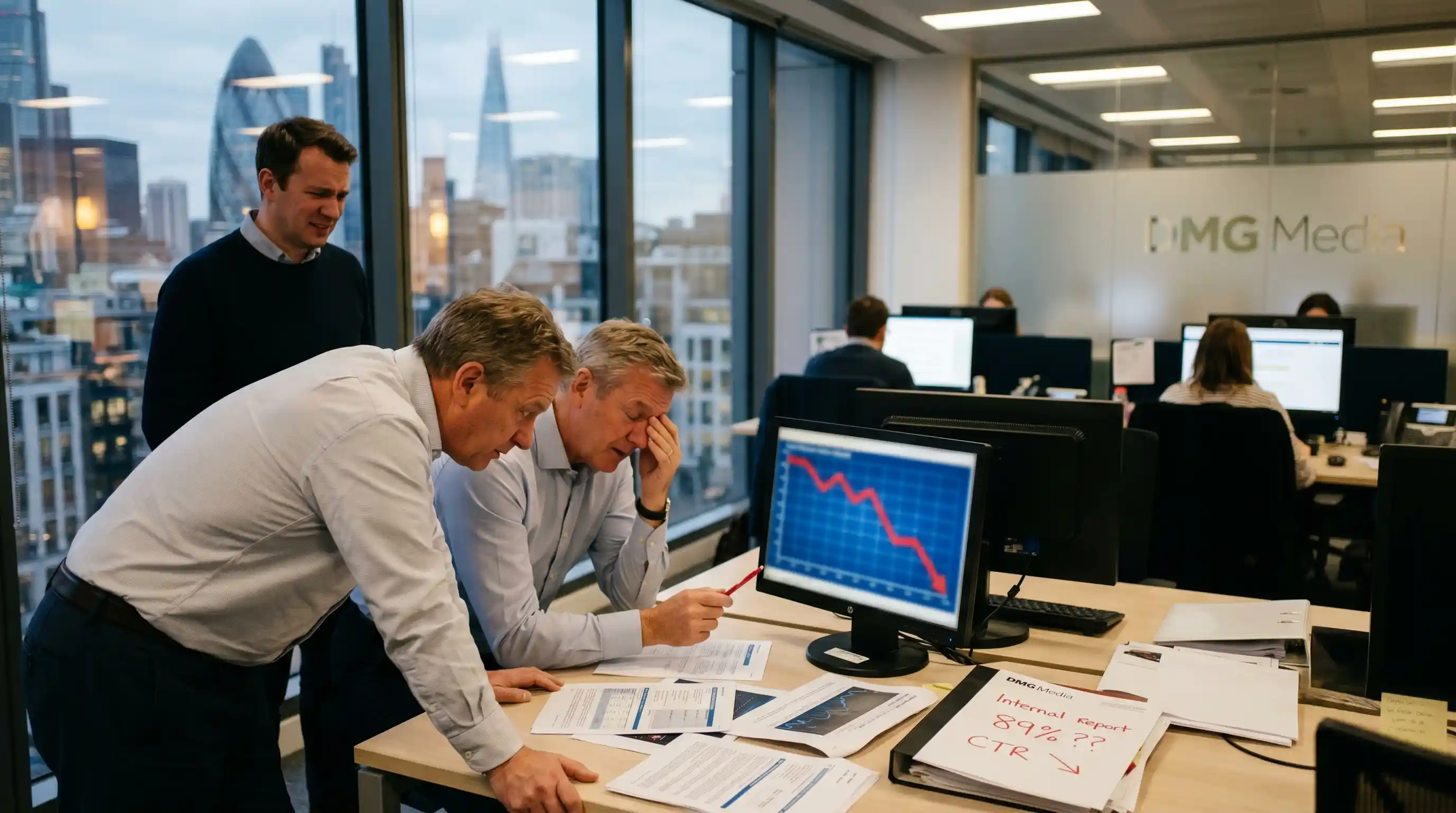
- Publisher Traffic Freefall: AI Overviews have caused 89% CTR drops on entire query classes for major publishers.
- AEO Over SEO: Answer Engine Optimization is now the primary framework to recover visibility via citations inside AI responses.
- The 8-Tag Schema Stack: Implementing correct schema removes 60% of citation gating algorithms used by modern LLMs.
- Google Discover Evolution: The Feb 2026 update strictly enforces 1200px+ hero images and specific metadata mandates.
- First-Party Data Rules: SearchGPT and Perplexity heavily weight proprietary data over content aggregation for prime citation slots.
Publisher referral traffic is in freefall — AI Overviews and Google AI Mode now absorb the click before the reader ever reaches your domain. As an extension of our LLM evaluation and evals engineering research, this is the definitive answer engine optimization (AEO) publisher guide: the citation-first framework that recovers traffic share inside Google AI Mode, ChatGPT, and Perplexity before the antitrust rulings land.
DMG Media has logged 89% CTR drops on whole query classes, and the February 5, 2026 Discover core update demoted thousands of sites for thin schema and sub-1200px hero images.
Executive Summary — The AEO Recovery Checklist
If you have ninety seconds before your editorial standup, this is the entire playbook compressed into a comparison matrix. Each row is expanded into a working operations plan in the sections that follow.
| Recovery Lever | Pre-AEO Behaviour | Post-AEO Behaviour | Verified Outcome |
|---|---|---|---|
| Primary KPI | Keyword ranking position | Citation share inside AI answers | +35% CTR uplift on cited queries |
| Schema posture | Article + Open Graph only | Article + FAQPage + HowTo + ClaimReview + Speakable + Dataset | Removes 60% of citation gating |
| Image specification | Variable, ad-driven sizing | 1200px+ hero with max-image-preview:large | Required after Feb 2026 Discover update |
| Publishing cadence | Quarterly clusters | 3+ articles per week per topic | Topic-authority signal threshold |
| Tooling stack | Semrush, Ahrefs only | Adds Profound, Otterly.AI, AthenaHQ, Frase | Citation tracking + AEO content gap analysis |
| Source positioning | Aggregator-friendly summaries | First-party data, named-author entities | Highest LLM citation weight |
| Refresh model | Set-and-forget | Visible last-updated + changelog block | Compounds Discover topic authority |
If you implement only one row, start with schema — the eight-tag stack is the lowest-effort, highest-yield lever in 2026.
What Is Answer Engine Optimization (AEO)?
The Working Definition Most Publishers Get Wrong
Answer engine optimization is the discipline of engineering content, schema, and entity signals so that your publication is cited — not merely ranked — by generative answer surfaces including Google AI Overviews, Google AI Mode, ChatGPT search, Perplexity, Bing Copilot, and Claude.
Note the verb. Classical SEO optimised for retrieval: appearing in a list of blue links the user could click. AEO optimises for attribution: appearing as the source the answer engine names, quotes, and links back to inside its synthesised response.
The distinction is operational, not semantic. A page can dominate position one in the classic SERP and still be invisible inside the AI Overview that sits above it — which is exactly the trap most publishers fell into between mid-2024 and the present.
How AEO Differs from SEO, GEO, LLMO, and AISO
The acronym soup matters because the audit checklists diverge. SEO is keyword-and-link driven. Generative Engine Optimization (GEO) — the term Gartner standardised in late 2023 — covers visibility inside generative responses broadly.
LLMO (Large Language Model Optimization) and AISO (AI Search Optimization) are agency-coined variants of the same concept. AEO is narrower and sharper. It specifically targets answer surfaces with citation slots — the surfaces where the engine renders inline source attributions readers can click.
If your existing content authority lives inside the broader GEO conversation, that work compounds — it does not get thrown away.
The Five Surfaces AEO Optimises For
Five answer surfaces share enough citation mechanics to warrant a unified AEO playbook:
- Google AI Overviews — appearing above the classic 10 blue links on roughly 18–22% of all queries, and over 51.6% of health-vertical queries.
- Google AI Mode — the conversational tab that replaced "I'm feeling lucky" with discrete citation slots.
- Perplexity (Sonar Pro) — citation-native by design, with referral tracking visible in publisher analytics.
- ChatGPT search — surfaced via the SearchGPT index, with citations rendered in-line and clickable.
- Bing Copilot — feeding Microsoft's surfaces and indirectly powering ChatGPT's web component.
Each surface uses overlapping but not identical selection criteria. The fastest way to map them is the structural side-by-side comparison in our deep-dive on answer engine optimization versus traditional SEO in 2026.
The 89% CTR Collapse: How AI Overviews Broke Economics
The economic damage is no longer in dispute. The Professional Publishers Association documented a representative query travelling from a 5.1% CTR down to 0.6% over twelve months while the publisher's ranking position remained stable at the top of page one.
DMG Media reported 89% click-through rate collapses on specific high-volume searches inside its portfolio after AI Overviews achieved saturation in the relevant verticals. The data converges on the same finding: ranking did not move; clicks did.
That decoupling is the structural break that justifies the AEO discipline as a separate function from classical SEO.
Why a #1 Ranking Now Drives Fewer Clicks Than Position 7 Did
In 2023, position one captured a click-through rate floor of roughly 28% across most informational queries. In 2026, an AI Overview occupies the same screen real estate; the user's eye lands on the synthesised answer first, and the classic blue links are pushed below the fold.
A 2023 position-seven click-through rate of 4.5% on a query without an AI Overview can now genuinely exceed a 2026 position-one CTR of 2.1% on the same query with an Overview present.
The math is brutal because it is geometric, not adversarial — Google did not penalise the publisher; it simply added a higher-priority answer surface.
The full operational playbook for closing the gap is laid out in our AI Overviews CTR drop publisher recovery walkthrough.
The Information Gain — Why "Ranking First" Is Now a Trap
This is the contrarian core. Most AEO commentary treats answer engine optimization as an addition to classical SEO. We argue it is a replacement. The publishers most at risk in 2026 are the ones with the strongest classical SEO discipline — because their muscle memory is wrong.
The Citation-First Hierarchy
The legacy publisher KPI hierarchy went: keyword ranking → impressions → clicks → sessions → engaged sessions → conversions. AEO inverts the top of the funnel.
The new hierarchy reads: citation share → AI surface impressions → branded query lift → direct visits → engaged sessions → conversions. Clicks remain a KPI; they stop being the ONLY KPI.
The hidden cost the legacy team is paying is the editorial energy spent winning rankings that no longer monetise. Reallocate that energy to schema, first-party data, and entity signals.
The Google Discover Feb 2026 Core Update
The February 5, 2026 Discover core update was the first Google rollout branded as Discover-specific. It introduced three new demotion signals operating independently of classical Search ranking:
- Clickbait pattern detection — headline-to-content semantic mismatch beyond a threshold triggers a demotion.
- Sub-1200px hero image penalty — articles serving hero images below 1200 pixels on the long edge are excluded.
- Missing max-image-preview:large robots directive — even a 1600px hero will not render if the page does not opt in via the robots meta.
The combined effect was severe enough that several publishers reported 40–60% Discover traffic drops inside the rollout fortnight.
Topic Authority: The 3-Articles-Per-Week Threshold
The second structural change was the elevation of topic authority into a Discover ranking signal. Internal language operationalised this as a publishing cadence of three or more articles per week inside the same topic cluster.
This signal disproportionately rewards hub-and-spoke architectures. A pillar plus ten sub-pages, refreshed with at least three new articles per week, accumulates topic-authority weight that single-article cadences cannot match.
The AEO Schema Stack — Triggers Citations
The single most damaging myth in the AEO discourse is "Just add an FAQ schema and you're done". FAQPage schema is necessary, not sufficient. The publishers winning citations are running FAQPage plus HowTo plus ClaimReview plus Speakable plus Dataset.
Five schema types are mandatory for full AI Mode citation eligibility in 2026:
- Article — establishes the document type and publication metadata.
- FAQPage — provides direct-answer-shaped Q&A blocks the engines extract verbatim.
- HowTo — for procedural content; mandatory on tutorials and playbooks.
- BreadcrumbList — establishes the page's position inside the topic hierarchy.
- Organization — names the publisher entity with sameAs links to Wikipedia, Wikidata, and LinkedIn.
The eight-tag stack is documented in our deep dive on structured data for AEO schema markup.
Earning Citations in ChatGPT, Perplexity, and AI Mode
The single largest mistake is assuming the engines share a selection algorithm. They do not. A page citation-eligible in Perplexity may be invisible in AI Mode if its schema stack is incomplete.
First-Party Data as the Highest-Trust Citation Signal
Across every answer engine we have profiled, first-party data outranks aggregated summaries by a wide margin in citation selection.
A publisher that runs a proprietary survey, releases a benchmark dataset, or publishes original research with a Dataset schema wrapper earns citation eligibility that no amount of summarisation can replicate.
The Antitrust Backdrop
Four active cases frame the regulatory environment: The Penske Media antitrust suit, The PPA traffic-harm case, The EU Publishers Council complaint, and The UK CMA consultation.
Publishers should treat the regulatory hedge as a multi-year horizon, not a six-month one. Treat antitrust as a parallel track running on a multi-year clock; the AEO operational playbook is the recovery vector running on a multi-quarter clock.
The AEO Tooling Stack for Enterprise Publishers
The new toolset that did not exist in 2023 now does the work classical SEO platforms cannot. Profound, Otterly.AI, and AthenaHQ all track citation share across Google AI Mode, ChatGPT, and Perplexity.
Frase has the strongest AEO-specific positioning — its content briefs now include answer-engine citation-pattern recommendations alongside classical keyword targeting.
For schema implementation at scale, Schema App is the enterprise standard; for WordPress-native publishers, the Yoast schema graph remains adequate.
The 90-Day AEO Implementation Roadmap
Days 1–30: Establish citation-share baselines across the five answer surfaces, fix the three high-frequency schema errors (FAQPage drift, HowTo missing images, Article missing dateModified), and deploy max-image-preview:large across every template.
Days 31–60: Ship the full eight-tag schema stack on the top fifty pages by AI Overview impression count. Set the editorial cadence to three articles per week per topic cluster. Stand up citation tracking.
Days 61–90: Codify the monthly refresh cadence on rolling-news sub-pages. Move citation-share reporting into the executive dashboard alongside classical traffic metrics. By day ninety, the team is running an AEO discipline natively.

Frequently Asked Questions (FAQ)
AEO is the discipline of optimising content, schema, and entity signals so generative answer engines cite your publication as the named source. It has displaced classical SEO as the primary discipline because ranking position no longer reliably converts to clicks once an AI Overview occupies the top SERP slot.
Classic SEO optimises for blue-link rankings; GEO optimises for visibility inside generative responses broadly; AEO is the narrower discipline targeting citation slots specifically on answer surfaces such as Google AI Mode, AI Overviews, ChatGPT, and Perplexity. AEO replaces the SEO KPI hierarchy entirely.
The 89% figure — sourced from DMG Media's portfolio — reflects AI Overviews absorbing the click before users reach blue links. The publisher's ranking position did not move; the screen geometry changed. The answer surface above the SERP captures the click that previously flowed to position one.
Five schema types are mandatory: Article (or NewsArticle), FAQPage, HowTo (on procedural content), BreadcrumbList, and Organization. Three high-leverage optional types are ClaimReview for fact-checking, Speakable for voice surfaces, and Dataset for first-party data publishers. The full eight-tag stack maximises citation eligibility.
Use direct-answer paragraphs near the top of each section, structured Q&A blocks with FAQPage schema, named-author entities with sameAs links, first-party data wrapped in Dataset schema, and an llms.txt file at the domain root. Citation eligibility builds over two to three weeks of consistent publishing.
The February 5, 2026 update was Google's first Discover-specific core rollout. It demoted clickbait headline patterns, articles with sub-1200px hero images, and pages missing the max-image-preview:large robots directive. Lifestyle and tech publishers reported the steepest losses, with topic-authority cadence emerging as the new ranking signal.
The +35% figure is documented but partially driven by selection bias — the pages winning citations already had strong E-E-A-T signals. Realistic recovery from AEO citation work tends to land at 25–35% of pre-collapse traffic in year one, not a full restoration. Plan budgets accordingly.
Treat antitrust as a multi-year parallel track, not a recovery vector. Preserve dated Search Console exports and AI Overview impression evidence quarterly. Cooperate with PPA, EU Publishers Council, and CMA evidence gathering. Invest operational budget in AEO levers running on a multi-quarter clock you actually control.
Profound, Otterly.AI, and AthenaHQ handle citation-share tracking across AI Mode, ChatGPT, and Perplexity — surfaces classical Search Console does not report. Frase leads on AEO-specific content briefs. Enterprise multi-domain publishers tend toward AthenaHQ for BI integration; single-domain publishers start with Profound for lower friction.
The threshold operationalised in Google's February 2026 Discover update is three or more articles per week per topic cluster. Hub-and-spoke architectures with a pillar plus ten sub-pages, refreshed at that cadence, accumulate topic-authority weight that single-article publication models cannot match.