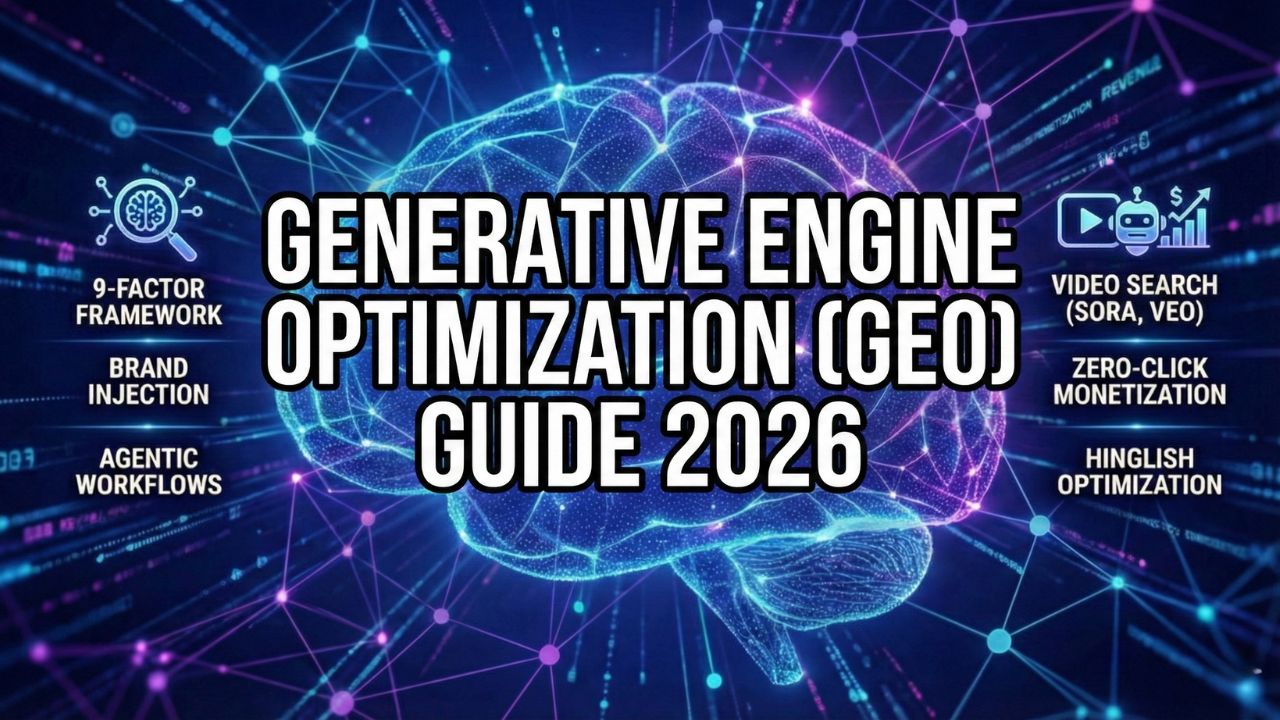
Generative Engine Optimization (GEO) 2026: The Ultimate Guide to Ranking in AI Search
The Day the Blue Links Died
It is 2026. You open your analytics dashboard, and the silence is deafening. The "ten blue links" that sustained businesses for two decades have faded into the background, replaced by direct answers from AI agents.
This isn’t just an algorithm update; it is an extinction event for traditional SEO. But for the prepared, it is the single greatest opportunity since the dawn of the internet.
Welcome to the definitive Generative Engine Optimization guide 2026. While your competitors are still keyword-stuffing meta tags, a new game is being played.
To survive, you must understand the fundamental GEO vs SEO difference: In the old world, we optimized for clicks; in the new world, we optimize for citations. The goal is no longer just to be found on Google, but to be the authoritative voice of the answer engine itself.
Tool: The "GEO Score" Calculator
Is your site ready for the AI era? Paste your URL below to get a 0-100 score based on "Entity Density" and "Schema Health."
Analyzing Entity Density... Checking Knowledge Graph connections... Scanning Schema Markup...
The New Rules: The "9-Factor" Framework
To master AI answer engine optimization, you must realize that Large Language Models (LLMs) do not "read" content like a search spider; they "ingest" concepts. Through our extensive testing at the GEO & Agentic Marketing Academy, we have identified the proprietary "9-Factor" Framework that determines if an AI will cite you or ignore you.
- Citation Authority: Are you a trusted root source?
- Quotability: Is your content structured for easy extraction?
- Entity Density: Do you speak the language of the Knowledge Graph?
- Freshness Vectors: Is your data current enough for real-time retrieval?
- Multi-Modal Signals: Do you exist in text, video, and code?
- Context Window Optimization: Do you fit within the token limits of the prompt?
- Semantic Coherence: Does your content make logical sense to a neural network?
- Sentiment Alignment: Does your tone match the query intent?
- Structured Data: Is your schema impeccable?
This framework is your survival kit for mastering Google Gemini SEO strategy and understanding how to rank in ChatGPT search. But knowing the theory isn't enough. You need proof.
Case Study: How We Ranked #1 in PerplexityThe Challenge: Ranking for "Best AI Events India" in 7 Days.
The Strategy: We ignored keywords and focused on "Entity Density" and "Freshness Vectors." We flooded Reddit with discussion threads and updated Wikidata entries for the event organizers.
The Result: Within one week, Perplexity cited us as the primary source, driving zero-click brand awareness and high-intent traffic.
Below, we break down the six pillars of a modern GEO strategy.
1. The Art of "Brand Defense": Stop the Hallucinations
Imagine a CEO searching for your company on ChatGPT, and the AI confidently replies that you went bankrupt in 2024. This is the nightmare of AI Hallucination, and it is a reputation management crisis waiting to happen.
Executives are waking up to realize they have no control over what AI says about them. The first step in GEO is not growth; it is defense.
We call this brand injection techniques, the process of forcing accurate entities into the AI's Knowledge Graph so it stops lying about you. You must audit your brand across five different LLMs and use Wikidata strategies for AI knowledge graph optimization to correct the record.
Deep Dive: Audit Your ReputationLearn exactly how to query LLMs to find errors and fix them with our "Hallucination Audit" checklist.
Read: Audit Your Brand on AI: How to Control What ChatGPT Says About You
2. The Agentic Workflow: Replace the Agency
While you are fixing your reputation, who is doing the marketing? In 2026, hiring a massive human team for repetitive tasks is obsolete. The "Builder" class of marketers is now deploying Marketing Agent Swarms.
Using tools like CrewAI and Python, you can build autonomous agents. Imagine a "LinkedIn Sentinel" that never sleeps, monitoring your brand mentions and drafting replies, or a "Designer Agent" creating visuals with Midjourney while you sleep. This isn't sci-fi; it's a Python script you can copy and paste today.
Deep Dive: Build Your Own SwarmStop hiring agencies. Get the actual Python code to build your own autonomous marketing bot.
Read: Building a "Marketing Agent Swarm": Replace Your Ad Agency with CrewAI
3. The Video Frontier: Ranking in Sora and Veo
Text is no longer enough. The search engines of the future watch video. With the rise of Google Veo and OpenAI Sora, video content is being indexed not just by title, but by the pixels and audio within it.
To rank here, you need a "Script-to-Rank" formula. You must speak specific "Entity Keywords" in the first 15 seconds of your video because AI transcription prioritizes early context. It’s about structuring metadata so machines can "watch" your content and understand it.
Deep Dive: Master Video GEODiscover the metadata strategies to rank your content in the new wave of AI video search.
Read: Video SEO 2026: Ranking in Sora, Veo, and YouTube AI
4. The "Zero-Click" Pivot: Monetization Without Traffic
Here is the hard truth: Traffic is going away. AI answers queries directly on the results page. If users don't click, how do you get paid?
This requires a massive pivot to a zero-click content strategy. The goal is no longer ad impressions on your site; it is "On-Platform Monetization". This means building newsletter empires where you own the audience, or structuring deals for sponsored mentions within the AI answers themselves, critical for mastering Perplexity AI ranking factors and revenue models.
Deep Dive: Survive the Traffic DropLearn how The New York Times and smart solopreneurs are monetizing citations instead of clicks.
Read: The "Zero-Click" Content Strategy: How to Monetize Without Traffic
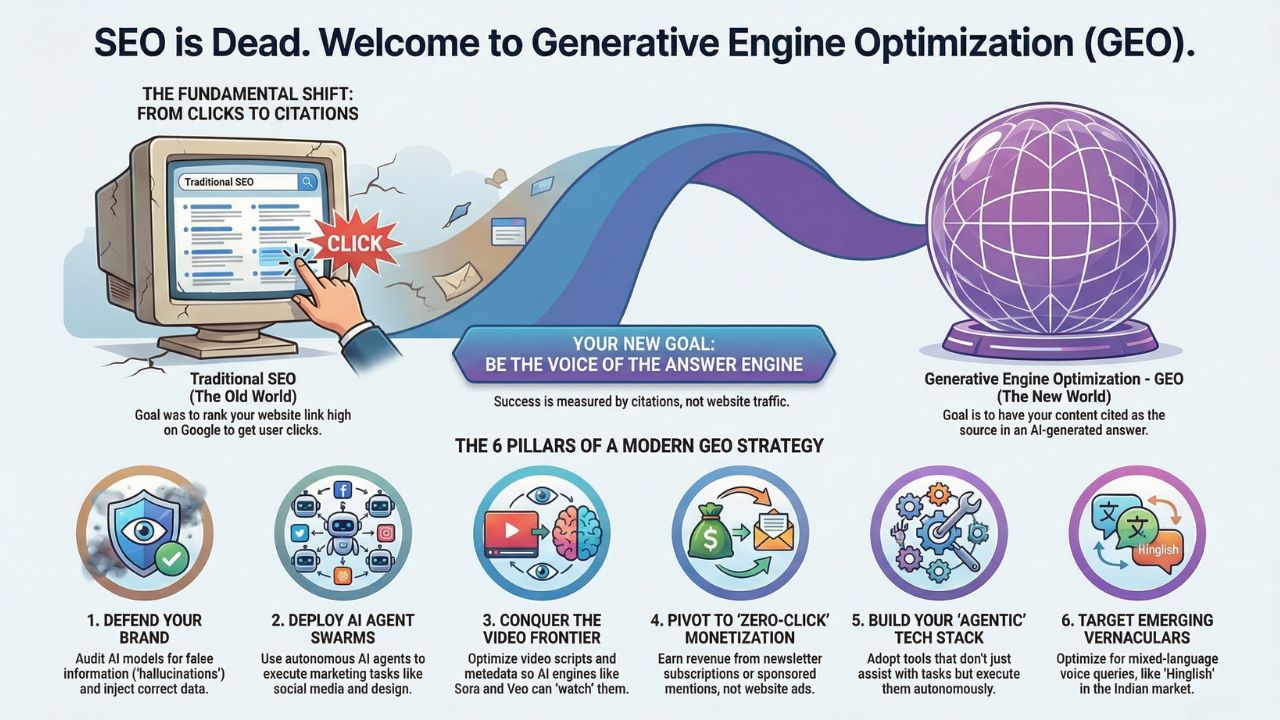
5. The "Agentic" Stack: Tools That Do the Work
Forget the writing assistants of 2023 like Jasper. The tools of 2026 don't just write; they execute. We are seeing a war between the giants: HubSpot Breeze vs. Salesforce Agentforce, versus the custom Python swarms built by developers.
Whether you need "Self-Healing Workflows" or "Autonomous Decision Making," choosing the right stack is critical. Are you an Enterprise needing safety, or a Dev needing power?
Deep Dive: Tool ReviewWe compare the top agentic tools head-to-head to help you decide: Buy or Build?
Read: Best AI Marketing Tools 2026: The "Agentic" Stack (Review)
6. The Indian Angle: Optimizing for "Hinglish"
Finally, we must look at the unique landscape of India. The "Next Billion Users" aren't searching in perfect English; they are voice-searching in "Hinglish" (e.g., "Best sasta 5G phone").
Models like Sarvam and Krutrim are being trained specifically on this vernacular data. To win in India, your GEO strategy must account for code-mixed terms and voice-first queries from Tier-2 and Tier-3 cities.
Deep Dive: The Bharat OpportunityAccess our "Hinglish Dictionary" and voice search stats to capture the massive Indian market.
Read: GEO in India: Optimizing for 'Hinglish' and Voice Search
Ready to Adapt?
The open web as we knew it is dying, but the Academy is open. Start by auditing your brand, then build your agents. The future belongs to those who control the answers, not just the links.
Frequently Asked Questions (FAQ)
Traditional SEO focuses on ranking blue links on a Search Engine Results Page (SERP). GEO (Generative Engine Optimization) focuses on optimizing content to be "cited" or "quoted" by AI models like ChatGPT and Gemini.
We recommend the "Hallucination Audit" method: Query 5 major LLMs (ChatGPT, Gemini, Claude, Perplexity, Llama) with specific questions about your brand and log the inaccuracies. You can then use "Brand Injection" techniques to correct them.
Yes. Modern "Agentic" workflows allow you to deploy swarms where one agent writes copy, another designs images, and a third posts to social media autonomously. This replaces the need for large human teams for repetitive execution.
Freshness Vectors are a GEO ranking factor that measures how up-to-date your data is. AI models prioritize sources that provide real-time or recently updated information, especially for news or trending topics.
The "Zero-Click" strategy shifts monetization from website ads to "On-Platform" revenue. This includes sponsored mentions within the AI answer itself (Answer Capsule ads) or using the AI answer to drive subscriptions to a newsletter you own.