Best AI Coding Assistants 2026: Cut Dev Time by 40%
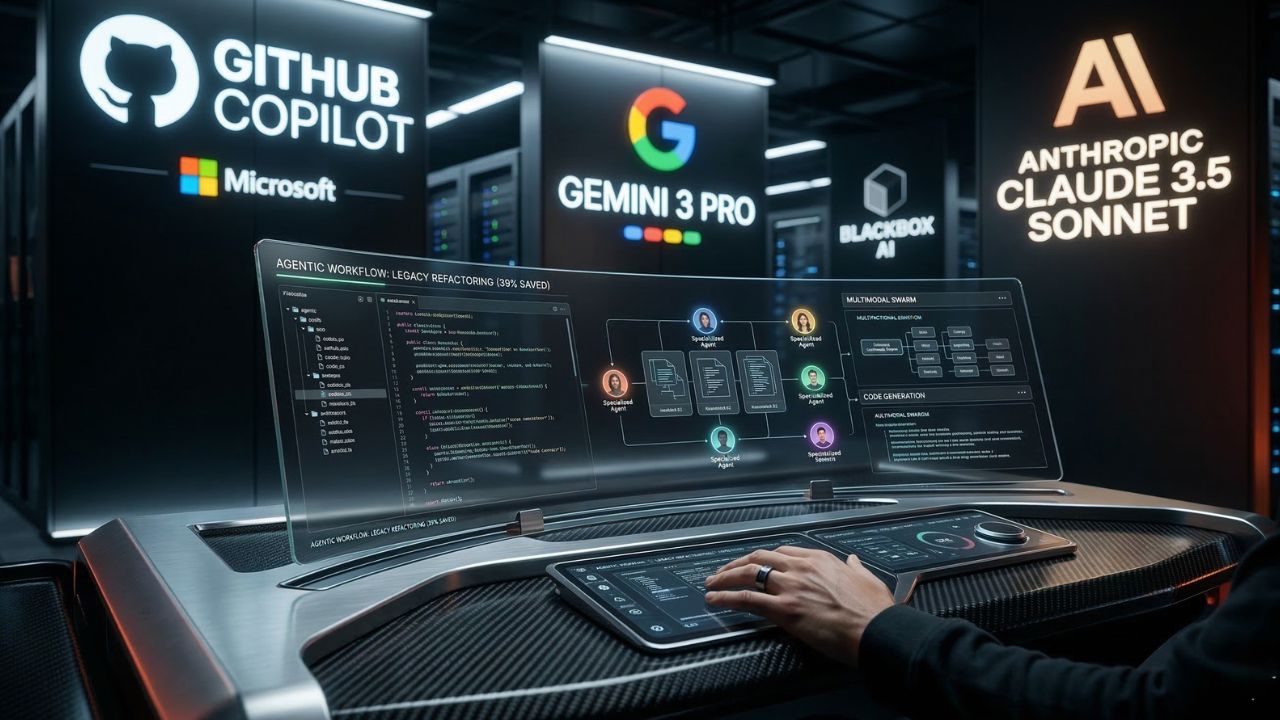
Key Takeaways:
- Stop Autocomplete Sprawl: Most engineering teams are bleeding budget on basic AI instead of utilizing true agentic workflows.
- Protect Your Codebase: Unregulated agentic sprawl ruins codebases and wastes premium enterprise API budgets.
- Real ROI Generation: Discover the exact comparison framework for the top tools that actually reduce dev time and tech debt in 2026.
When searching for the Best AI Coding Assistants, most engineering teams are bleeding budget on glorified AI autocomplete instead of true agentic workflows.
Don't let agentic sprawl ruin your codebase while you pay premium enterprise API costs for minimal productivity gains. Discover the top tools that actually deliver ROI and stop the cash burn with our exact comparison framework.
Executive Summary: The 2026 AI Developer Stack
Before diving into the architecture and integration strategies, here is the immediate breakdown of the market leaders. Securing high E-E-A-T and strong ROI requires knowing exactly which tool serves your deployment pipeline.
| Tool / Platform | Best Core Use Case | Primary Differentiator | 2026 ROI Impact |
|---|---|---|---|
| GitHub Copilot Enterprise | Seamless IDE integration | Native GitHub PR context | 25% faster code reviews |
| Gemini 3 Pro | Complex Agentic Swarms | 1M+ multimodal context window | 40% reduction in planning |
| Blackbox AI Pro | Budget-conscious scaling | Aggressive cost-per-token limits | High volume boilerplate |
| Claude 3.5 Sonnet | Refactoring legacy systems | Superior logic flow retention | 30% reduction in tech debt |
The End of Autocomplete: Welcome to the Agentic Era
The software engineering landscape has fundamentally shifted. We are no longer relying on simple autocomplete plugins that predict the next line of code.
Modern development requires autonomous coding agents. These systems can map entire codebases, write unit tests, and execute multi-file refactoring without human prompting. However, deploying these agents without proper governance leads to severe technical debt.
Teams must architect their workflows to handle massive token context windows responsibly. This is where understanding the mechanics of vibe coding with Gemini 3 pro complete guide becomes your strongest competitive advantage.
Expert Insight: The Agentic Warning
Author's Note: Treating an advanced LLM like a standard chatbot is the fastest way to generate legacy spaghetti code. Always mandate strict circuit breakers in your AI pipelines to prevent autonomous agents from pushing unverified changes to your main branch.
The Information Gain: Why "Agentic Sprawl" is Killing Your Codebase
The biggest mistake enterprise organizations make in 2026 is assuming that more AI activity equals higher productivity. This is a critical misconception.
When developers use multiple, overlapping AI assistants without centralized oversight, it creates "agentic sprawl." Different models generate conflicting design patterns, leading to integration nightmares.
The actual value doesn't come from generating raw code faster. It comes from orchestrating these models to handle complex architectural reasoning. If your team is not utilizing a centralized, highly governed pipeline, you are actively degrading your code quality while increasing your cloud compute spend.
Decoding the Pricing Trap and API Cost Centers
CTOs are sleepwalking into massive unexpected bills because they fundamentally misunderstand how LLMs calculate token usage.
When a developer prompts an AI assistant to analyze a repository, the tool must send thousands of background context tokens per API call. This hidden background usage burns through daily quotas instantly.
To protect your budget, you must audit your organization's API limits. Understanding blackbox AI pricing limits 2026 is critical before your CFO locks down your engineering resources.
By setting hard spend caps and caching frequent repository queries, teams can reduce API overhead by up to 60%.
Expert Insight: Cost Optimization
Pro Tip: Never use your premium agentic models for boilerplate generation. Route simple syntax tasks to cheaper, local LLMs via your IDE, and reserve your high-cost API calls strictly for deep architectural refactoring.
The Talent Pipeline: Academic Licenses and Security Risks
Universities and coding bootcamps are adopting AI developer tools at scale. However, they are failing to teach the severe security risks associated with open-source data leakage.
Many junior developers enter the enterprise environment accustomed to free tools that actively train on user inputs. This creates a massive vulnerability for proprietary codebases.
If your entry-level hires are asking is blackbox AI free for students?, you must intervene immediately. Ensure they are onboarded onto zero-retention enterprise instances.
Implementing strict data privacy training for junior developers is no longer optional; it is a critical security mandate for 2026.
Orchestrating Multimodal Swarms for Complex Pipelines
Building simple wrapper applications around single LLMs is a dead-end business model. True engineering value now comes from multimodal agent swarms.
These advanced architectures allow different specialized AI models to collaborate. One agent analyzes visual UI/UX mockups, while another writes the underlying frontend code, and a third handles backend database schemas.
To execute this properly, you must configure reliable error recovery. Following a rigorous Gemini 3 pro agentic multimodal AI tutorial will ensure your pipeline doesn't crash during complex operations.
By integrating natively generated audio, video, and text processing, your development pipeline becomes a fully automated software factory.
The 2026 Mandate: Orchestrate, Don't Autocomplete
The engineering teams that dominate this year won't be the ones manually writing the most lines of code; they will be the ones orchestrating the smartest agents.
Surviving this industry shift requires abandoning basic autocomplete habits and fully adopting secure, agentic architecture. By strictly governing your API token limits and prioritizing complex system planning over raw output speed, achieving a 40% reduction in development time is a highly realistic baseline.
Stop paying enterprise premiums for legacy results. Audit your current AI developer stack, enforce strict data privacy protocols, and deploy the coding assistants that deliver actual, measurable ROI.

Frequently Asked Questions (FAQ)
For enterprise teams, GitHub Copilot Enterprise and Gemini 3 Pro lead the market. Copilot offers the deepest native PR integration, while Gemini 3 Pro provides an unmatched million-token context window for analyzing entire massive repositories simultaneously.
While GitHub Copilot excels at inline autocomplete and contextual chat, true AI coding agents operate autonomously. Agents can create their own step-by-step plans, navigate file systems, execute code in sandboxes, and automatically debug their own errors without continuous human prompting.
Enterprise tiers of Claude 3.5 Sonnet and GitHub Copilot offer zero-data-retention policies, meaning your proprietary code is never used to train foundational models. Always verify that your organization's service level agreement explicitly forbids telemetry and snippet collection.
When properly integrated into CI/CD pipelines, enterprise teams see an average ROI of 40% reduction in development time. This metric heavily depends on using the tools for architectural planning and test generation, rather than just basic syntax autocomplete.
The primary hidden costs are background API token consumption and technical debt. Autonomous agents often send massive amounts of hidden repository context with every prompt, leading to unexpected API overages and complex, difficult-to-maintain code structures if left unreviewed.
No. AI assistants shift the junior developer's role from writing boilerplate code to reviewing and orchestrating AI outputs. Junior devs are now required to act as prompt engineers and code reviewers, escalating their responsibilities toward architectural oversight much earlier in their careers.
Gemini 3 Pro and tools powered by Claude 3.5 Sonnet excel in Python and data science due to their strong logical reasoning and ability to ingest massive datasets directly into their context windows. They easily handle complex pandas dataframes and machine learning model configurations.
Integration requires setting up secure API keys within your pipeline secrets. You can configure agents via GitHub Actions or GitLab CI to automatically review pull requests, generate unit tests upon commit, and flag security vulnerabilities before the build reaches the staging environment.
Autocomplete tools react passively to the developer's cursor, predicting the next few lines of code. An agent is proactive and goal-oriented; given a broad prompt like "build a login page," it will autonomously create the HTML, CSS, backend routing, and database schema across multiple files.
Advanced models handle legacy refactoring by ingesting the entire legacy codebase into a massive context window. They map the existing data flows and rewrite the logic into modern frameworks, though developers must strictly enforce unit testing to ensure the business logic remains perfectly intact.
Sources and References
- Stack Overflow Annual Developer Survey (2026 Insights): Comprehensive metrics on AI tool adoption and developer sentiment regarding agentic workflows.
- GitHub Engineering Blog: Deep technical breakdowns of Copilot integration, token management, and enterprise security standards
- Vibe coding with Gemini 3 pro complete guide
- Blackbox AI pricing limits 2026
- Is blackbox AI free for students
- Gemini 3 pro agentic multimodal AI tutorial
External Sources
Internal Sources