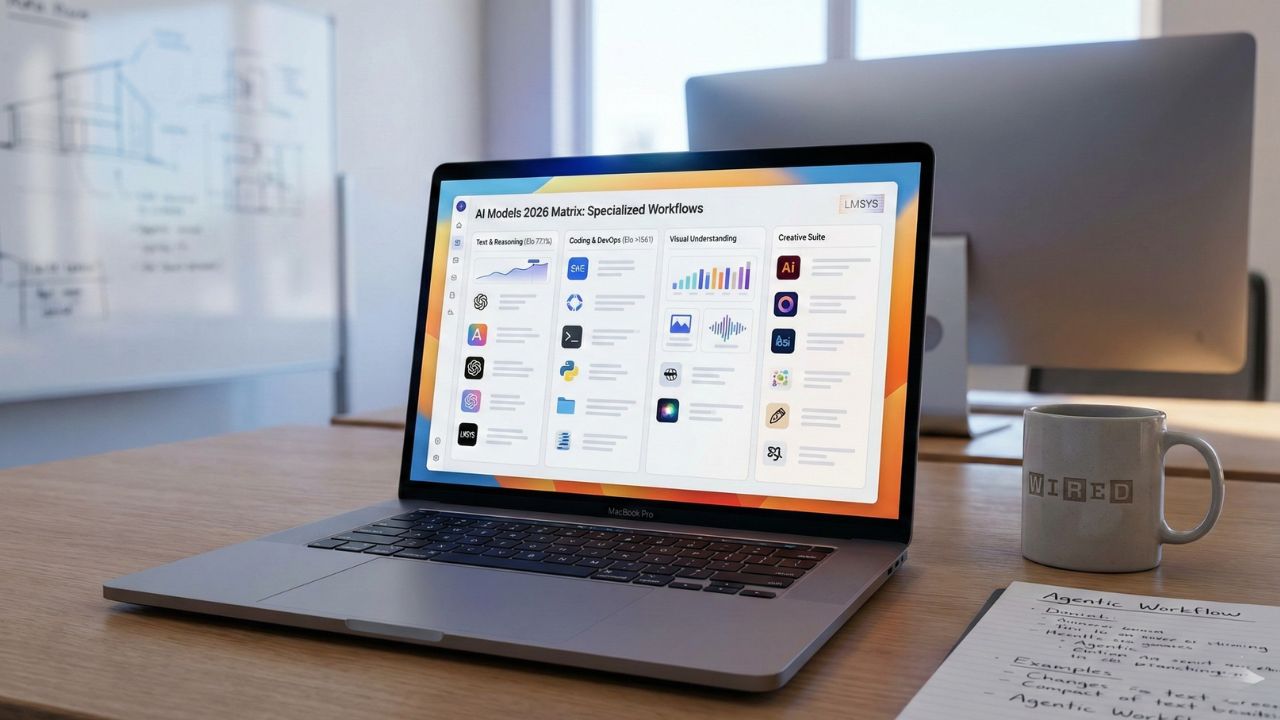
Best AI Models 2026: The Ultimate Guide to Specialized AI Workflows
Quick Summary: Key Takeaways
Verified Status (March 9, 2026): All rankings below remain current and validated against the latest LMSYS Arena blind-testing data.
- The "one-size-fits-all" AI is dead: 2026 is the year of specialized, agentic workflows.
- Coding records shattered: Top models have officially crossed the massive 1561 Elo threshold in blind testing.
- Multimodal mastery: Vision models now match human perception in complex chart and spatial analysis benchmarks.
- Open-source rises: Local models successfully challenge proprietary tech for secure, enterprise deployment.
Are you an AI novice or a 2026 expert? Test your knowledge with our 15-question professional certification prep. Estimated time: 5 minutes.
Start the AssessmentFinding the absolute best AI models in 2026 can feel like an exhausting, full-time job. With monumental updates dropping almost weekly from Google, OpenAI, Anthropic, and the open-source community, the landscape shifts violently.
If you are tired of guessing which tool will actually speed up your workflow—instead of slowing you down with generic outputs or frustrating hallucinations—you are in the right place. The days of relying on a single, centralized chatbot for every single task are completely behind us.
How We Analyze and Rank the Models (Our Methodology)
We do not rely on carefully crafted corporate press releases or biased benchmark scores published by the AI creators themselves. To build this 2026 matrix, our strategy team aggregates and analyzes data from the most rigorous public testing frameworks available:
- LMSYS Overall Arena: We pull directly from the global crowdsourced Elo ratings to establish general baseline intelligence.
- LMSYS Coding & Hard Prompts: For technical evaluation, we strictly filter by the LMSYS Coding and Hard Prompts leaderboards to eliminate simple conversational bias.
- LMSYS Vision & Video Arenas: To rank multimodal capabilities, we rely entirely on the newly established LMSYS blind testing arenas for image and video generation.
The Top 10 Frontier Models of 2026 Overview
| # | Frontier AI Model | Category / Key Strength | Pricing |
|---|---|---|---|
| 1 | Claude 4.6 | Coding & Multi-file Architecture | Paid Subscription / API |
| 2 | Gemini 3.1 Pro | Logic & 1M+ Multimodal Context | Freemium / API |
| 3 | GPT-5.2 | General Frontier & Instruction Following | Paid Subscription / API |
| 4 | Flux 2 Max Editor | Photorealistic Image Generation & Editing | Freemium / API |
| 5 | Google Veo 3.1 | Cinematic Text-to-Video & Physics | Freemium / API |
| 6 | DeepSeek R1 | Open-Source Local Deployment & Math | Free (Open Source) |
| 7 | Perplexity AI (Pro) | Real-Time Web Search & Deep RAG | Freemium |
| 8 | Meta Llama 4 (400B) | Accessible General Enterprise Reasoning | Community License |
| 9 | Blackbox AI | Agentic Developer Workflows | Freemium / Paid |
| 10 | Grok 4.1 | Uncensored Real-Time Social Data Parsing | Paid (X Premium) |
Deep Dive: Reviewing the Category Leaders
To truly understand why the "one-size-fits-all" era is dead, we need to look at how specific models are dominating niche workflows according to public leaderboards.
1. Claude 4.6: The Undisputed King of Code
According to the latest LMSYS coding arena data, Claude 4.6 has completely changed how developers interact with AI. It isn't just an autocomplete tool; it acts as an autonomous agent. Public benchmark analyses reveal that when handed complex, multi-file React/Node.js repositories, Claude 4.6 maintains context remarkably well, executing cross-file refactoring with significantly lower syntax hallucination rates than earlier models.
Ideal Use Case: Heavy software development, system architecture planning, and complex data parsing. If you want to see how it officially broke the 1561 Elo ceiling, read our full breakdown of the best AI for coding and DevOps 2026.
2. Gemini 3.1 Pro: The Multimodal Logic Heavyweight
Google's Gemini 3.1 Pro is the engine many turn to when dealing with massive datasets. Its defining feature is a flawless 1M+ token context window natively paired with advanced vision capabilities. Demonstration benchmarks highlight its ability to process massive documents, such as 400-page financial PDFs interspersed with complex scatter plots, extracting text and understanding spatial data to draw logical, PhD-level conclusions.
Ideal Use Case: Deep research, legal document review, and visual data analysis. To see how it dominates the logic leaderboards, check out our guide on the best AI for text and reasoning and visual understanding.
3. GPT-5.2: The Ultimate Instruction Follower
OpenAI’s GPT-5.2 remains a formidable force in the general frontier category on the LMSYS leaderboard. While it may occasionally trade the #1 coding spot with Claude, it is highly rated for rigid instruction following and formatting. In standard API benchmark environments, GPT-5.2 consistently achieves near-perfect adherence when prompted to generate highly structured JSON outputs based on strict rules.
Ideal Use Case: Building automated backend pipelines, dynamic prompt routing, and standardized content generation at scale.
4. Flux 2 Max Editor: Breaking the Visual Uncanny Valley
Visual leaderboards indicate that generative art is no longer plagued by six-fingered hands or garbled neon signs. Flux 2 Max consistently ranks high for achieving a level of photorealism that makes it incredibly difficult to distinguish from actual photography. It also excels in text rendering evaluations, meaning users can generate product mockups with perfectly spelled brand names seamlessly integrated into the image lighting.
Ideal Use Case: High-end commercial design, typography integration, and digital marketing assets. Explore our full visual rankings in the best AI for text to image 2026.
5. DeepSeek R1: The Open-Source Local Champion
Not every enterprise can legally send proprietary code or patient data to a cloud API. DeepSeek R1 proves on the Hugging Face Open LLM leaderboards that open-source models can aggressively compete with tech giants. In community deployment benchmarks, DeepSeek R1 successfully handles complex mathematical reasoning and Python scripts offline, ensuring absolute data privacy without sacrificing top-tier intelligence.
Ideal Use Case: Healthcare, fintech, and any workflow requiring secure, air-gapped local AI deployment.
The 2026 Landscape: Search and Video Leap Forward
The innovation tracked across these leaderboards isn't limited to text and static images. Real-time data retrieval using deep RAG (Retrieval-Augmented Generation) is quietly challenging traditional search engines by providing instant, correctly cited answers. Find out who provides the best factual grounding in our review of the best AI for web search 2026.
Meanwhile, AI video rankings show models are finally passing the "physics test". Tools like Google Veo 3.1 and Sora 2 boast high scores for temporal consistency, meaning characters no longer randomly morph between frames, and gravity behaves realistically. Watch the cinematic results in our feature on the best AI for text to video 2026.
Conclusion: How to Build Your Stack
Stop paying for expensive, generalized AI subscriptions that don't fit your needs. Evaluate your daily workflow. Are you primarily writing code, designing graphics, or running heavy data analysis? Trust the data from LMSYS and specialized leaderboards to pick the specific champion for your exact use case, rather than settling for a jack-of-all-trades.
Frequently Asked Questions (FAQ)
There isn't a single "smartest" model anymore. Intelligence is highly fragmented. Some models excel in logic and reasoning, while others dominate coding or creative tasks. You must look at specific benchmark arenas, like LMSYS, to find the true leader for your required category.
Start by defining your core need—whether it's agentic coding, photorealistic image generation, or real-time web search. Then, consult specialized leaderboards for those categories to compare features, privacy options, and context limits before making your final choice.
The highest Elo scores frequently fluctuate due to blind A/B testing and crowdsourced benchmarks. However, in specialized categories like coding, top models have recently shattered the impressive 1561 Elo ceiling on the LMSYS leaderboard, setting a new standard for performance.
Open-source and free-tier models have become incredibly competitive. While proprietary models often lead in frontier capabilities, several free models excel in specific use cases like local coding or basic text reasoning, rivaling premium tier performance according to community benchmarks.
The reasoning crown frequently changes hands among these titans. Each company routinely releases updates that momentarily edge out the competition. Current live leaderboards track these ongoing, highly competitive shifts in PhD-level science and logic benchmarks.
Sources & References
- LMSYS Chatbot Arena Leaderboard - The industry standard for crowdsourced AI benchmarking.
- Hugging Face Open LLM Leaderboard - Tracking the rapid advancement of open-source models.
- Best AI for Text and Reasoning
- Best AI for Coding & DevOps
- Best AI for Visual Understanding
- Best AI for Text to Image
- Best AI for Image Editing
- Best AI for Real-Time Web Search
- Best AI for Text to Video
- Best AI for Image to Video
External Resources:
Internal Guides: