Ethics of AI-Generated Assets: Why Your "Passive Income" Could Be a Legal Trap
Quick Summary: Key Takeaways
- No Automatic Copyright: In the U.S., raw AI output generally cannot be copyrighted; you need significant human input to own it.
- Liability Risks: You are responsible for what you publish. If your AI tool plagiarizes a trademarked character, you are the one who gets sued.
- Transparency Matters: Hiding AI usage can lead to bans on platforms like Amazon KDP and Steam.
- Human-in-the-Loop: To secure legal protection, you must prove a human creative process guided the machine.
- Asset Ownership: You might own the arrangement of a work (like a book layout), but not the individual AI-generated images inside it.
The promise of the new digital economy is enticing: click a button, generate a product, and profit. However, the reality of managing copyright risks for AI art is far more complex.
While tools like Midjourney and ChatGPT are powerful, they are not legal shields. If you are building a business based on the Best AI Passive Income Ideas 2026, you must understand the legal foundation first.
Ignoring the ethics of AI-generated assets is the fastest way to turn a profitable asset into a costly liability. This guide acts as your legal firewall, ensuring that the empire you build actually belongs to you.
The Core Problem: Who Owns the Machine's Work?
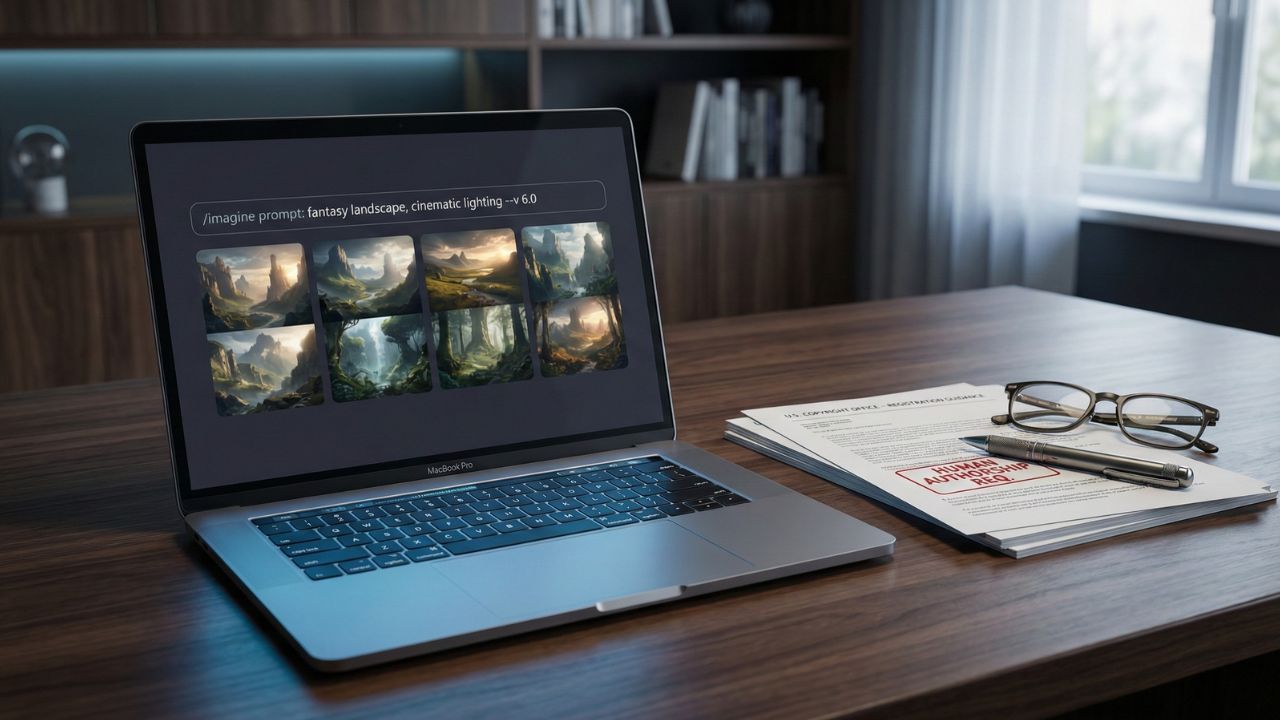
The United States Copyright Office (USCO) has made its stance clear: copyright requires human authorship. If you simply type a prompt like "fantasy landscape" into an AI generator, the resulting image is considered "public domain."
This means anyone can legally download your image and sell it on a t-shirt without paying you a dime. To protect your AI creative asset governance, you must demonstrate that the AI was merely a tool, like a paintbrush, and that you were the artist.
The "Human-in-the-Loop" Requirement
To gain copyright protection, you must transform the raw AI output. This concept is critical for intellectual property for generative media.
The USCO looks for "sufficient human creativity". This could include:
- Heavily editing the image in Photoshop.
- Arranging AI text into a unique, curated structure.
- Iterative prompting where you guide the specific details of the output (though this is still legally gray).
For a detailed breakdown on documenting this process, you should read our guide on the AI-Generated Asset Copyright Audit. It explains how to prove you are the real author behind the machine.
Managing Copyright Risks for AI Art & Text
The risk isn't just about losing ownership; it's about getting sued. Generative AI models are trained on billions of images and texts, some of which are copyrighted.
If your AI tool inadvertently reproduces a famous character (like Mickey Mouse) or a specific artist's distinct style, you could be liable for infringement.
Key Liability Traps:
- Likeness Rights: Generating an image that looks like a celebrity.
- Trademark Infringement: Accidentally generating a logo that resembles a real brand.
- Plagiarism: Publishing AI text that regurgitates existing articles word-for-word.
Marketplace Compliance: The "Ban-Hammer"
Beyond the courts, you have to worry about the platforms. Amazon KDP, Adobe Stock, and Steam have strict policies regarding AI creative asset governance.
- Amazon KDP: You must disclose if content is "AI-Generated" or "AI-Assisted".
- Adobe Stock: Requires strict labeling of generative AI content.
Failure to label your work correctly is a violation of the ethics of AI-generated assets guide and can result in an immediate, permanent account ban.
Conclusion
Building a passive income stream is useless if you don't legally own the asset. By understanding the legal liability for AI passive income, you can shift from being a "prompter" to a "publisher".
Focus on the human value you add, the editing, the curation, and the strategy. Remember, the machine creates the raw material, but you create the value.

Frequently Asked Questions (FAQ)
Yes, it is generally legal to sell AI-generated products. However, you cannot claim exclusive copyright ownership over raw AI outputs. This means while you can sell a print, you might not be able to stop others from selling the exact same image if they get their hands on it.
Currently, no one owns the copyright to raw AI-generated images in the U.S. They are considered public domain. However, if a human significantly modifies the image (e.g., painting over it, combining it into a collage), that modified version can be copyrighted.
The biggest risks are copyright infringement (accidentally copying an artist's style or character), lack of ownership (competitors legally copying your work), and platform bans (violating terms of service on sites like Amazon or Etsy).
Generally, no. The USCO has stated that prompts are "instructions" to a machine, not the creative work itself. While complex prompts show effort, they do not currently grant copyright protection over the output.
You protect it by adding "human authorship". Don't just publish raw outputs. Edit them, combine them, and layer them with human-created elements. Document your process to prove your creative input.
Sources & References
- Best AI Passive Income Ideas 2026
- AI-Generated Asset Copyright Audit
- U.S. Copyright Office: Copyright Registration Guidance: Works Containing Material Generated by Artificial Intelligence
- Google Search Central: Google Search's guidance about AI-generated content
Internal Resources:
External Authorities: