Blackbox AI API Pricing vs OpenAI: The 2026 Cost Audit
By Sanjay Saini | Last Updated: May 15, 2026
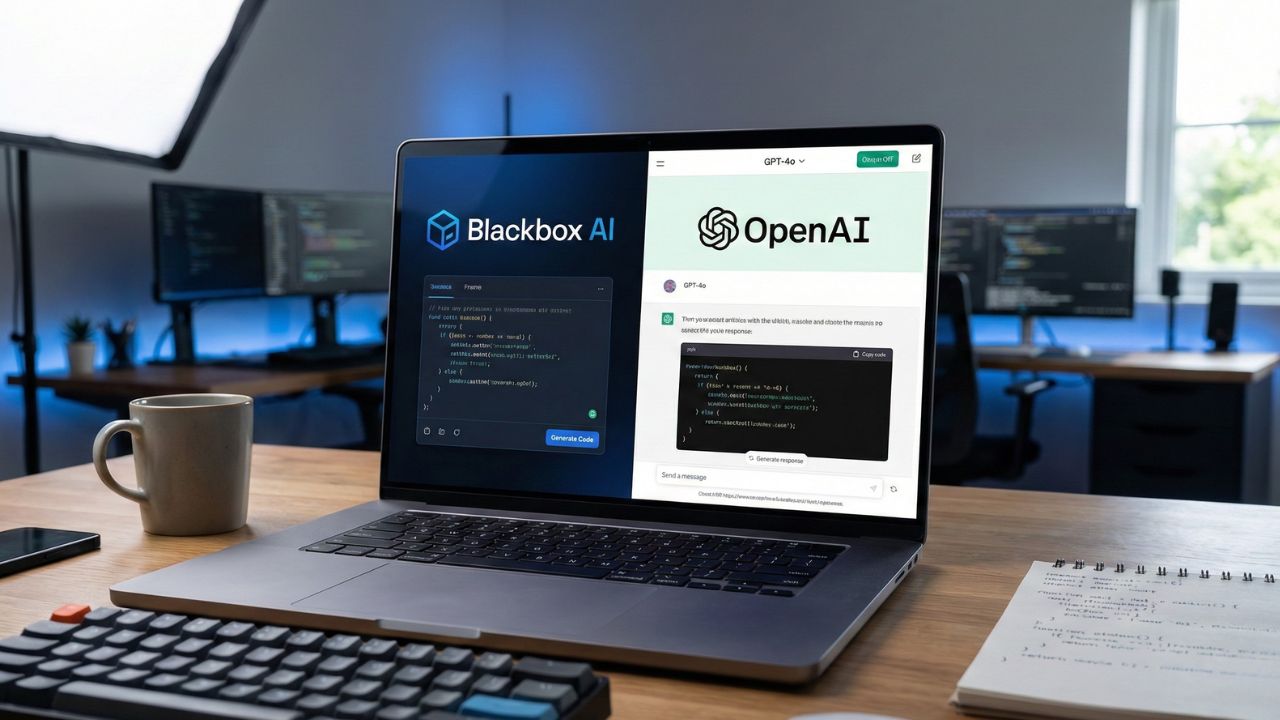
What's New in This Update
- OpenAI Pricing Shifts: Updated cost benchmarks to include OpenAI's recent deployment of GPT-5.4 Nano and its impact on bulk token economics.
- Rate Limit Transparency: Added specific RPM (Requests Per Minute) ceilings for Blackbox's standard developer tiers.
- Agentic Workflows: Expanded the comparison to focus strictly on multi-agent execution costs rather than basic autocomplete features.
Quick Answer: Key Takeaways
- The Cost Verdict: Blackbox AI API pricing is generally structured to undercut OpenAI’s flagship models by 10-20% for bulk code generation, but lacks the granular tiering seen in the broader market.
- Agent Suitability: While cheaper per prompt, Blackbox’s API has historically enforced lower rate limits, making it less stable for high-frequency autonomous agents compared to OpenAI’s highly resilient infrastructure.
- The "Hidden" Tier: Unlike OpenAI’s public pay-as-you-go model, deep Blackbox API access is frequently gated behind custom enterprise agreements.
- Best Use Case: Deploy Blackbox for isolated bulk code generation; rely on OpenAI for complex, multi-step reasoning and orchestrating agentic workflows.
For startups and developers building the next generation of autonomous coding agents, the cost of raw intelligence is the single largest bottleneck to profitability.
While OpenAI continues to set the industry standard for reasoning and reliability, the aggressive search for a budget-friendly alternative has led many engineering teams to investigate Blackbox AI API pricing versus OpenAI. With the recent rollout of OpenAI's highly optimized GPT-5.4 Nano, the baseline cost for AI computation has dropped, forcing competitors to adjust their API economic models.
If you are building an application that generates, refactors, or reviews code autonomously, you must determine whether you are paying a necessary premium for the OpenAI brand name or if a specialized budget option like Blackbox will inevitably crash your production environment under heavy load.
This deep dive is part of our extensive guide on Blackbox AI Pricing & Limits 2026.
1. The Core Difference: Blackbox AI vs OpenAI Infrastructure
Before dissecting the specific costs per million tokens, developers must understand the fundamental architectural differences between these two providers.
OpenAI operates a generalized, frontier-level infrastructure designed to handle immense scale and diverse reasoning tasks. Its API endpoints (like `gpt-4o` and `gpt-4o-mini`) are engineered for high availability, offering tiered rate limits that scale seamlessly as your application's usage grows.
Conversely, Blackbox AI originally built its reputation as a consumer-facing coding assistant—a tool integrated directly into IDEs like VS Code to help developers write snippets faster. Its API is a specialized extension of this core product. Because it is highly tuned specifically for software engineering datasets, it often requires fewer tokens to arrive at a correct coding solution. However, this specialization comes with structural trade-offs.
2. Breakdown: Blackbox AI API Pricing in 2026
Acquiring transparent, self-serve pricing for the Blackbox AI API remains challenging for independent developers. Unlike providers that publish flat token rates on their homepages, Blackbox frequently routes heavy API users through an enterprise sales pipeline.
Standard Token Costs
Based on developer reports and custom enterprise agreements negotiated in early 2026, Blackbox effectively prices its code-generation endpoints approximately 10% to 20% lower than OpenAI's standard GPT-4o model. This positions it as an attractive option for companies processing millions of lines of legacy code.
The Hidden Rate Limit Penalty
When building an autonomous coding agent (like Devin or an internal custom tool), latency and rate limits matter substantially more than the raw token price. If an agent hits a rate limit mid-task, the entire workflow stalls.
Blackbox’s infrastructure is heavily optimized for its own consumer web chat. Developers utilizing the API consistently report aggressive rate limits (Requests Per Minute). If your application sends concurrent multi-file prompts to review an entire repository, Blackbox's API is likely to throttle the connection, causing your agent to "hang" indefinitely.
For organizations pushing massive token volume, evaluating the cost of running LLMs locally versus the cloud has become a viable strategy to completely bypass external rate limits entirely.
3. Breakdown: OpenAI Developer Pricing (GPT-4o & GPT-5.4)
OpenAI's pricing model is completely transparent, allowing developers to calculate precise operational costs before writing a single line of code.
The Tiered Throughput Advantage
OpenAI groups developers into specific usage tiers (Tier 1 through 5) based on their historical spend and prepayment deposits. As you advance through the tiers, your RPM (Requests Per Minute) and TPM (Tokens Per Minute) ceilings increase exponentially. This predictable scaling is non-negotiable for enterprise applications that require 99.9% uptime.
OpenAI recently shifted enterprise billing structures by introducing flexible pay-as-you-go pricing for Codex teams, giving engineering managers much greater cost predictability for internal tools.
Context Window Economics
Modern coding agents need to ingest entire codebases. OpenAI provides massive 128k+ context windows. While feeding 100,000 tokens into GPT-4o costs real money, the model's ability to retain instructions across long, complex reasoning chains prevents developers from having to repeatedly send the same context data—ultimately saving money on the overall transaction.
4. Which API is Better for Autonomous Coding Agents?
Building a stable multi-agent system requires strict token management, a core focus when evaluating CrewAI versus LangGraph architecture costs. Selecting the right underlying API determines whether those agents succeed or fail in production.
The Latency and Stability Factor
OpenAI guarantees high throughput. Blackbox’s API performance can fluctuate based on the simultaneous load from their free web users. If your internal agent requires strict uptime to automate CI/CD pipeline reviews, the monetary savings generated by Blackbox tokens will be entirely wiped out by the labor costs of debugging failed API calls and timeouts.
Integration and Developer Experience
- OpenAI: Provides world-class documentation, robust SDKs for Python and Node.js, and a massive community. Critical agentic features like strict JSON mode, structured outputs, and seedable reproducibility are natively supported.
- Blackbox AI: API documentation is functional but significantly less comprehensive. Developers often have to build custom error-handling wrappers to manage unexpected endpoint drops.
5. Final Verdict: When to Pay the OpenAI Premium
If you are building an isolated script to generate boilerplate code or translate single files from one language to another in bulk, pursuing a custom enterprise API agreement with Blackbox AI can yield a 10% to 20% cost reduction. It is a highly capable model for focused, linear software tasks.
However, if you are developing a complex autonomous agent that plans architecture, executes code, reads terminal errors, and iterates on its own logic, OpenAI remains the mandatory choice in 2026. The reliability, massive rate limits, and advanced reasoning capabilities of the OpenAI platform justify its premium price tag. For production environments where failure halts the development pipeline, stability is far more valuable than a marginal discount on tokens.
While individual learners might find value in testing whether Blackbox AI is free for students via their web interface, enterprise APIs operate under entirely different operational demands.
Compare Market Intelligence Tools. Try SimilarWeb

Frequently Asked Questions
Pricing is frequently customized for Enterprise usage rather than a public pay-as-you-go tier, but effective negotiated rates typically undercut standard OpenAI models by 10-20% for bulk code-specific tasks.
Unlike its consumer web chat interface, the Blackbox API does not typically provide a permanent free tier. It functions as a paid product intended for commercial developers and startups.
Yes, but developers must architect around strict rate limits. It is best utilized for the discrete code-generation step of an agent's workflow rather than the complex planning and reasoning steps.
Developers must request API access through the official provider portal. Once approved by sales, you will receive an API key that functions similarly to other standard RESTful LLM endpoints.
It is stable for internal tools, bulk processing, and non-critical workflows. However, it may experience more latency fluctuations and timeouts than major infrastructure providers like OpenAI or Anthropic during peak global hours.