Clinical AI Guide 2026: The Medtech Revolution Saving Lives
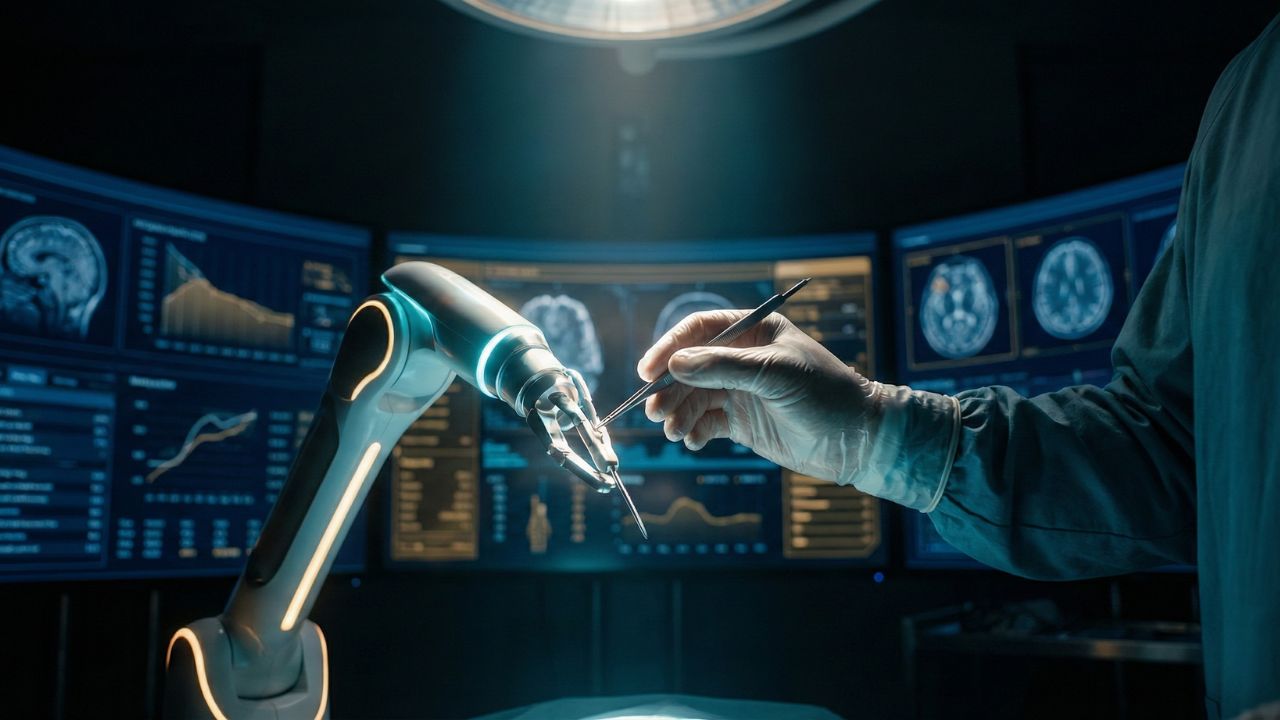
Quick Summary: What You’ll Learn
- The New Standard: Why AI is no longer "experimental" but essential for modern hospitals.
- Superhuman Vision: How algorithms are detecting cancers 3 years before human doctors can.
- Robotic Precision: The rise of autonomous surgeons and what it means for patient safety.
- Speed Cures: How Generative AI is cutting drug discovery times from years to days.
- The Risks: A look at the ethical dilemmas and privacy concerns you need to know.
Welcome to your definitive Clinical AI guide 2026; the era where code cares for patients as much as doctors do.
Remember when "AI in healthcare" sounded like science fiction? That was five years ago. Today, you might be diagnosed by an algorithm, treated by a robot, and triaged by a chatbot before you ever see a human face.
The future of AI in medicine isn't coming, it’s already here. From reducing ER wait times to performing microsurgery with steady steel hands, Artificial Intelligence is rewriting the rules of life and death.
But is it safe? And can we trust it? Let’s dive into the medtech trends 2026 that are transforming hospitals globally.
1. The "Second Opinion" That Never Sleeps
Imagine a doctor who has memorized every X-ray ever taken in history. That is exactly what modern medical imaging AI tools bring to the table.
Human doctors are incredible, but they get tired. They can miss microscopic anomalies. AI doesn't blink.
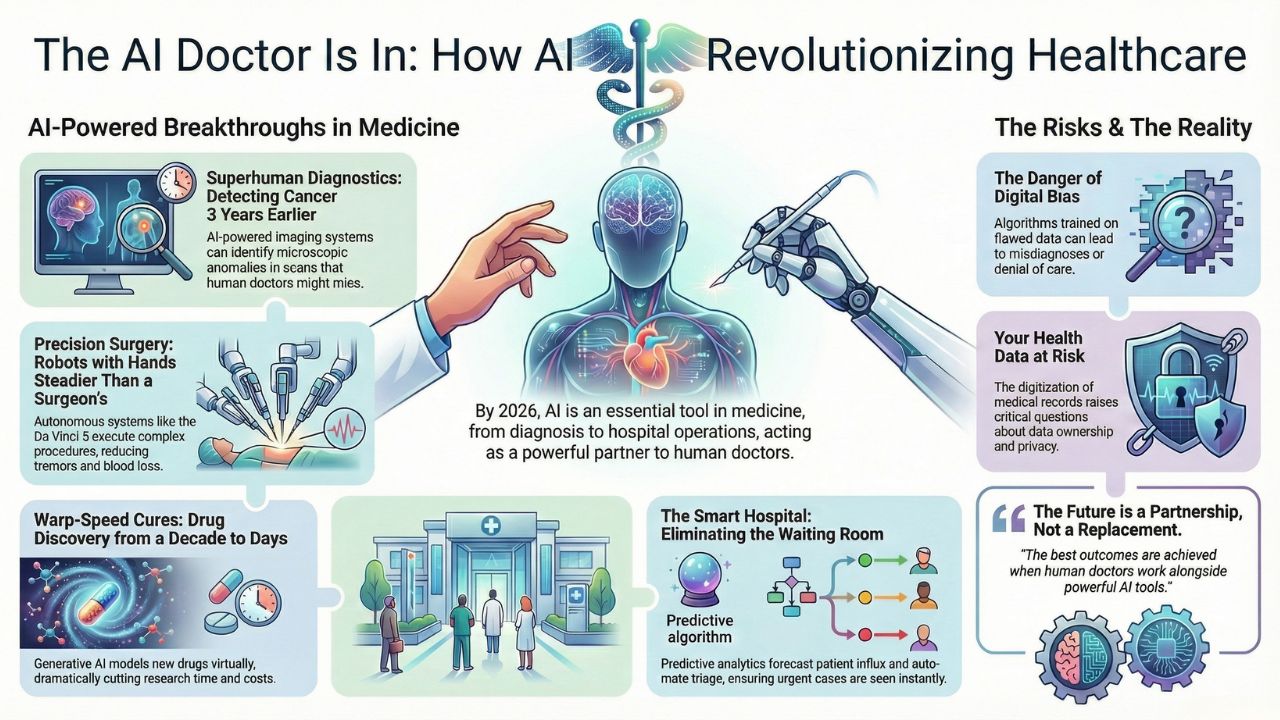
New computer vision systems are currently detecting lung and breast cancers up to 3 years earlier than traditional methods. They aren't replacing radiologists; they are giving them superpowers.
If you are wondering how accurate these systems really are compared to human eyes, you need to read our deep dive on Better Than Human Eyes? The "Second Opinion" AI Detecting Cancer 3 Years Early.
2. The Surgeon With Steel Hands
Would you let a robot operate on your heart? In 2026, the answer for millions of patients is a resounding "Yes."
Autonomous robotic surgery has moved beyond simple assistance. Systems like the Da Vinci 5 are now capable of executing complex sutures with a precision no human hand can match.
These robots reduce tremors, minimize blood loss, and speed up recovery times. However, the question of liability remains. If the robot makes a cut, who is responsible?
We investigate the safety and the "pros and cons" of these steel surgeons in our article: Surgeon or Software? Inside the Operating Room Where Robots Call the Shots.
3. Finding Cures at Warp Speed
Traditionally, bringing a new drug to market took 10+ years, $2 Billion in R&D, and had massive failure rates.
Generative AI drug discovery has completely shattered this timeline. Tools like Google's AlphaFold are folding proteins and simulating drug interactions in virtual environments before a single physical test is done.
We are seeing cures for diseases previously thought "undruggable." It’s a revolution that is saving lives and slashing costs.
Curious about how algorithms are compressing decades of research into days? Check out The 30-Day Cure: How Generative AI is Finding Drugs Big Pharma Missed.
4. The Smart Hospital: No More Waiting Rooms?
The most painful part of healthcare often isn't the treatment, it's the waiting. AI hospital management systems are declaring war on the waiting room.
By using predictive analytics, hospitals can now forecast patient influx spikes (like flu season), optimize bed availability in real-time, and automate triage so urgent cases are seen instantly.
This is the birth of the "Smart Hospital," where administrative chaos is replaced by algorithmic efficiency. See how technology is ending the ER bottleneck in our report: The Death of the Waiting Room: Why Smart Hospitals Are Hiring "Chief AI Officers".
5. The Dark Side: Bias and Privacy
We cannot talk about AI without talking about the risks. Algorithms are trained on data, and data is often biased.
There have been alarming cases where medical AI denied coverage or misdiagnosed patients based on faulty demographic data. Furthermore, with your health data digitizing, who actually owns your medical records?
Efficiency is great, but it shouldn't cost you your privacy.
We expose the hidden dangers you need to watch out for in The Algorithm Denied My Surgery: The Hidden Bias in Medical AI.
Final Thoughts
The future of AI in medicine is a partnership, not a replacement. It promises a world where diagnosis is instant, surgery is safer, and administrative headaches are a thing of the past.
As we move through 2026, the best doctors won't be the ones who fear AI, but the ones who work alongside it regarding this Clinical AI guide 2026.
Frequently Asked Questions (FAQ)
AI is automating diagnostics, enabling robotic surgery, accelerating drug discovery, and optimizing hospital logistics to reduce wait times and improve patient outcomes.
Generally, yes, when used as a "second opinion." AI tools are often more sensitive than human eyes for early detection, but a human doctor should always verify the results.
Top tools include AI radiology software for cancer detection, robotic surgical systems like Da Vinci 5, and generative AI platforms (like AlphaFold) for drug research.