Better Than Human Eyes? The "Second Opinion" AI Detecting Cancer 3 Years Early
Key Takeaways:
- Superhuman Sight: AI radiology tools can detect pixel-level anomalies up to 3 years before they are visible to the human eye.
- The "Second Opinion" Model: Computer vision acts as a tireless safeguard, significantly reducing false negatives in mammograms and CT scans.
- Rapid Triage: Algorithms prioritize critical scans instantly, ensuring urgent patients skip the waiting line.
Imagine a doctor telling you that you are healthy, only to find out years later that a tumor was growing right before their eyes, hidden in plain sight. For decades, radiologists have relied on the limitations of human vision.
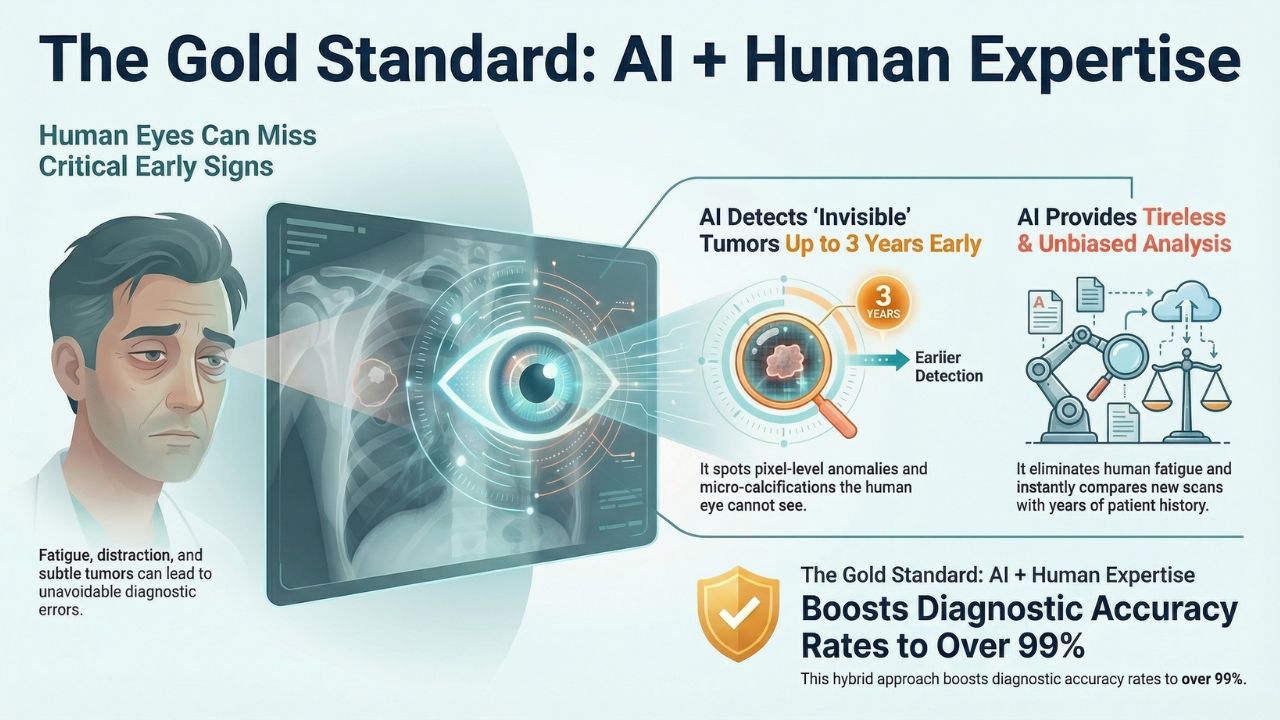
Fatigue, distraction, and the sheer subtlety of early-stage tumors have led to unavoidable diagnostic errors. But in 2026, the game has changed.
We are witnessing a new era where algorithms don't just "read" scans; they analyze them at a microscopic level. (Note: This deep dive is part of our extensive guide on the Clinical AI & MedTech Revolution. Check out the main pillar page for the full roadmap of AI in healthcare.)
The "Invisible" Tumor: How Computer Vision Works
How can software see cancer before a trained specialist? The answer lies in pattern recognition.
A human radiologist looks for shapes, shadows, and masses. An AI model, trained on millions of images, looks for mathematical anomalies in pixel density. It detects what humans miss:
- Micro-calcifications too small for the naked eye to focus on.
- Subtle texture changes in dense tissue.
- Blood flow irregularities consistent with early tumor growth.
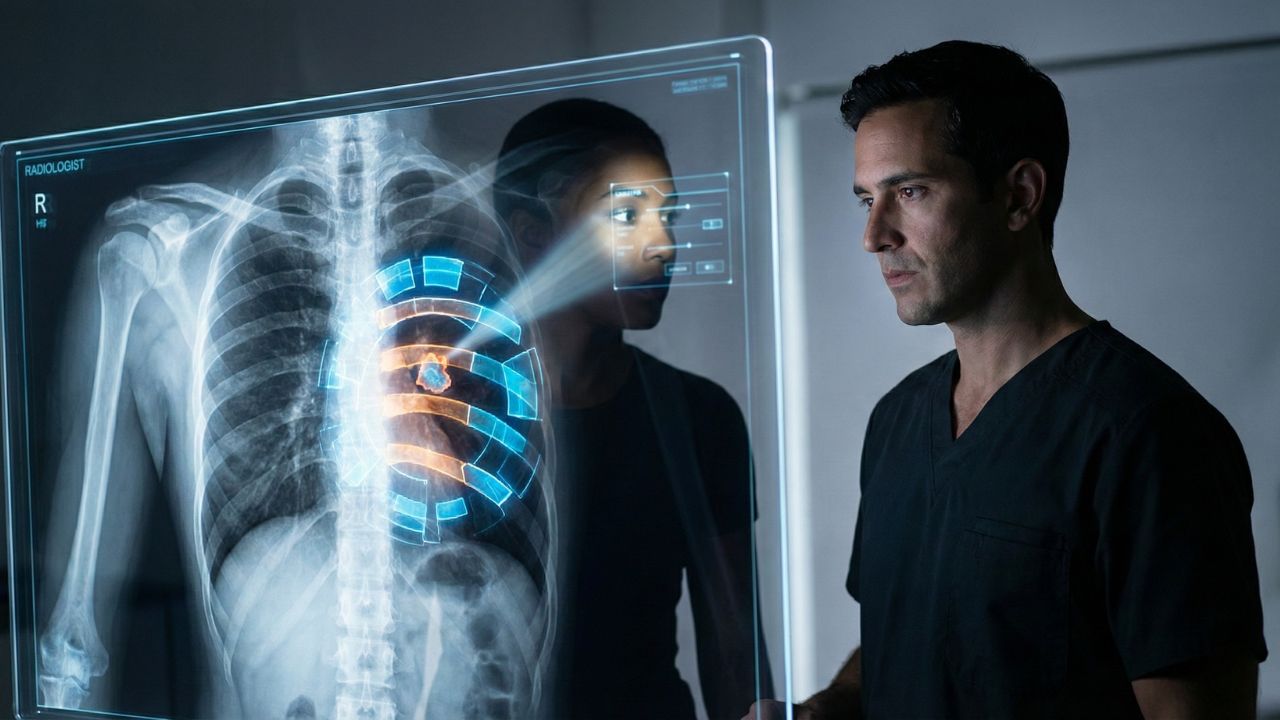
These early detection AI algorithms create a "heat map" of the scan. This highlights suspicious areas that require a closer look. It isn't replacing the doctor; it is giving them bionic eyes.
AI vs. Radiologist: The Accuracy Battle
Is AI actually better? The data suggests it is certainly more consistent. Recent studies in AI radiology software have shown that deep learning models can reduce false positives and false negatives by significant margins.
Why AI wins on consistency:
- No Fatigue: AI doesn't get tired after an 8-hour shift.
- Bias Removal: It doesn't care about the patient's history, only the raw data.
- Historical Comparison: AI can instantly compare a current scan against 5 years of previous scans to spot minute changes.
However, relying solely on AI has risks. We discuss the dangers of algorithmic errors in our article on The Algorithm Denied My Surgery: The Hidden Bias in Medical AI.
The current "Gold Standard" is the Hybrid Model: AI + Human. When a radiologist uses AI as a "second opinion," diagnostic accuracy rates often surpass 99%.
From Diagnosis to Cure: The AI Workflow
Detecting the problem is only step one. The real power of AI is how it connects diagnosis to treatment speed.
1. Instant Triage
In the past, a scan might sit in a queue for days. Today, AI flags urgent anomalies immediately. This integration helps hospitals manage patient flow efficiently, a topic we cover in The Death of the Waiting Room: Why Smart Hospitals Are Hiring "Chief AI Officers".
2. Surgical Precision
Once a tumor is identified with high precision, the data is instantly prepped for intervention. In modern smart hospitals, this diagnostic data is fed directly to surgical systems.
This allows for robots to perform the cure with the same level of precision used to detect the disease. We have covered this topic in our article Surgeon or Software? Inside the Operating Room Where Robots Call the Shots.
3. Personalized Medicine
For complex cancers, simple removal isn't enough. The genetic data gathered during diagnosis helps create custom drug regimens.
This is where The 30-Day Cure: How Generative AI is Finding Drugs Big Pharma Missed steps in to design tailored treatments.
Top Medical Imaging AI Tools in 2026
Hospitals are rapidly adopting these tools to handle the massive volume of imaging data.
- Neural Networks for Mammography: Specialized AI that reduces unnecessary biopsies by distinguishing between benign cysts and malignant masses.
- Lung CT Scanners: Algorithms capable of spotting lung nodules years before they become inoperable.
- Neurological AI: Tools that detect early signs of stroke or Alzheimer’s from standard MRI scans, often before clinical symptoms appear.
Conclusion
The phrase "caught early" is the difference between a simple procedure and a life-threatening battle. AI radiology software is not just a technological upgrade; it is a survival tool.
By acting as a tireless second opinion, these algorithms are ensuring that when a patient hears "you are clear," it is the absolute truth.
As these tools integrate with robotic surgery and AI drug discovery, we are moving toward a future where cancer is treated as a manageable condition rather than a terminal sentence.
Frequently Asked Questions (FAQ)
In specific tasks, yes. AI excels at spotting micro-anomalies and pattern recognition in dense tissue (like mammograms) where human eyes struggle. However, humans are still better at understanding the full patient context.
While it varies by tool, top-tier AI models in 2026 are achieving sensitivity rates above 90-95% for specific cancers (like breast and lung cancer), often outperforming solo human radiologists.
Computer vision breaks an image down into millions of pixels. It analyzes the numerical value of these pixels to find irregular patterns, such as density changes, that correlate with training data from known cancer cases.
Sources & References
- National Cancer Institute (cancer.gov) – "Artificial Intelligence (AI) and Cancer"
- Radiological Society of North America (RSNA.org) – "Artificial Intelligence: Resources & Clinical Practice"
- The Lancet Digital Health – "A comparison of deep learning performance against health-care professionals in detecting diseases from medical imaging"