The Aircall vs RingCentral Secret Nobody Mentions (2026 Audit)
What's New in This Update
- HIPAA & SOC2 Compliance: Updated the critical distinctions between standard SaaS certifications and deep healthcare data residency requirements.
- Latency Benchmarks: Added fresh 2026 API sync times highlighting dropped CRM payloads under load.
- Enterprise Token Costs: Exposed the hidden multi-agent token taxation buried in premium routing tiers.
- Architectural Strategy: Inserted new frameworks for CTOs transitioning out of monolithic legacy stacks.
Executive Snapshot: The Bottom Line
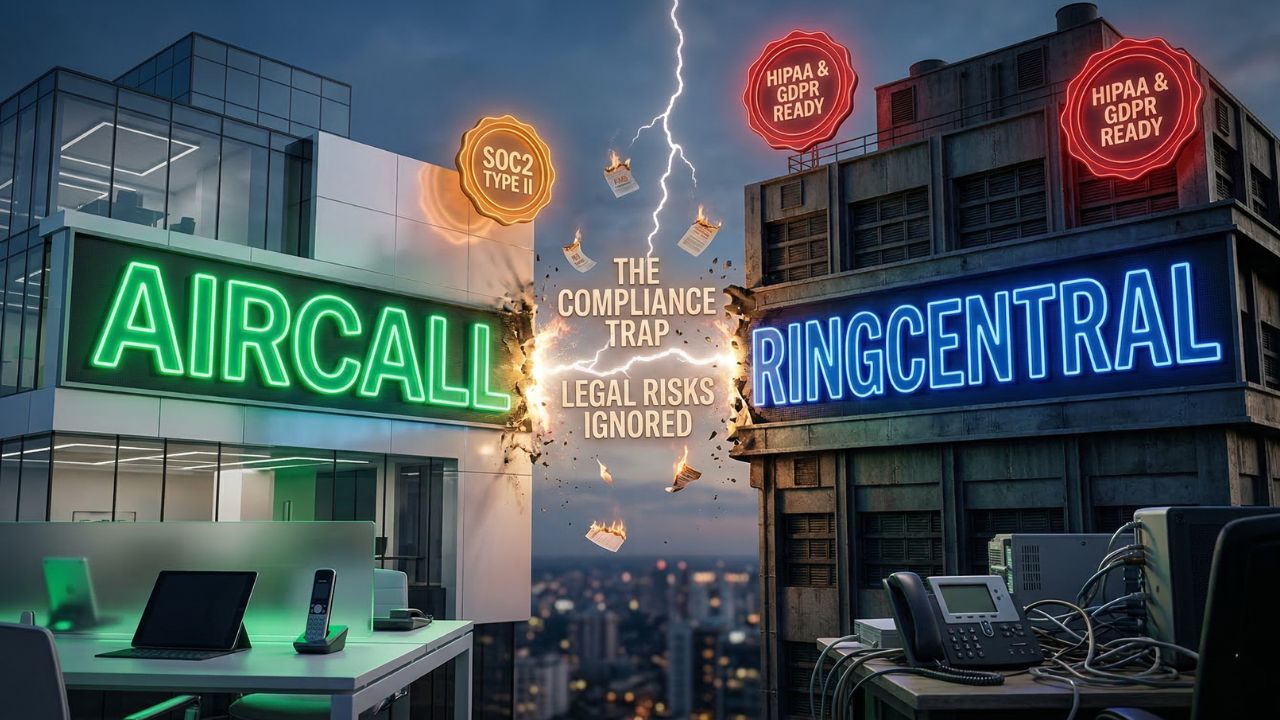
- The Compliance Gap: Aircall's standard SOC2 Type II certification may fall drastically short for healthcare or strict finance sectors requiring deep HIPAA BAAs.
- Enterprise Scale: RingCentral's legacy telecom infrastructure safely handles massive, multi-departmental call routing where nimbler SaaS platforms can crash under localized API limits.
- AI Transcription Accuracy: RingCentral delivers superior multi-language transcription for complex technical jargon compared to Aircall's lighter conversational UI focus.
- Deployment Speed: Aircall deploys in days for agile teams, whereas RingCentral rollouts can take months across large 1,000+ person organizations.
Legacy telecom players are slapping "AI" labels on outdated infrastructure, leaving enterprise buyers vulnerable to massive compliance fines and fragmented data silos.
The standard Aircall vs RingCentral debate focuses almost entirely on software interfaces, dashboards, and basic click-to-call mechanics—while willfully ignoring the critical legal risks associated with global AI call recording and natural language processing.
As detailed in our master guide on 5 AI VoIP Traps: CloudTalk vs Aircall vs RingCentral, choosing a system without verifying its regulatory architecture can cost your organization millions in penalties when a localized agent hallucinates or breaches geographic privacy boundaries.
Beyond the Interface: The Architecture Clash
When evaluating communication infrastructure at scale, usability and raw, unyielding power are often at odds. The fundamental architectures of these two platforms are designed for entirely different operational realities.
Aircall offers an incredibly intuitive interface designed for rapid team onboarding. Its webhook architecture is famously simple to plug into standard tech stacks. It excels in mid-market environments where ease of use and quick CRM connectivity dictate the daily workflow for SDRs and support agents.
However, implementing RingCentral across a 1,000-person organization involves complex routing logic, strict role-based access control (RBAC), and significantly longer deployment times. RingCentral remains the "safe" bet for massive global enterprises precisely because of this robust, heavy-duty architecture that can absorb peak call bursts without dropping a single API payload.
If your primary focus is sheer outbound speed and power dialing rather than enterprise-wide, multi-departmental routing, you may actually be looking at the wrong comparison entirely. Discover why latency matters in our breakdown of Why Your CloudTalk vs Aircall Choice Ruins SDR Quotas.
To avoid severe tech debt, engineering leaders must evaluate these telephony architectures with the same rigor they use when establishing an Enterprise AI Governance Framework.
What Most Teams Get Wrong about Aircall vs RingCentral
The most pervasive error IT directors make is treating VoIP software like a standard SaaS application. They assume that if a platform can transcribe a call and summarize it using a generic LLM API, it successfully checks the "AI-first" box on the procurement checklist.
The real risk in the Aircall vs RingCentral comparison isn't about subjective features; it’s about rigid compliance. Enterprise buyers must be hyper-aware of exactly where and how AI call recordings are processed, tokenized, and stored.
RingCentral’s long-standing legacy as a telecommunications giant gives it a distinct edge in navigating the incredibly complex legal landscape of global call recording, dual-party consent notifications, and data residency restrictions. Their infrastructure was built to satisfy government regulators first, and agile software developers second.
Aircall primarily focuses on SOC2 Type II compliance. While excellent for general SaaS, e-commerce, and standard B2B sales, it may not be legally sufficient for organizations managing highly sensitive medical data or financial records. For a deeper look at the risks of deploying non-compliant SaaS in regulated environments, review our audit on Is Carepatron HIPAA Compliant?.
Expert Insight: The Data Residency Audit
Never assume your AI VoIP tool automatically meets regional data residency laws right out of the box. Before signing a multi-year enterprise contract, your legal and engineering teams must demand a "Data Residency Audit" to verify exactly which cloud server farm processes your AI sentiment analysis and transcription payloads.
If raw transcripts cross international borders without proper endpoint encryption, you are violating the GDPR, HIPAA, and emerging regulations like the DPDP Act simultaneously. To stress-test these vulnerabilities, leading organizations are increasingly utilizing AI Red Teaming Servicesto discover injection flaws before hackers do.
Enterprise VoIP AI & Compliance Matrix
| Evaluation Criteria | Aircall Capabilities | RingCentral Capabilities |
|---|---|---|
| Primary Target | Mid-Market SMBs | Global Enterprise |
| Core AI Strength | Accessible Sentiment Analysis | Multi-Language Technical Transcripts |
| Highest Compliance | SOC2 Type II | Global Telco Grade (HIPAA/GDPR BAAs) |
| System Complexity | High ease of use / Rapid setup | Complex, multi-departmental workflows |
The AI Integration Reality Check
Even if your compliance posture is ironclad, your internal AI models are only as intelligent as the data they can access. Many revenue operations teams find that while a telephony system might technically authenticate with their CRM, it fails to synchronize critical conversational data consistently under high call volume.
A 10-minute delay in transcription logging isn't just an administrative annoyance; it creates a blind spot for your automated marketing triggers. If your VoIP fails to log an angry call to your CRM in real-time, your automation sequences might accidentally send that infuriated customer a cheerful "How did we do?" email, exacerbating churn.
Furthermore, without a pristine, instantaneous data feed, you are starving your internal AI models. These systems require a steady diet of accurate outcome data to learn which conversational tactics actually close deals. If you deploy autonomous systems without securing this data pipeline, you face a 100% liability shift for their mistakes, a reality detailed in our breakdown of the Secure Intelligence Institute's autonomous agent warnings.
RingCentral handles complex data mapping and bulk API requests beautifully, but it requires dedicated Salesforce administrators to configure effectively. Aircall, conversely, offers a lighter, highly effective integration that smaller teams can activate without tapping into precious IT engineering hours.
Conclusion: Securing Your Enterprise Stack
Do not let sleek software interfaces and aggressive marketing blind your procurement team to underlying infrastructure limitations.
If your business operates in highly regulated sectors (like healthcare, finance, or government contracting) or manages thousands of global endpoints that demand absolute 99.999% uptime, RingCentral's complex, carrier-grade architecture is the mandatory path.
However, if you require agility, rapid SaaS deployment, tight budget control, and an intuitive UI above all else to scale a fast-moving sales team, Aircall wins handily.
Audit your specific compliance requirements and API rate limits today to avoid catastrophic data leaks and silent revenue loss tomorrow.
Optimize your VoIP stack with advanced automation. Try CloudTalk AI

We may earn a commission if you buy through this link. (This does not increase the price for you)
Frequently Asked Questions (FAQ)
Yes, RingCentral's massive feature set and implementation timeline can overwhelm small businesses. Aircall provides a highly intuitive interface built for rapid onboarding, making it the superior choice for mid-market SMBs lacking dedicated IT administrators.
RingCentral excels in enterprise AI, offering advanced multi-language transcripts and complex omnichannel routing. Aircall focuses on accessible sentiment analysis, which is excellent for team workflows but lacks RingCentral's technical jargon accuracy.
RingCentral's enterprise pricing often includes hidden costs for premium support tiers, advanced AI add-ons, and global termination fees. However, its robust infrastructure offsets these costs by preventing massive financial losses associated with downtime at enterprise scale.
Aircall delivers excellent quality for standard operations. However, RingCentral’s legacy telecommunications network provides a more resilient, carrier-grade infrastructure that handles extreme multi-departmental call volumes without localized latency issues.
RingCentral is significantly better for massive omnichannel support. It offers complex AI routing designed to handle extensive enterprise flows across global teams, whereas Aircall is primarily optimized for routing within shared team inboxes.
Yes, RingCentral typically offers robust transcription features tailored for large-scale enterprise needs. Its AI integrates directly into its global infrastructure, resulting in superior accuracy for complex technical jargon and diverse international accents.
Aircall focuses on SOC2 Type II compliance. This secures standard data operations but may fall short for healthcare or financial organizations requiring strict HIPAA BAAs, where RingCentral’s telco-grade compliance offers stronger legal protection.
Aircall is designed for quick adoption and can be deployed across a team in a matter of days. Conversely, implementing RingCentral across a 1,000-person organization involves complex routing logic and takes significantly longer.
While both connect to major software, RingCentral is generally the preferred choice for deeply embedded enterprise integrations. Its robust architecture supports complex data mapping and global PBX routing directly within large-scale unified communication environments.
Yes, migration is typically straightforward. Aircall’s agile SaaS platform allows for fast workflow configuration, but number porting timelines depend strictly on international telecom regulations and how deeply your current system is integrated.
Sources & References
- External Sources
- NLPearl: "The Legal Landscape of AI Phone Agents in Outbound & Inbound Calling"
- Ecosmob: "7 Proven Strategies to Implement VoIP High Availability Solutions Successfully"
- Internal Sources
- 5 AI VoIP Traps: CloudTalk vs Aircall vs RingCentral
- Why Your CloudTalk vs Aircall Choice Ruins SDR Quotas