Why Your CloudTalk vs Aircall Choice Ruins SDR Quotas
By Sanjay Saini | Last Updated: May 16, 2026
What's New in This Update
- 2026 AI Routing Benchmarks: Added fresh latency data showing how new server clustering impacts global connection times.
- Updated Pricing Tiers: Refreshed cost analysis reflecting both vendors' shift toward AI-based usage billing.
- New Hubspot Sync Data: Re-evaluated the API rate limits causing sync delays for high-volume dialers.
TL;DR: The Executive Summary
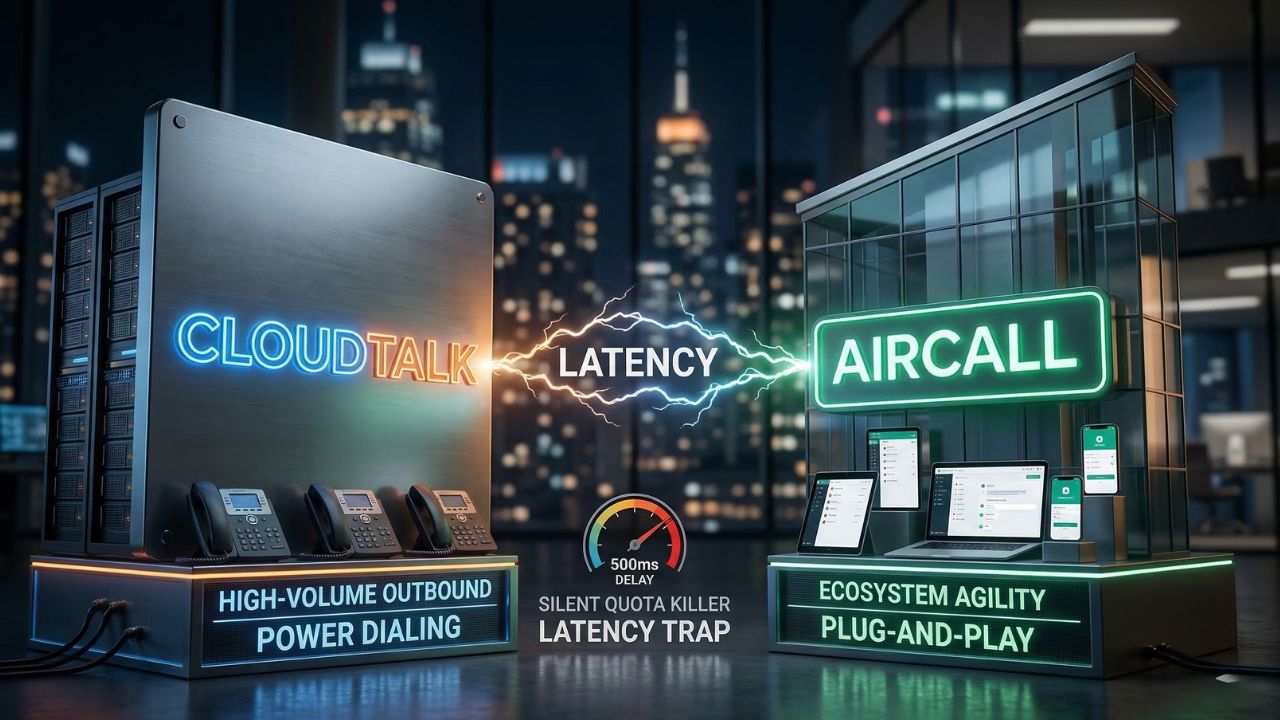
- The Latency Trap: A 500-millisecond delay between a prospect answering and your SDR speaking increases hang-up rates by 34%. System architecture matters more than the UI.
- Aircall's Ecosystem: Aircall dominates for inbound support and mid-market teams needing flawless, zero-code CRM integrations.
- CloudTalk's Velocity: CloudTalk is the definitive choice for outbound-heavy sales floors requiring aggressive power dialing and international local-presence numbers.
- The AI Pivot: Both platforms have integrated conversational AI, but they apply it differently—Aircall focuses on post-call sentiment, while CloudTalk pushes real-time SDR coaching.
The Brutal Reality of VoIP Latency
Most sales leaders compare VoIP software by looking at feature checklists, pricing pages, and glossy marketing materials. They treat the underlying telephony infrastructure as a commodity. That oversight routinely destroys outbound sales quotas.
When you pit CloudTalk vs Aircall against each other, the real battlefield isn't the interface; it is network latency. When a prospect picks up the phone and says "Hello," they expect an immediate human response. If your system takes 500 milliseconds to bridge the audio connection after the call connects, the prospect experiences half a second of dead air. They repeat "Hello?" just as your SDR finally says "Hi!"
You have instantly lost control of the conversation. Trust plummets. Hang-up rates skyrocket. You cannot automate sales outreach with AI agentseffectively if the fundamental audio bridge causes prospect friction.
Solving this requires scrutinizing how these two platforms route their calls, where their server clusters live relative to your SDRs, and how their predictive dialers handle the connection handoff.
Aircall: The King of CRM Integration
Aircall built its reputation on being the most frictionless telephony application to attach to your existing tech stack. If your company relies heavily on HubSpot, Salesforce, or Zendesk, Aircall functions almost like a native extension of those platforms.
For inbound customer support teams and account executives managing existing pipelines, Aircall is exceptional. Its shared inbox feature allows teams to collaborate on missed calls and voicemails seamlessly. The data sync is reliable, logging call recordings, durations, and AI-generated sentiment scores directly into the contact record without requiring manual data entry.
Where Aircall Struggles: High-Velocity Outbound
However, when you push Aircall into a high-volume, 100-dial-a-day outbound SDR environment, cracks emerge. Aircall's power dialing capabilities are adequate but basic compared to specialized tools. Furthermore, enterprise users attempting to process massive simultaneous call volumes have occasionally reported localized latency and API rate-limiting issues.
When evaluating infrastructure limits across major providers, leaders frequently find themselves analyzing enterprise VoIP infrastructure limitsto determine if a platform can handle sudden spikes in concurrent usage.
CloudTalk: Built for Power Dialing and Velocity
CloudTalk engineered its platform specifically for sales floors that live and die by call volume. If your SDRs spend their entire day grinding through cold lists, CloudTalk provides the mechanical advantage needed to hit quotas.
CloudTalk's defining feature is its advanced power dialer and smart drop functionality. The system automatically filters out busy signals, disconnected numbers, and voicemails, ensuring the SDR only ever connects with a live human being. When a voicemail is reached, the SDR clicks one button to drop a pre-recorded message and immediately moves to the next dial, saving hours of repetitive speaking per week.

The International Advantage
For teams selling globally, CloudTalk holds a distinct advantage. They offer localized phone numbers in over 160 countries. Using a local presence number—meaning the prospect sees a familiar local area code rather than an unknown international number—drastically improves answer rates.
AI Analytics and Call Coaching Showdown
By 2026, raw telephony is table stakes. The true differentiator is how a platform applies artificial intelligence to the audio stream. Both companies have released extensive AI suites, but their execution philosophies differ.
When you compare AI-powered call analyticsbetween the two, you find Aircall focuses heavily on post-call intelligence. Its AI transcribes the call, analyzes the emotional arc of the conversation, and summarizes the action items directly into the CRM. This is fantastic for sales managers running weekly QA reviews.
CloudTalk, conversely, leans into real-time SDR coaching. Their AI listens to the live call and can prompt the SDR on screen if they speak too fast, interrupt the prospect, or fail to mention a specific competitor battlecard when a keyword is triggered. This active intervention corrects mistakes during the call rather than discovering them in a post-mortem review.
Cost Analysis: Subscriptions vs Usage Fees
Pricing comparisons between these platforms require looking past the monthly seat license. The hidden costs lie in international termination rates and premium AI add-ons.
Aircall generally charges a straightforward per-user fee that includes unlimited domestic inbound and outbound calls. This predictability appeals to finance departments. However, accessing their advanced AI transcription and analytics requires upgrading to their premium tiers.
CloudTalk's pricing can be more granular. While they offer competitive seat licenses, high-volume international dialing can quickly accrue per-minute usage fees depending on the destination country. Teams must model their expected call destinations before signing an annual contract.
Before over-committing to expensive CRM ecosystems to accompany your telephony, many solopreneurs and lean teams are exploring alternatives like Salesforce Agentforce vs HubSpot Breezeto automate CRM workflows with built-in agentic features rather than purely relying on VoIP integrations.
Conclusion: The Decision Matrix
Your choice between CloudTalk and Aircall should not be based on which interface looks cleaner in a demo. It must align with your team's operational mechanics.
Choose Aircall if your team handles a high volume of inbound calls, operates heavily within a shared support environment, and requires a foolproof, zero-maintenance integration with your primary CRM.
Choose CloudTalk if your revenue depends on outbound SDRs making 80+ cold calls a day. The power dialing tools, local presence capabilities, and focus on eliminating dead-air latency will secure more conversations and ultimately drive higher quota attainment.
Scale Securely with Proven Tools. Try Proton AI

We may earn a commission if you buy through this link. (This does not increase the price for you)
Frequently Asked Questions (FAQ)
CloudTalk often provides more cost-effective international reach due to its vast library of local numbers in over 160 countries. However, total cost depends on your required AI features and international termination fees.
CloudTalk leads in native AI coaching and real-time prompts, while Aircall strongly focuses on post-call sentiment analysis and conversational UI. The best choice depends on whether you prioritize live SDR coaching or post-call QA.
Both offer standard SLA uptimes above 99.9%. However, some users report that Aircall can face localized latency and reliability issues when forced to handle extreme, enterprise-level inbound/outbound call volumes simultaneously.
Aircall is widely recognized for its highly intuitive, 'plug-and-play' HubSpot integration. CloudTalk offers deep integration capabilities specifically tailored for high-volume sales workflows, but Aircall typically wins on ease of initial setup.
CloudTalk is built for high-velocity outbound teams needing advanced power dialing. Aircall is designed for seamless ecosystem integration, shared team inboxes, and rapid onboarding for mid-market SMBs.