Key KPIs for Global Capability Centers performance measurement: 7 Metrics You’re Ignoring
Quick Summary: Key Takeaways
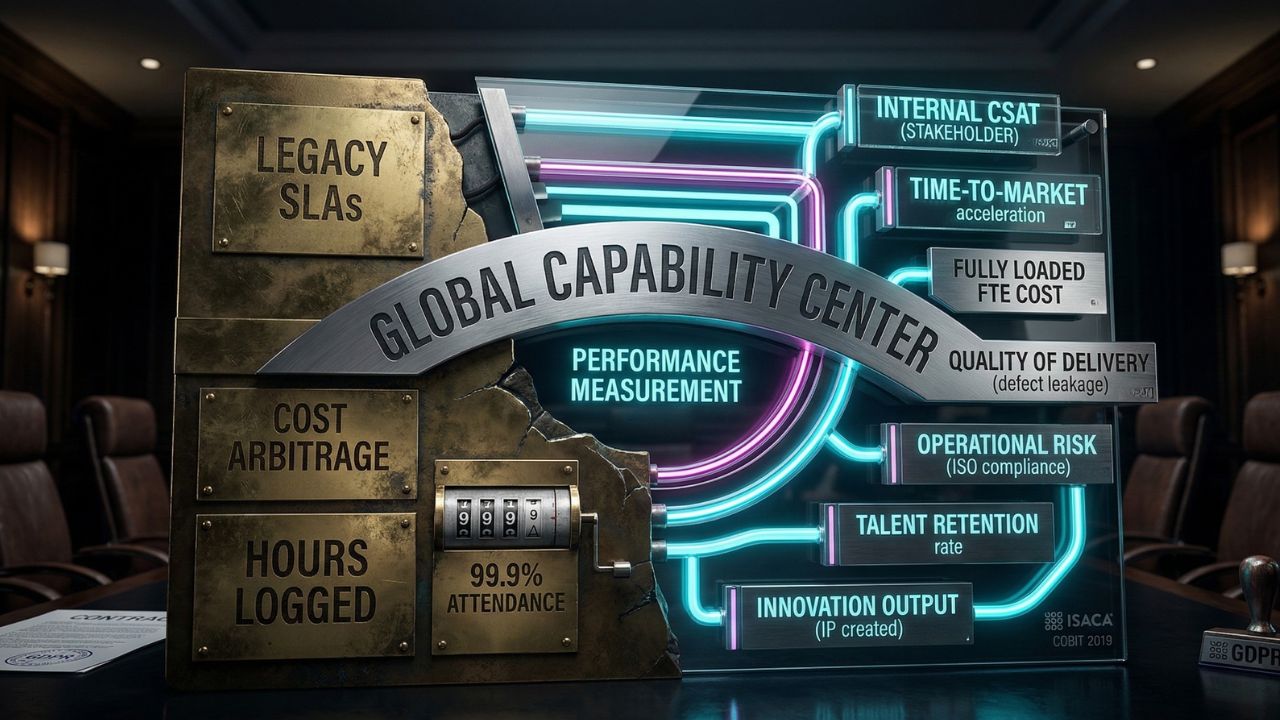
- Outdated metrics kill value: Stop relying solely on legacy SLAs and basic cost arbitrage.
- CSAT is non-negotiable: Internal stakeholder satisfaction defines your center's true impact.
- True cost matters: Fully loaded FTE costs reveal the hidden drain on your offshore ROI.
- Quality over quantity: First-time-right delivery metrics prove mature operational excellence.
- Value creation is paramount: You must track innovation output, not just hours logged.
Mastering the Key KPIs for Global Capability Centers performance measurement is the only way to prove ROI to your enterprise board. If you are only tracking surface-level operational health, you are leaving millions on the table and risking offshore obsolescence.
This deep dive is part of our extensive guide on GCC performance KPIs: The $100M Mistake Sinking Offshore Value in 2026. To transform your center into a high-value innovation engine, you must urgently integrate these seven overlooked metrics into your global dashboards.
The 7 Critical Metrics for Offshore Success
Your board expects outcomes, not just effort. It is time to elevate your reporting beyond basic attendance and ticket resolution. Here are the seven crucial metrics you must start tracking today.
1. Internal Customer Satisfaction (CSAT)
Measuring internal customer satisfaction (CSAT) for a GCC is the ultimate test of your center's integration. If the headquarters views the offshore hub as difficult to work with, financial savings are irrelevant.
Track this by: Conducting quarterly pulse surveys with onshore project managers to evaluate communication, agility, and partnership quality.
2. Time-to-Market Acceleration
How fast is your offshore team turning ideas into deployable corporate assets? Tracking time-to-market improvements in a GCC requires analyzing the cycle time from project intake to final delivery.
Centers that shrink product development cycles are immediately recognized as strategic growth drivers rather than mere support staff.
3. True Cost per FTE (Fully Loaded)
Calculating the true cost per FTE in a GCC goes far beyond base salaries and standard benefits. You must factor in infrastructure, software licenses, management overhead, and hidden training costs.
A transparent, fully loaded cost metric prevents budget shocks and provides an honest baseline for ROI calculations.
4. Quality of Delivery
Volume means nothing if the output requires constant onshore rework. Measuring quality of delivery in a GCC involves tracking defect leakage rates, code rollback frequency, and first-time-right approvals.
High quality scores directly correlate with operational maturity and enterprise trust.
5. Standard Operational Risk
Operating across borders introduces significant systemic vulnerabilities. The standard metric for measuring GCC operational risk evaluates your compliance with data privacy laws and business continuity readiness.
To ensure your risk profile meets international expectations, review our insights on benchmarking GCC performance against global standards.
6. Talent Retention Rate
High turnover destroys institutional knowledge and drastically inflates your recruiting costs. A good talent retention rate for an offshore center generally hovers above 85%, depending on the local tech market dynamics.
You must track annualized voluntary attrition and implement aggressive upskilling programs to keep your best people.
7. Innovation Output
Are your offshore teams simply keeping the lights on, or are they generating new intellectual property? You must track the percentage of hours dedicated to process automation and enterprise transformation.
To dive deeper into making this transition, read our guide on GCC cost savings vs value creation metrics.
Conclusion: Elevating Your Offshore Strategy
Setting up a balanced scorecard for a Global Capability Center ensures these metrics work together harmoniously. You must align financial efficiency with undeniable operational excellence to justify your offshore footprint.
Tracking the right Key KPIs for Global Capability Centers performance measurement is the blueprint for thriving in 2026.
Optimize Your Code with Blackbox AI. Try HeyGen AI

We may earn a commission if you buy through this link. (This does not increase the price for you)
Frequently Asked Questions (FAQ)
The top KPIs include internal customer satisfaction (CSAT), fully loaded cost per FTE, time-to-market acceleration, talent retention, and innovation value creation.
Quality is measured by tracking defect leakage rates, first-time-right delivery percentages, and the reduction of required onshore rework.
Critical financial metrics include the true cost per FTE, budget variance, ROI on new technology investments, and overall enterprise cost avoidance.
CSAT is measured through structured quarterly surveys and net promoter scores (NPS) gathered from the onshore business leaders and project stakeholders.
A strong retention rate typically exceeds 85%, though this varies by region; tracking voluntary versus involuntary turnover is key to assessing culture.
Track the average cycle time from initial project request to final deployment, monitoring the velocity of sprints and milestone completions.
Operational excellence is proven by high SLA compliance, minimal system downtime, rapid incident resolution, and consistent adherence to global IT standards.
Combine the employee's base salary with taxes, benefits, real estate overhead, software licensing, hardware, and management expenses to find the fully loaded cost.
Risk metrics include the frequency of security incidents, compliance audit scores (like ISO or GDPR), and business continuity recovery time objectives.
Design a scorecard that equally weighs four quadrants: financial performance, internal customer satisfaction, internal process quality, and organizational learning/growth.
Sources & References
- ISO/IEC 20000-1 - Information technology — Service management
- COBIT 2019 Framework - ISACA
- GCC performance KPIs: The $100M Mistake Sinking Offshore Value in 2026
- GCC cost savings vs value creation metrics
- Benchmarking GCC performance against global standards
External Industry Standards:
Internal Deep Dives: