Human-in-the-Loop Approval for AI Agents
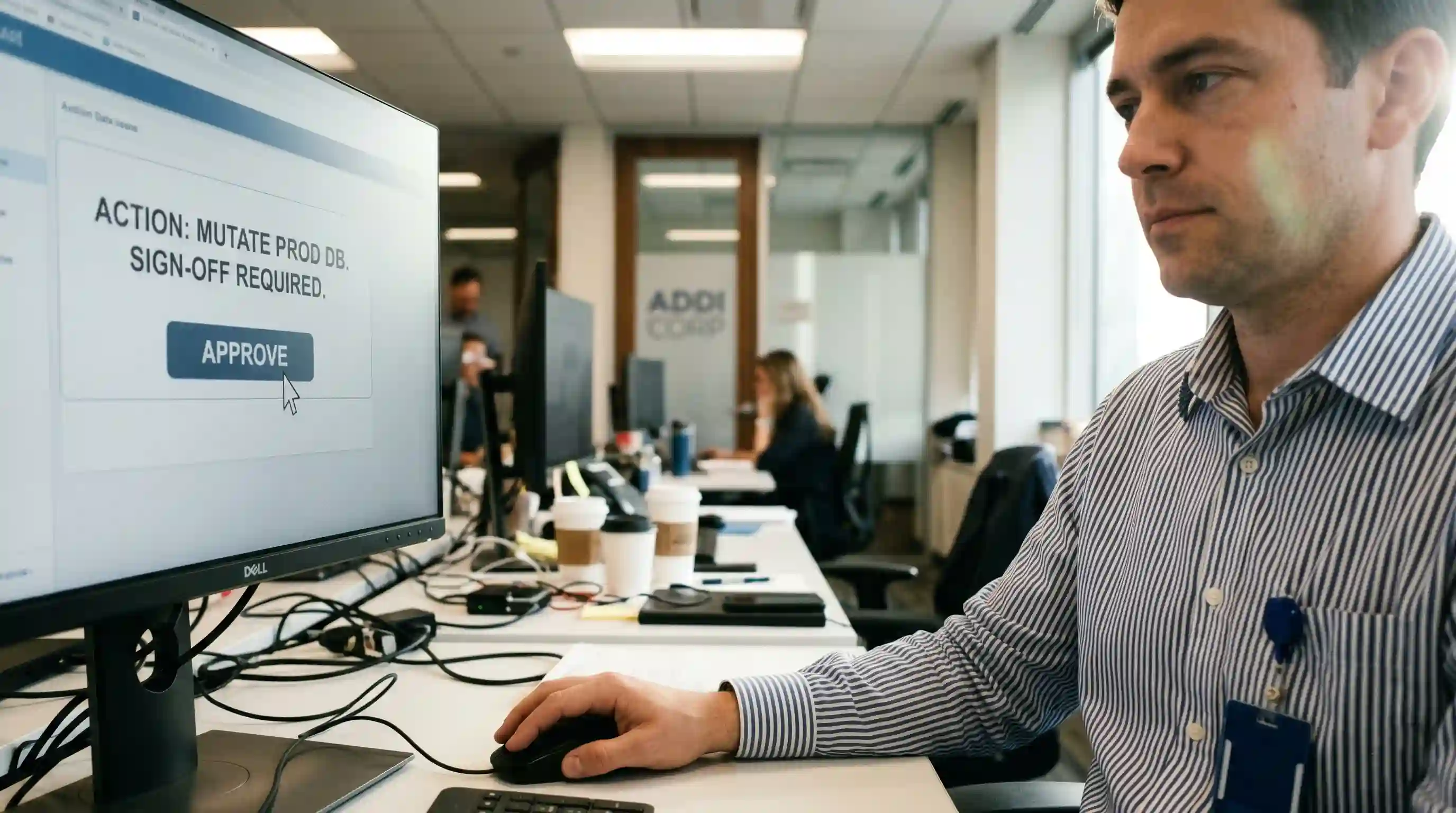
- Approval Gates: Mandatory pauses embedded in an AI's execution graph that require a human operator's manual sign-off before proceeding.
- Risk Tiers: Actions are classified into distinct autonomy levels (Auto, Notify, Require Approval) to maintain speed while ensuring safety.
- Audit Trails: Every approval or rejection is logged immutably, providing a clear history of human oversight for enterprise compliance.
- Escalation Logic: Guardian agents act as the primary triage mechanism, actively deciding when a worker agent's proposed action is too risky to auto-approve.
Full autonomy is rarely the goal in high-stakes enterprise environments; the true objective is reliable, secure augmentation.
To prevent catastrophic systemic errors, engineering teams must add human-in-the-loop agent approval gates before agents act.
These approval gates form the backbone of modern AI governance, ensuring that autonomous systems remain compliant and safe.
This architecture relies heavily on the oversight provided by guardian agents.
By enforcing strict boundaries on what an AI can execute independently, organizations protect their databases, clients, and reputations without sacrificing the speed of autonomous research and drafting.
Understanding Human-in-the-Loop Agent Approval
Human-in-the-loop (HITL) agent approval is an architectural pattern that intercepts an AI agent's execution trajectory.
Instead of allowing an agent to chain tools continuously until a task is finished, the system intentionally suspends the state graph.
The agent proposes an action—like dropping a database table or sending a mass email—and waits.
A human operator reviews the proposed payload, context, and intent. If the human approves, the agent resumes execution. If rejected, the agent receives feedback and must generate a new plan.
The Autonomy-Tier Decision Table
To prevent human operators from becoming a bottleneck, organizations must implement an autonomy-tier decision model. Not every action requires an approval gate.
Implementing a tier system ensures that agents maintain their velocity for routine tasks while securing critical infrastructure.
- Tier 1 (Auto-Execute): Low-risk actions, such as internal web scraping, querying vector databases, or drafting internal documentation. The agent acts instantly.
- Tier 2 (Execute & Notify): Medium-risk actions, such as creating a Jira ticket or summarizing meeting notes. The agent executes the task but sends an asynchronous webhook (e.g., a Slack message) detailing the action.
- Tier 3 (Require Approval): High-risk actions, such as mutating production SQL databases, transferring funds, or sending external emails to clients. The agent pauses entirely until manual sign-off is granted.
How Guardian Agents Drive Escalation Paths
How do approval gates actually trigger in a dynamic multi-agent system? This is where the oversight layer becomes essential.
Guardian agents are programmed with your enterprise's specific risk thresholds. When a worker agent completes a plan, it submits it to the guardian.
The guardian evaluates the semantic risk of the proposed tool call. If the action crosses into Tier 3 territory, the guardian automatically triggers the escalation path.
It intercepts the execution, serializes the graph state, and alerts the designated human owner, detailing exactly why the action requires review.
Maintaining a Secure Audit Trail
Regulatory compliance demands more than just a momentary approval; it requires a permanent, verifiable record.
When establishing human-in-the-loop agent approval, the system must log every facet of the interaction.
You must capture the original user prompt, the agent's proposed tool payload, the timestamp of the pause, and the specific identity of the human who clicked "Approve."
This data ensures that if an incident occurs, security teams can definitively trace the error back to either an AI hallucination or a human misjudgment.
Tools and Frameworks for Approval Workflows
Modern stateful orchestration frameworks natively support these approval pauses. They handle the complex backend work of freezing a process in memory and resuming it hours later.
To understand the governance policies that dictate these workflows, consult our complete playbook on enterprise AI governance frameworks.
If you are a developer looking for the exact code implementation to build these pauses, do not write it from scratch.
Instead, follow our dedicated LangGraph human-in-the-loop tutorial to see how to trigger node interruptions programmatically.

Frequently Asked Questions (FAQ)
It is a governance mechanism where an AI agent's execution is intentionally paused before executing a critical tool or action. The system waits for a human operator to manually review, approve, or reject the proposed action before continuing.
Approval is mandatory for irreversible, high-risk actions. Examples include executing raw SQL queries on production databases, sending emails to external clients, deleting cloud infrastructure, or finalizing financial transactions.
A centralized state graph tracks the progress of all agents. Before a high-risk node executes, a conditional edge interrupts the graph, saving the current state to a database. Execution resumes only when an external API call confirms human authorization.
Categorize all available agent tools into risk tiers (Auto, Notify, Require Approval). Configure your routing logic so that any tool call tagged as high-risk automatically triggers a webhook to a human operator's dashboard or Slack channel.
Guardian agents evaluate the worker agent's proposed action against a set of predefined corporate policies and semantic risk prompts. If the proposed action is deemed destructive or touches sensitive data, the guardian routes it to the approval queue.
Utilize state checkpointers (like PostgreSQL) to log every graph transition. When an approval occurs, record the state ID, the exact payload the agent proposed, the human reviewer's user ID, and the cryptographic timestamp of the decision.
It only slows down the specific high-risk execution. Because you layer this with an autonomy-tier model, low-risk research and data aggregation happen instantly. The pause only occurs precisely when security supersedes speed.
Any action that mutates external state must be gated. This includes UPDATE, INSERT, or DELETE commands in databases, pushing code to production repositories, provisioning paid cloud resources, and external client communications.
A guardian agent is an AI that supervises other AI, catching logical errors autonomously. HITL is a structural pause requiring an actual human being. Guardians often act as the triage layer that decides when to trigger a HITL pause.
LangGraph is the industry standard for this, utilizing its interrupt_before functionality and persistent checkpointers. Other enterprise platforms, such as LangSmith and specialized governance tools, provide the UI dashboards needed for humans to review these pauses.