Guardian Agents: How AI Supervises AI in Production
- Guardian Layer: A specialized agent role that monitors worker agents, validates intermediate outputs, and enforces governance constraints probabilistically.
- Supervisor-Worker Pattern: The dominant orchestration model (via LangGraph/CrewAI) where a single supervisor agent routes tasks to specialized worker nodes.
- Defense in Depth: Deterministic guardrails prevent syntax errors, while guardian agents catch semantic hallucinations and logic loops.
- Kill Switches: Essential circuit breakers that halt execution when token spend or recursive depth exceeds safe thresholds.
Deploying autonomous AI agents into production without oversight is a recipe for cascading failures and blown API budgets. When a worker agent hallucinates a tool input or gets stuck in a recursive loop, traditional application monitoring often cannot detect the semantic failure until the damage is done. As detailed in our anchor piece on Guardian / Supervisor Agents, the solution is implementing guardian agents—a robust agent oversight layer designed to supervise, route, and halt autonomous systems in real time.
By enforcing the supervisor-worker pattern, engineering teams can safely scale multi-agent architectures. This guide breaks down how to architect guardian agents, wire up human-in-the-loop approvals, and deploy kill switches that guarantee your AI agents stay on track.
1. What Is a Guardian Agent? The AI Oversight Layer
A guardian agent is an AI entity explicitly provisioned to supervise other AI agents rather than executing end-user tasks. In a multi-agent system, workers execute code, query databases, or draft emails, while the guardian sits one layer above, analyzing execution traces and tool calls for policy violations.
Without an oversight layer, agents fail silently. A worker might repeatedly query a database with the wrong schema, burning context window limits without triggering a standard HTTP 500 error. Guardian agents solve this by providing semantic observability—evaluating the meaning of an agent's trajectory, not just its HTTP status.
For a deep dive into definitional mechanics and the exact capabilities of an oversight layer, read our breakdown of what a guardian agent is. If you are still mapping out your base architecture, consult our AI agent framework decision matrix to see which orchestration tools best support multi-layer oversight.
2. The Supervisor-Worker Agent Pattern
The most reliable topology for production oversight is the supervisor-worker pattern. In a flat swarm, agents communicate peer-to-peer, making it nearly impossible to debug execution graphs or enforce strict state boundaries. The supervisor-worker model routes all communication through a central node.
The supervisor acts as the router. It receives the user prompt, breaks it into sub-tasks, delegates them to specialized workers (e.g., a "Research Agent" and a "Coding Agent"), and evaluates the returning payloads. If a worker times out or returns garbage data, the supervisor can retry the task or escalate it.
Learn how to implement task routing and handle worker failures in our guide to the supervisor-worker agent pattern, and explore alternative topologies in our best AI agent orchestration frameworks for 2026.
3. Building a LangGraph Supervisor Agent
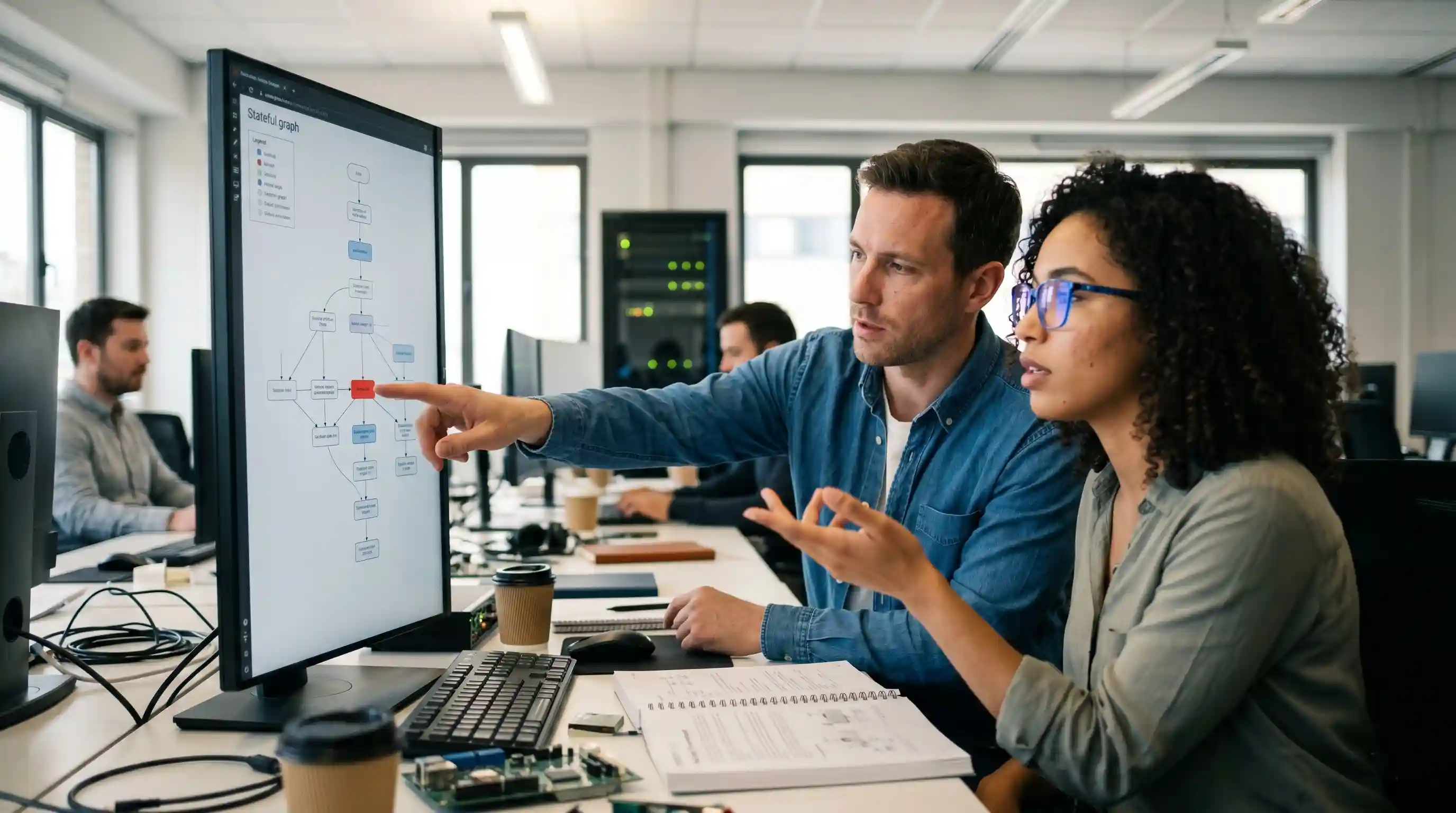
Frameworks like LangGraph treat agents as nodes in a stateful graph, making it trivial to inject supervisor and guardian checkpoints. Because LangGraph forces explicit edge routing, you can design a supervisor node that definitively controls which worker acts next based on the current graph state.
By leveraging state checkpointing, the supervisor can pause execution, record the history to a database, and wait for external validation. This fundamentally solves the "black box" problem of autonomous execution, allowing engineers to replay failed trajectories exactly as they happened.
To see the exact code for routing nodes and handling timeouts, follow our LangGraph supervisor agent tutorial. For deep implementation details on state management, review our rollback and checkpoint pattern for LangGraph, and integrate it with our LangGraph human-in-the-loop tutorial.
4. Information Gain: Guardrails vs Guardian Agents
A frequent anti-pattern is assuming that configuring NeMo Guardrails or LLM-Guard eliminates the need for a guardian agent. These two concepts solve entirely different problems and must be layered together for defense in depth.
Guardrails are deterministic. They enforce hard, fast rules: "Block this output if it contains a social security number" or "Fail the request if it exceeds 4,000 tokens". They are cheap, fast, and binary. Guardian agents are probabilistic. They evaluate complex semantic intent: "Did the research agent actually answer the user's question, or did it just summarize an irrelevant Wikipedia page?".
Read our full comparison matrix in guardrails vs guardian agents, and learn how to configure the deterministic layer via our Agent HQ guardrails setup guide.
5. Human-in-the-Loop (HITL) and Enterprise Approval
Full autonomy is rarely the goal in enterprise environments; reliable augmentation is. For high-stakes actions—like executing destructive SQL queries, sending customer emails, or provisioning cloud infrastructure—the guardian agent must escalate to a human.
An effective HITL architecture uses the guardian agent to triage. The guardian determines the risk tier of the worker's proposed action. If the action is low-risk, it auto-approves. If it hits a predefined risk threshold, it pauses the graph state and sends an asynchronous webhook to a human operator (e.g., via Slack or Teams) for review.
We outline the escalation paths and autonomy tiers in our guide to human-in-the-loop agent approval. Ensure your strategy aligns with broader compliance mandates using our enterprise AI governance frameworks playbook.
6. Detecting Runaway Agents and Kill-Switches
The most expensive failure mode in agentic AI is the runaway loop. A worker agent encounters an error, the LLM hallucinates a fix that causes another error, and the agent rapidly loops—burning thousands of API tokens per minute.
Guardian agents must implement circuit breakers. By monitoring graph depth (number of sequential hops) and cumulative token spend per session, the guardian can trip a kill-switch before the budget explodes. If a worker fails to resolve a tool error after three attempts, the guardian forcefully terminates the session.
Learn how to detect loops and enforce limits in our playbook on how to detect and stop runaway AI agents. Supplement this with our technical guides on building an AI kill switch, configuring circuit breakers for swarms, and debugging silent tool failures.
7. The 2026 Agent Oversight Tool Landscape
You do not need to build an oversight dashboard from scratch. In 2026, the observability stack has matured to natively support multi-agent tracing, token cost attribution per agent, and visual graph debugging.
Platforms like LangSmith and Langfuse excel at tracing individual LLM calls, while AgentOps provides dedicated primitives for tracking agent sessions, tool failures, and supervisor routing logic. Selecting the right tool depends heavily on whether you are using LangChain, AutoGen, or custom Python orchestration.
Compare the leading platforms in our roundup of the best AI agent oversight tools, and see our deep-dive LangSmith vs Langfuse vs AgentOps comparison. Finally, secure your deployments using our AI agent observability playbook.
Want to audit your current agent architecture? Use the OWASP LLM Self-Assessment Tool to identify critical oversight gaps in your production environment.

Frequently Asked Questions (FAQ)
A guardian agent is an AI specifically designed to supervise other AI agents. Instead of executing user tasks, it monitors worker agents for hallucinations, logical loops, and policy violations, intervening to correct errors or halt execution before damage occurs.
Regular (worker) agents focus on generating content, writing code, or querying databases to solve a user's prompt. Guardian agents focus strictly on evaluation, governance, and routing—analyzing the outputs of worker agents against predefined safety and quality criteria.
Multi-agent systems are highly non-deterministic. Without oversight, a worker agent might fail silently, hallucinate incorrect tool parameters, or enter an infinite loop of retries. Oversight prevents these failures from corrupting production databases or exhausting API token budgets.
The most common is the supervisor-worker pattern, where a central supervisor routes tasks to specialized workers and evaluates their output. Other patterns include peer-review swarms, hierarchical DAGs (Directed Acyclic Graphs), and human-in-the-loop (HITL) approval gates.
No. Guardrails are deterministic, rule-based constraints (e.g., blocking regex patterns or max token limits). Guardian agents are probabilistic; they use LLM reasoning to evaluate the semantic intent and quality of another agent's plan before allowing execution.
LangGraph is currently the industry standard for supervisor architectures due to its stateful graph approach. CrewAI also natively supports hierarchical processes with manager agents. AutoGen supports custom supervisory patterns via group chat manager roles.
As enterprise AI adoption shifts from copilots to autonomous agents, the oversight and observability market is expanding rapidly. Purpose-built platforms for agent tracing, like AgentOps, alongside governance features in LangSmith, represent a rapidly growing enterprise software category.
The biggest failure mode is supervisor overload, where a single guardian is tasked with managing too many workers, degrading its reasoning context. Other failures include infinite retry loops between supervisor and worker, and excessive token spend on evaluation.
For high-risk operations—like mutating a production database or sending external client emails—guardian agents absolutely require human-in-the-loop integration. The guardian acts as a triage layer, auto-approving safe tasks and pausing execution to request human sign-off for critical actions.
If using a graph framework like LangGraph, insert a new evaluation node directly after your worker nodes. Configure graph edges so worker outputs must pass through the guardian node for validation before the final response is delivered to the user.