Are Home Robots Safe? The Risks No Demo Shows
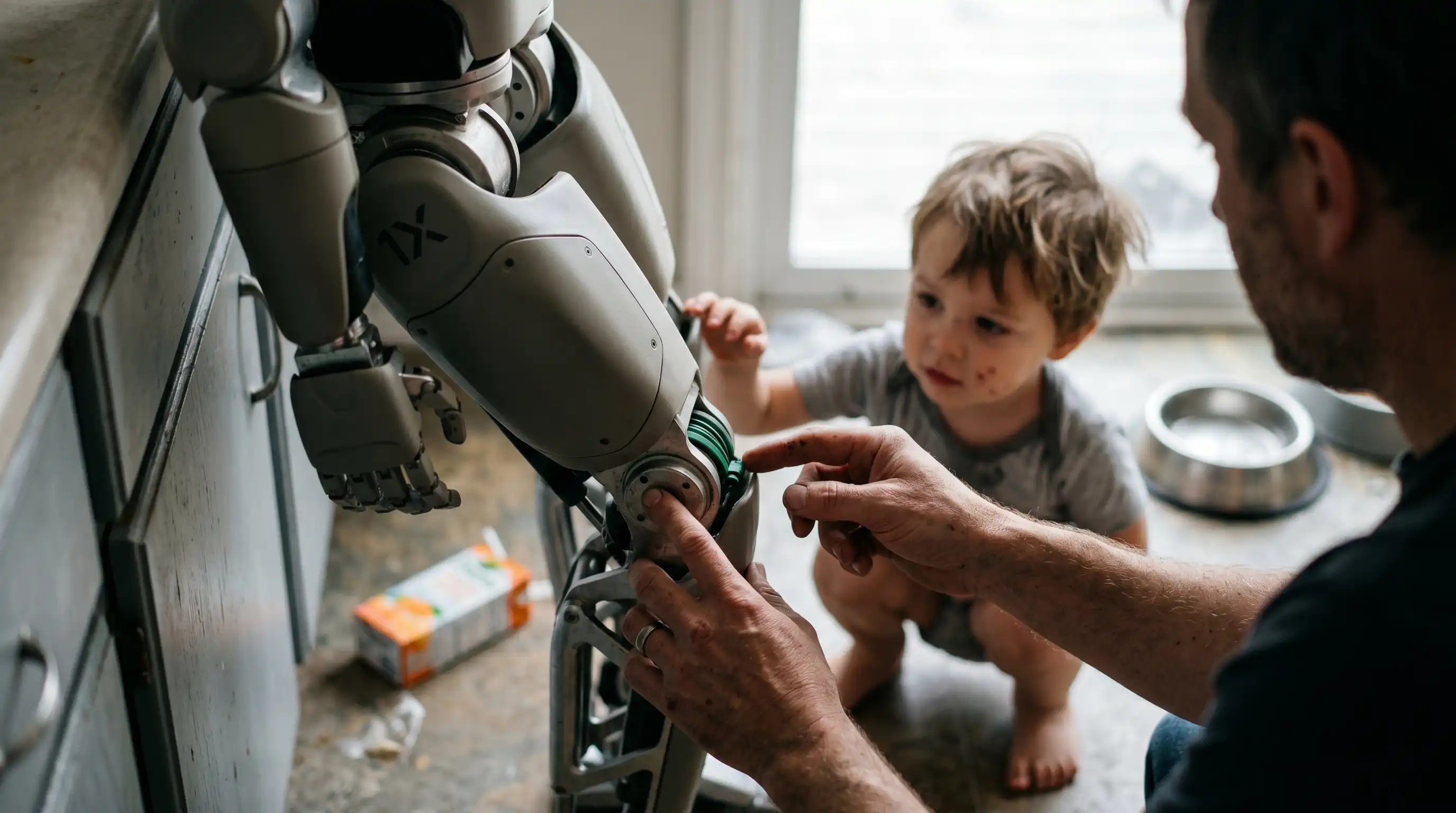
- Kinetic Energy Impacts: Total physical mass dictates impact severity, making lighter frameworks inherently less hazardous in sudden collisions.
- Joint Compliance Dynamics: Systems built with series elastic actuators dramatically lower crushing forces compared to rigid industrial gear trains.
- Thermal Management: High-capacity lithium batteries present active thermal runaway risks during high-amp overnight charging cycles.
- Network Exploitation Surfaces: Unencrypted local network ports expose video streams and physical control systems to potential lateral cyber attacks.
Are home robots safe? A 30–68kg machine moving near kids and pets carries risks the glossy demos skip—physical, data, and fire. As autonomous machinery shifts from isolated industrial cells directly into unstructured domestic environments, evaluating core mechanical and algorithmic risk variables becomes a foundational safety requirement.
Before implementing these systems near family members, it is vital to review our cornerstone operational framework: Home Humanoid Robots 2026: Buy Now or Wait?
Understanding the broad market readiness curve allows early adopters to manage emerging hardware vulnerabilities effectively. The core issue is that consumer humanoids are not merely software appliances.
They are heavy kinetic systems operating via complex actuators, dense lithium-based battery packs, and constantly active cloud communication channels.
The Kinetic Reality: Physical Mass and Actuator Mechanics
Mass vs. Velocity: Calculating Impact Energy in the Living Room
To accurately answer if are home robots safe, users must analyze kinetic energy formulas. The physical energy transferred during an accidental collision is determined by the standard kinetic energy equation:
Ek = ½mv2Evaluating a heavy platform like the 60 kg Figure 03 moving at a standard human walking pace of 1.5 m/s reveals an impact energy profiles of 67.5 Joules. By contrast, the 30 kg 1X NEO moving at identical velocities generates exactly 33.75 Joules of kinetic energy.
This lower mass profile directly reduces the mechanical force applied during an unexpected stumble, which significantly decreases injury risks around fragile surfaces, toddlers, or companion animals.
Series Elastic Actuators vs. Rigid Gears: How Joint Compliance Saves Limbs
Industrial robots rely on rigid planetary gearboxes designed to maintain absolute positional accuracy under heavy payloads. If a human arm blocks that path, the rigid joint will push forward with full motor torque, causing severe crushing injuries.
Consumer-first platforms mitigate this hazard by deploying series elastic actuators (SEAs) or direct-drive motor configurations. SEAs place a physical spring element between the motor gears and the output joint.
This spring acts as a mechanical shock absorber. When the limb strikes an unexpected obstruction, the spring deflects instantly, allowing the onboard sensors to detect the force spike and shut down joint power before serious injury occurs.
Thermal Dynamics and Battery Hazards under the Chassis
Lithium-Ion Thermal Runaway Risks in Overnight Charging Docking Stations
Operating a human-scale machine requires substantial electrical power, necessitating high-capacity lithium-ion battery configurations. These multi-cell packs store immense energy and operate under high thermal stress during continuous chore routines.
The primary fire hazard occurs during fast-charging cycles at overnight docking stations. If internal separators experience manufacturing defects or micro-punctures from high-stress movements, a short circuit can trigger thermal runaway.
Once thermal runaway begins, individual cells rapidly self-heat past 180°C, releasing toxic gases and causing adjacent cells to ignite. Automated docking bases must feature physical containment shields and localized circuit isolation breakers to suppress early internal battery fires.
Passive Metallic Chassis Cooling vs. Active Forced Air Fans
Managing internal component temperatures requires robust thermal architectures. Platforms with metallic frames often use the external shell as a giant passive heat sink.
While this approach prevents fan noise, it can cause the robot's outer skin to reach uncomfortable temperatures during heavy lifting tasks.
Systems using active, forced-air cooling fans maintain lower surface temperatures but require continuous air filter maintenance to prevent dust blockages inside residential spaces.
Cybersecurity Vulnerabilities: The Mobile Sensor Exploitation Surface
Unsecured Local MQTT Protocols and Compromised API Endpoints
Humanoid platforms are highly sophisticated mobile data-collection systems. They use multiple high-definition cameras, wide-angle microphones, and depth sensors to map your home layout in real time.
Security concerns arise if the internal communication paths rely on unencrypted protocols like default MQTT messaging. If a malicious actor compromises your local Wi-Fi network, they can intercept these unencrypted data streams.
This vulnerability could allow an attacker to view live navigation feeds or extract detailed 3D maps of your home. Protecting this data requires manufacturers to enforce end-to-end local encryption on all internal diagnostic connections.
Remote Operator Hijacking and Firmware Side-Channel Attacks
Because modern consumer platforms use cloud-assisted teleoperation for complex tasks, they contain native pathways for external control. This design introduces a critical threat vector: remote operator hijacking.
If an attacker compromises a manufacturer’s cloud infrastructure, they could theoretically gain control of active units. For a deep look at the data protections required to block these specific remote exploits, see our dedicated security review: neo robot privacy teleoperation analysis.
Regulatory Landscape: Compliance Protocols and Global Standards
ISO 13482 and UL 3300: What Certifications Actually Mean for Consumers
Buyers should not assume that a retail consumer humanoid meets standard home safety criteria by default. The primary global framework governing these systems is ISO 13482, which regulates personal care robots and mobile servant platforms.
This standard mandates strict validation testing for autonomous obstacle avoidance, emergency stop limits, and skin temperature safety thresholds.
Complementing this is the emerging UL 3300 safety standard, designed specifically for consumer service devices. When evaluating new models, verify they carry verified certifications from independent testing bodies like TÜV or UL.
Avoid importing uncertified developer kits, as they often skip these automated fallback systems and collision testing protocols.
Conclusion & CTA
Evaluating whether are home robots safe requires looking past basic marketing demos to inspect joint mechanics, battery cooling systems, and network data encryption layers.
Choosing platforms built with lightweight frames and compliant actuators minimizes physical kinetic risks, while running the hardware on secure, isolated networks blocks cyber vulnerabilities.
To monitor ongoing updates on consumer safety standards, regional data compliance policies, and automated home technologies, track our core repository: AI Living, Smart Homes & Robots hub.

Frequently Asked Questions (FAQ)
They are reasonably safe by design, but require close supervision. Lighter models like the 30 kg NEO use soft materials and compliant joints to reduce impact force. However, any large moving machine can drop objects or miscalculate a path, making direct supervision around toddlers essential.
Yes, a mechanical system can cause injury if its safety sensors fail. Heavy platforms carrying rigid gear assemblies can deliver high crushing forces during mechanical glitches. It is vital to maintain clear pathways and verify joint compliance systems are active.
Standard navigation systems use depth sensors to identify dogs and cats, but sudden movements can confuse the AI. Smaller animals face tripping or pinching hazards near moving joints, so it is best to restrict robot operations to spaces clear of loose pets.
Modern systems feature multi-layered safety tools, including immediate emergency stop switches, touch-sensitive outer skins, and torque-limiting joint software. They also let users map out digital boundaries to keep the unit away from hazardous zones like staircases.
Yes, balancing on two legs in unpredictable home environments introduces falling risks. If a robot slips on a rug or loses power, its mass will collapse along its gravity vector, making it important to keep the machine away from seating or sleeping areas.
High-capacity lithium batteries present minor fire risks if the internal cells suffer damage or overheat during charging cycles. Using certified charging docks equipped with built-in thermal sensors and circuit protection helps minimize these hazards.
When internal diagnostics detect a motor or sensor fault, the system triggers an automated safe-state lockdown. This protocol cuts power to the main actuators and applies mechanical brakes to freeze the joints, preventing erratic or unsafe movements.
Yes, any internet-connected device is vulnerable to network cyber attacks if left unsecured. Hackers could theoretically access camera feeds or send unauthorized movement commands, which makes strong network firewalls and multi-factor authentication mandatory.
Yes, emerging frameworks like ISO 13482 and UL 3300 set clear safety guidelines for personal care and domestic service robots. Consumers should check for these official safety certifications to ensure the hardware includes certified collision prevention systems.
Weights vary drastically based on design philosophy, ranging from lightweight 30 kg soft-body systems up to heavy 60 kg or 68 kg industrial-grade metal frames. Total mass directly impacts the machine's safety profile and handling needs within residential spaces.