HLE Benchmark vs LMSYS Arena Rankings: Vibe vs. Verifiable Logic
Quick Summary: Key Takeaways
- Methodology Gap: HLE uses verifiable, expert-level logic, while LMSYS relies on subjective human preference (ELO).
- Predictive Power: Human preference (vibes) in chat interfaces often fails to predict performance in hard reasoning.
- "Sounding" Smart vs. Being Smart: Models frequently rank high on LMSYS due to helpful "vibes" but fail rigorous HLE logic tests.
- Developer Trust: While LMSYS tracks user satisfaction, HLE is the trusted standard for technical accountability and professional-grade reasoning.
Introduction: Why Popularity Isn't Reasoning
Comparing the HLE benchmark vs LMSYS arena rankings is essential for understanding the difference between user preference and hard reasoning.
This deep dive is part of our extensive guide on Humanity's Last Exam Leaderboard 2026.
In 2026, many models achieve high ELO ratings by being polite or helpful. However, the HLE benchmark vs LMSYS arena rankings reveal that "sounding smart" does not guarantee a model can solve a complex, multi-step logic problem.
Understanding the Methodology: Logic vs. ELO
The primary differentiator in the HLE benchmark vs LMSYS arena rankings is how success is measured.
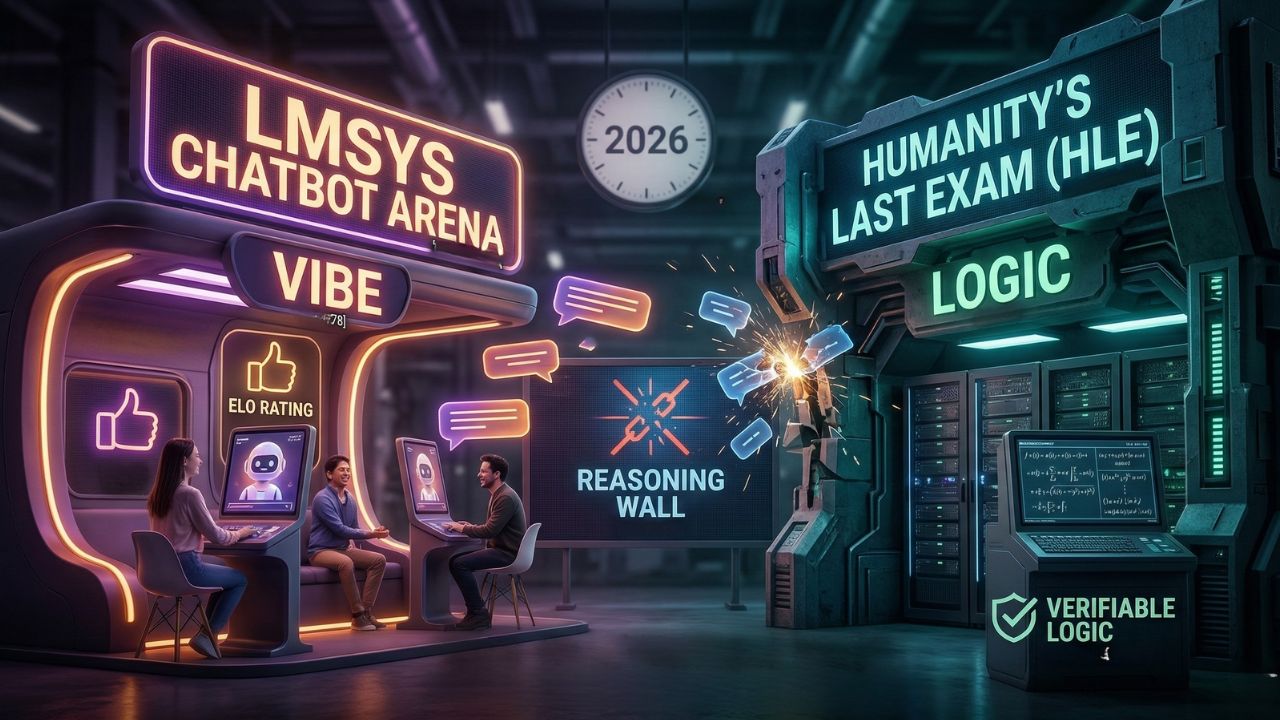
LMSYS uses a "blind test" where humans vote on which model gave a better response. This is essentially the LMSYS: The "Vibe" System.
- Subjective Ranking: Based on human preferences, which can be swayed by formatting or tone.
- Elo Ratings: High scores reflect a model's ability to satisfy general user queries.
- Limited Math Testing: Standard users rarely test the "impossible" math found in frontier models.
HLE: The Verifiable System
- Objective Logic: Questions have one verifiable, expert-level correct answer.
- Contamination-Proof: Designed so models cannot rely on memorized training data.
- Deep Reasoning: Models must show "System 2" thinking to succeed.
For a closer look at how models struggle with these objective logic tests, see the Gemini 3 pro hle benchmark score exact.
Why Top Models Often Clash in Rankings?
It is common to see a model rank in the top three on LMSYS but fall into the bottom half of the Humanity's Last Exam leaderboard 2026.
This occurs because human preference cannot accurately predict performance in niche scientific fields or advanced logic. Developers who prioritize B2B ROI often look past the "fan favorite" status of a model.
Instead, they use the HLE answer key and dataset for developers to verify that a model's logic is sound before deployment.
Comparison: HLE vs. LMSYS
| Feature | HLE Benchmark | LMSYS Chatbot Arena |
|---|---|---|
| Primary Methodology | Verifiable, expert-level logic | Subjective human preference (ELO) |
| Measurement Goal | Objective Logic: Questions have one verifiable correct answer | Vibe System: Measures user satisfaction |
| Testing Style | Contamination-Proof: Prevents data memorization | Blind Test: Users vote on anonymous responses |
| Cognitive Requirement | Requires "System 2" thinking | Rewards politeness and helpfulness |
| Math & Science | Includes "impossible" math problems | Limited math testing by standard users |
| Predictive Power | High for deployment readiness | Low for hard reasoning tasks |
| Primary Audience | Developers & Enterprises (B2B ROI) | Consumer-facing applications |
Conclusion: Verifiable Logic Over "Vibes"
The HLE benchmark vs LMSYS arena rankings prove that in 2026, professional-grade AI requires more than just high user satisfaction scores. While LMSYS is excellent for measuring conversational appeal, HLE is the only way to verify true intelligence.
Trusting a model because of a "vibe" is a risk that most enterprises can no longer afford. As we move toward more autonomous systems, verifiable logic must remain the gold standard for performance evaluation.
Scale Securely with Proven Tools. Try Blackbox AI

We may earn a commission if you buy through this link. (This does not increase the price for you)
Frequently Asked Questions (FAQ)
HLE is a verifiable logic test focusing on expert-level reasoning. LMSYS is a preference-based system where humans vote on responses, creating an "ELO" rating based on user satisfaction rather than technical accuracy.
Accuracy depends on the goal. ELO scores accurately reflect how much people like interacting with a model. HLE scores are a more accurate measure of a model's ability to solve complex, novel logic and math problems.
A model may rank high on LMSYS because it "sounds" smart and is helpful to general users. However, it may rank low on HLE because it lacks the "System 2" thinking required to solve expert-level reasoning tasks.
No, HLE is strictly based on verifiable logic. Every question in the HLE dataset has a specific, expert-level answer that must be reached through sound reasoning rather than pattern matching.
Rarely. Human preference tends to favor models that are articulate and polite, while HLE performance requires deep technical knowledge and multi-step deductive reasoning that general users do not typically test.
While some users may input math problems, LMSYS is not structured for systematic, expert-level math testing. HLE specifically includes a dataset of "impossible" math problems to test the limits of AI reasoning.
Sources & References
- Humanity's Last Exam Leaderboard 2026
- Gemini 3 Pro HLE Benchmark Score Exact
- HLE Answer Key and Dataset for Developers
- UK AI Regulation White Paper : Accountability and Redress in AI
- ISO/IEC 42001:2023 : Information technology — Artificial intelligence — Management system
- IEEE Standard 7001-2021 : Transparency of Autonomous Systems
Internal Resources:
External Authority Links: