Humanity's Last Exam Leaderboard 2026: Why No AI Can Score 100%
Quick Summary: Key Takeaways
- The End of Memorization: HLE is designed to be "contamination-proof," meaning AI cannot win by simply scraping its own training data.
- Reasoning Over Vibes: While models might "feel" smart in a chat, HLE proves that expert-level logic is still a massive hurdle for even the top 1% of LLMs.
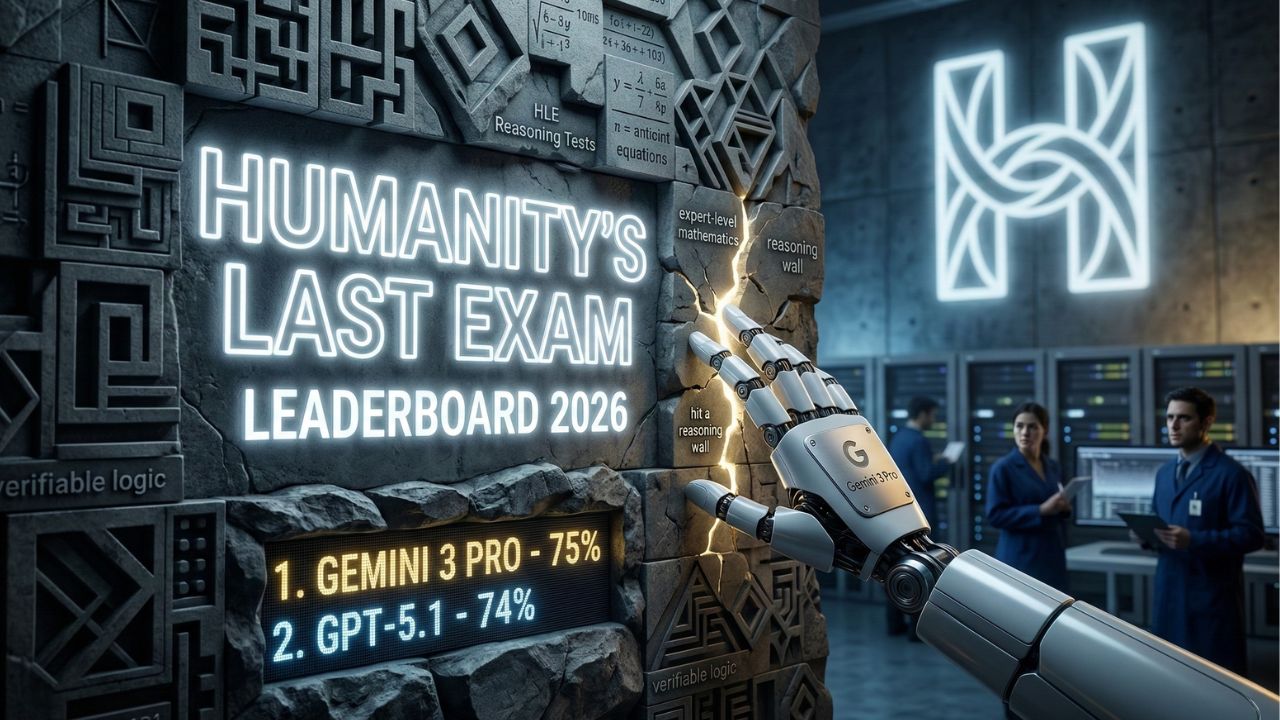
- Gemini 3 Pro Performance: Google’s flagship model shows promise but still hits a "reasoning wall" in specific high-level subjects.
- New Industry Standard: In 2026, HLE has officially replaced MMLU as the primary metric for "Frontier" model evaluation.
- Compliance Matters: HLE rankings are now integrated into performance evaluations for ISO/IEC 42001:2023 AI management systems.
Keeping a close eye on the humanity's last exam leaderboard 2026 is essential if you want to know which AI models actually "think" versus those that simply "memorize."
If you are relying on yesterday's benchmarks to choose your enterprise LLM, you are essentially using an outdated map for a brand-new frontier.
The Death of MMLU and the Rise of HLE
For years, the industry obsessed over MMLU scores, but that era has officially ended due to benchmark saturation.
Most top-tier models have now "solved" MMLU, making it a poor differentiator for true intelligence.
To understand why this shift occurred, you should read our full analysis on Why MMLU is dead: The rise of HLE reasoning tests.
The HLE benchmark focuses on 5 distinct stages of reasoning that require verifiable logic rather than pattern matching.
Analyzing the Humanity's Last Exam Leaderboard 2026
The current Humanity's Last Exam leaderboard 2026 shows a fascinating and somewhat humbling landscape for AI developers.
Even the most expensive "Deep Think" models are struggling to maintain accuracy across the dataset's complex subject breakdowns.
Google’s latest release has sparked intense debate among researchers. You can find the Gemini 3 pro hle benchmark score exact in our detailed breakdown, which highlights where the model succeeded and where it failed "impossible" math.
- Frontier Models: Most are hovering between 60% and 75% accuracy.
- Reasoning Gap: The distance between AI and human experts remains wide in niche scientific fields.
- Update Frequency: The leaderboard is updated dynamically as new "challenger" models are released.
Vibe Check vs. Verifiable Logic
There is a growing disconnect between how a model ranks in the LMSYS Chatbot Arena and how it performs on HLE.
LMSYS measures "vibes" and user preference, while HLE measures hard, expert-level reasoning.
For a technical comparison of these two evaluation styles, see our guide on HLE benchmark vs LMSYS arena rankings.
It explains why a model might be a "fan favorite" but fail a rigorous logic test.
Developer Resources and Implementation
If you are a developer looking to benchmark your local LLMs, transparency is key to avoiding data contamination.
Ensuring your model can actually solve novel problems is the only way to prove B2B ROI in 2026.
We provide a comprehensive guide on how to access the HLE answer key and dataset for developers.
This includes details on license terms, GitHub availability, and local testing protocols.
Optimize Your Code with Blackbox AI. Try Blackbox AI

We may earn a commission if you buy through this link. (This does not increase the price for you)
Frequently Asked Questions (FAQ)
The 2026 leaderboard tracks the performance of frontier LLMs against a dataset of "impossible" reasoning tasks. It is currently dominated by models like Gemini 3 Pro and GPT-5.1, though no model has yet surpassed the 80% mark on the full expert-level dataset.
Currently, top-tier frontier models are neck-and-neck, with rankings shifting monthly. While Gemini 3 Pro and GPT-5.1 hold the highest positions, their scores fluctuate based on the specific reasoning categories being tested, such as expert-level mathematics or complex logic.
Gemini 3 Pro shows significant breakthroughs in reasoning compared to the 1.5 version, but it still struggles with about 40% of the hardest logic puzzles. It performs exceptionally well in coding but hits a wall in multi-step "impossible" math problems.
HLE is considered harder because MMLU has become saturated; models have essentially memorized the answers. HLE uses "contamination-proof" questions that require original reasoning and multi-step logic, making it a more accurate measure of true intelligence.
Yes, the HLE answer key and dataset are available for researchers and developers. However, users must adhere to specific license terms designed to prevent the data from being leaked into future training sets, which would ruin the benchmark's integrity.
The dataset covers a wide array of expert-level subjects, including advanced mathematics, theoretical physics, ethical reasoning, and complex programming. Each category is designed to test the limits of an AI's ability to apply logic rather than retrieve facts.
The HLE benchmark maintains an open-source ethos to encourage transparency and local testing. Developers can access the dataset on platforms like GitHub to evaluate their own fine-tuned models against the global gold standard for AI reasoning.
The leaderboard is updated in real-time or as soon as new frontier models are verified through a standardized testing process. This ensures that the AI community always has an up-to-date view of which model currently leads in reasoning capabilities.
A 0% score typically indicates a total failure in "System 2" thinking. It means the model is relying entirely on pattern matching and cannot perform the multi-step logical deductions required to solve the benchmark's unique, non-memorized problems.
HLE is a verifiable logic test, whereas LMSYS is a preference-based "ELO" system. A model might rank high on LMSYS because it "sounds" smart (vibes), but rank low on HLE because it cannot solve complex reasoning tasks.
Sources & References
- Gemini 3 pro hle benchmark score exact
- HLE answer key and dataset for developers
- Why MMLU is dead: The rise of HLE reasoning tests
- HLE benchmark vs LMSYS arena rankings
- ISO/IEC 42001:2023: Information technology — Artificial intelligence — Management system
- NIST AI RMF: Artificial Intelligence Risk Management Framework
- IEEE Standard 7001-2021: Transparency of Autonomous Systems
Internal Resources
External Authority Links