Linus Torvalds Just Changed His Mind: Why the Linux Creator Loves "Vibe Coding"

Key Takeaways: Quick Answer
- The News: In early 2026, Linus Torvalds admitted to using AI to write code for a personal project called AudioNoise.
- The Tool: He didn't use Vim for this, he used Google Antigravity (an AI-powered IDE).
- The Quote: He explicitly stated in the project's README that the Python visualizer was "basically written by vibe-coding."
- The Verdict: Linus supports AI for efficiency and learning but remains strictly against "AI slop" in the Linux Kernel.
For decades, Linus Torvalds has been the ultimate gatekeeper of code quality.
Known for his "harshest critic" persona, he famously called AI "90% marketing and 10% reality" in 2024.
But in 2026, something changed. The creator of Git and Linux didn't just tolerate AI, he used it to replace his own manual coding process.
This is a critical turning point in our Guide to Vibe Coding for Developers.
If the man who built the infrastructure of the modern web is "vibe coding," the debate about whether this is a "real" engineering skill is officially over.
The "AudioNoise" Revelation
The controversy started when developers noticed a curious update in the README file of AudioNoise, a hobby project Torvalds created to experiment with digital audio effects.
While he wrote the C-based audio filters manually (his area of extreme expertise), he openly admitted that he had no interest in writing the visualization tools by hand.
Torvalds wrote:
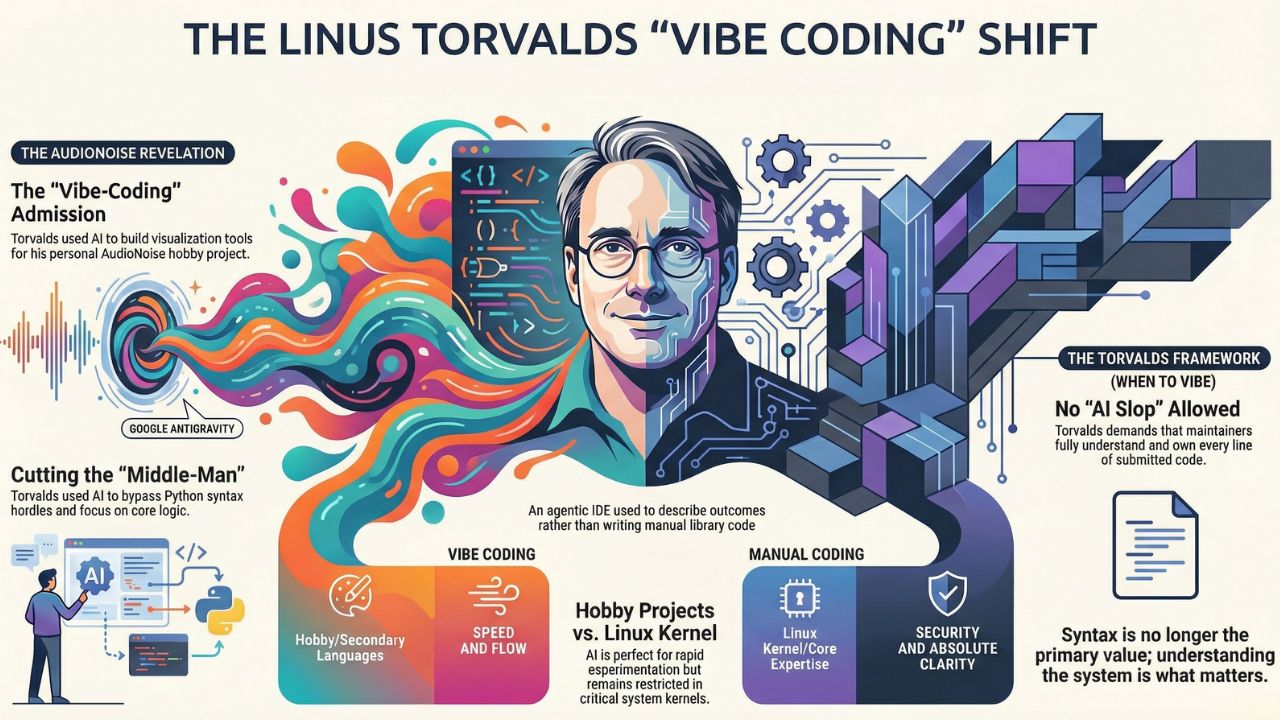
"Also note that the python visualizer tool has been basically written by vibe-coding... I cut out the middle-man -- me -- and just used Google Antigravity."
Why this matters?
He admitted ignorance: Linus acknowledged he didn't know Python well enough to write it efficiently.
He chose flow over syntax:Instead of spending hours learning Python syntax, he let the AI handle the implementation details so he could focus on the logic of the sound waves.
He validated the workflow: He didn't check every line of the Python code with the same scrutiny as Kernel code; he trusted the "vibe" enough for the tool to work.
Why the Change? (It’s About Pragmatism, Not Hype)
Linus hasn't suddenly become an AI hype-man. His shift represents the core philosophy of Vibe Coding using AI to bypass the "boring" parts of engineering to get to the result faster.
Torvalds referred to himself as the "middle-man" between the idea and the code. For languages he knows inside-out (like C), he is a fast middle-man.
For languages he doesn't use often (like Python), he is a slow middle-man. AI removes that bottleneck.
It is crucial to note that Linus draws a hard line at the Linux Kernel. For Hobby Projects: "Vibe coding" is perfect. It allows for rapid experimentation and learning.
For the Kernel: He has explicitly banned "AI slop", code generated without understanding. He recently stated that documentation cannot fix bad AI code; only competent maintainers can.
Note: If you are choosing between tools for your own workflow, check out our comparison of Cursor vs Copilot to see which one aligns with the "Torvalds Workflow."
The Tool He Used: Google Antigravity
Interestingly, Linus didn't use the standard tools most developers expect. He specifically mentioned Google Antigravity.
What is it? A fork of the Windsurf IDE (itself based on VS Code) that focuses heavily on "agentic" coding, where the AI takes over entire file generation tasks.
Why he liked it: It allowed him to describe the outcome (a visualizer for audio frequencies) without getting bogged down in libraries like Matplotlib or NumPy.
This endorsement serves as a massive validation for agentic IDEs over simple autocomplete plugins.
Conclusion: The Green Light for Pragmatists
Linus Torvalds "vibe coding" does not mean he accepts bad code. It means he accepts that syntax is no longer the primary value metric for developers.
If you are a Junior Developer, this is your signal. You don't need to memorize every library. You need to understand the systems well enough to know when to let the AI take the wheel.
The takeaway? Code by vibe when you can, but code by logic when you must.

Frequently Asked Questions (FAQ)
No. He said AI is useful for "cutting out the middle-man" in languages or tasks where the developer is less proficient.
He still believes human expertise is required for critical infrastructure like the Linux Kernel.
AudioNoise is a personal hobby repository created by Linus Torvalds in 2026 to experiment with digital audio effects and guitar pedals.
It became famous because he used it to publicly admit to "vibe coding."
He is extremely skeptical of "AI slop" in the Kernel.
While he doesn't ban AI tools outright (viewing them as tools like compilers), he demands that the submitter fully understands and owns the code. You cannot blame the AI for bugs in the Kernel.
Sources and References
- Linus Torvalds on AI Coding
- Cursor vs. Copilot Comparison
- Official GitHub Repository: Vibe Coding & Flow State Engineering Playbook
- ZDNET : "Even Linus Torvalds is vibe coding now”
- The Register/Phoronix : "Linus Torvalds: The AI Slop Issue Is NOT Going To Be Solved With Documentation"
- GitHub (AudioNoise) : Torvalds' personal repository where he documents using Google Antigravity
- Linus Torvalds on Vibe Coding
Internal Resources:
External References: