Vibe Coding 101: How AI is Replacing Syntax with Intuition in 2026

Key Takeaways: What You Will Learn
- The Definition: Why "Vibe Coding" is the shift from writing syntax to guiding logic.
- The Endorsement: Why Linux creator Linus Torvalds believes this is the future of programming.
- The Tech Stack: How tools like Cursor AI and GitHub Copilot enable this workflow.
- The New Skill: Why "Intuition" and "Taste" are becoming more valuable than memorizing algorithms.
Welcome to the era of Vibe Coding.
For forty years, being a software engineer meant one thing: fighting with syntax.
You had the logic in your head. But to get it into the machine, you had to memorize semicolons, brackets, and boilerplate.
In 2026, that barrier is gone.
Generative AI developer workflows have fundamentally changed the job description.
We are no longer "writers" of code. We are "directors" of it.
You provide the intent (the Vibe). The AI handles the implementation (the Code).
This isn't just a productivity hack. It is a career-altering shift.
Here is your ultimate guide to surviving and thriving in the age of intuition-based programming.
What is "Vibe Coding" Exactly?
It sounds like a meme, but it is a serious technical evolution.
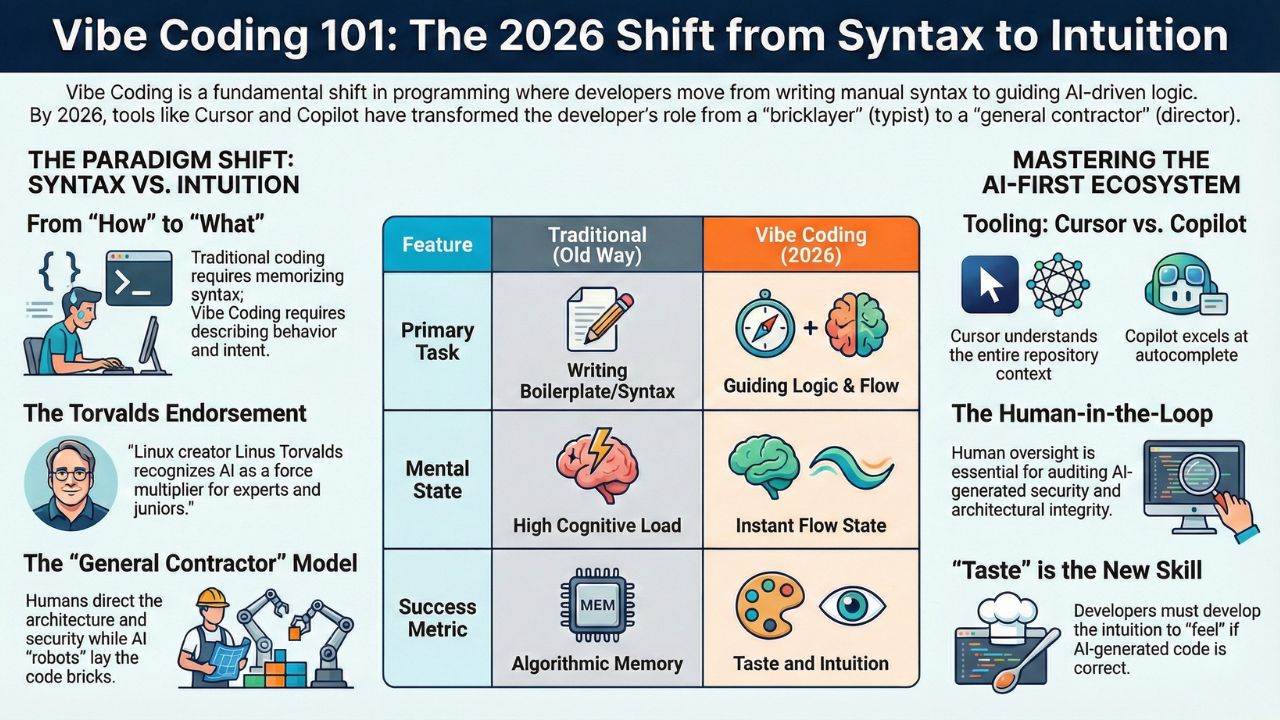
Vibe Coding is the practice of using Large Language Models (LLMs) to handle the implementation details of software while the human developer focuses purely on high-level architecture and logic.
In the old world (2023 and earlier), if you wanted to build a React component, you typed out the imports, the state variables, and the JSX.
In the Vibe Coding world, you simply describe the behavior you want.
Old Way: Memorizing the syntax for useEffect hooks.
New Way: Asking the AI to "Fetch user data on mount and handle race conditions."
The focus shifts from How (Syntax) to What (Logic).
This allows developers to stay in a permanent "Flow State," moving from feature to feature without getting stuck on missing brackets.
The Linus Torvalds Endorsement
For years, purists argued that AI generated "garbage code."
Then, the boss spoke.
Linus Torvalds, the creator of Linux and Git, and notoriously the harshest critic in tech, came out in support of AI-assisted coding.
He recognized that AI serves as an incredible force multiplier.
It allows experts to verify code faster than they can write it.
And it allows juniors to build things they never could before.
When the guardian of the Linux Kernel says the industry is changing, you listen.
👉 Deep Dive: Read our breakdown of his viral comments in Linus Torvalds Just Changed His Mind: Why the Linux Creator Loves "Vibe Coding".
The Tooling: Cursor vs. Copilot
You cannot Vibe Code in Notepad++.
You need an IDE that understands context.
Right now, the battle is between GitHub Copilot and Cursor AI.
Copilot started the revolution. It is an excellent "autocomplete" that guesses your next line.
But Cursor is different. It is a fork of VS Code that has AI baked into the core.
It doesn't just guess the next line; it understands your entire repository.
You can highlight a bug and ask, "Why is this happening?"
and it scans 50 files to find the root cause.
Choosing the right tool is the difference between fighting the AI and dancing with it.
👉 The Showdown: Which tool fits your flow? Check out our comparison in Cursor vs. Copilot: Which AI Tool Actually Understands Your "Vibe"?.
Engineering "Flow State"
The biggest benefit of Vibe Coding isn't speed.
It is mental clarity.
Traditional coding involves a high "Cognitive Load." You are constantly mentally compiling code, remembering variable names, and looking up documentation.
AI removes that load.
This allows you to enter Flow State instantly.
You stop being a typist and start being an architect.
But this requires discipline. If you let the AI do too much thinking, you lose control of the system.
You need to engineer your workflow to keep the human in the loop where it matters (Logic, Security, Architecture) and keep the AI where it excels (Syntax, Boilerplate, Tests).
👉 The Method: Learn how to structure your day in Flow State Engineering: How to Code 10x Faster Without Burnout.
The Skills Gap: Syntax vs. Intuition
If the AI writes the syntax, what should Junior Developers learn?
Is it worth memorizing LeetCode algorithms in 2026?
The answer is complex.
Syntax is dead. You generally don't need to memorize standard library functions anymore.
But Intuition is King.
You need to develop "Taste." You need to look at AI-generated code and feel if it is wrong.
You need to understand System Design, Security Principles, and Data Structures better than ever.
Because if you don't understand what the AI wrote, you are just a passenger.
👉 Career Advice: Future-proof your resume by reading Is Syntax Dead? Why Junior Devs Need to Master "Vibe" Over Logic.
Conclusion: The Future of the Code
Vibe Coding isn't about being lazy.
It is about being effective.
It elevates the role of the developer from a "Bricklayer" to a "General Contractor."
You are still responsible for the building. But you have an army of robots to lay the bricks.
The developers who embrace Vibe Coding will build unicorns with teams of three people.
The ones who fight it will be left debugging syntax errors in an empty room.

Frequently Asked Questions (FAQ)
While it started as internet slang, it has been adopted to describe "Intuition-based programming," where the developer guides the outcome via natural language rather than rigid syntax.
Yes. AI can hallucinate insecure patterns or use outdated libraries.
That is why "Developer Intuition" and security knowledge are arguably more important now. You must audit the AI's work.
AI replaces the drudgery of junior development. Juniors who refuse to use AI will be replaced.
Juniors who master AI tools will become "Senior" much faster because they can learn from the AI's output.
Sources and References
- Linus Torvalds on AI Coding
- Cursor vs. Copilot Comparison
- Flow State Engineering Guide
- Junior Developer Skills 2026
- Official GitHub Repository: Vibe Coding & Flow State Engineering Playbook
- Linux Foundation: Open Source AI Trends
- Cursor Blog: The Future of AI-First Editors
Internal Resources:
External References: