The Agentic Workflow Nvidia Wants Developers to Master
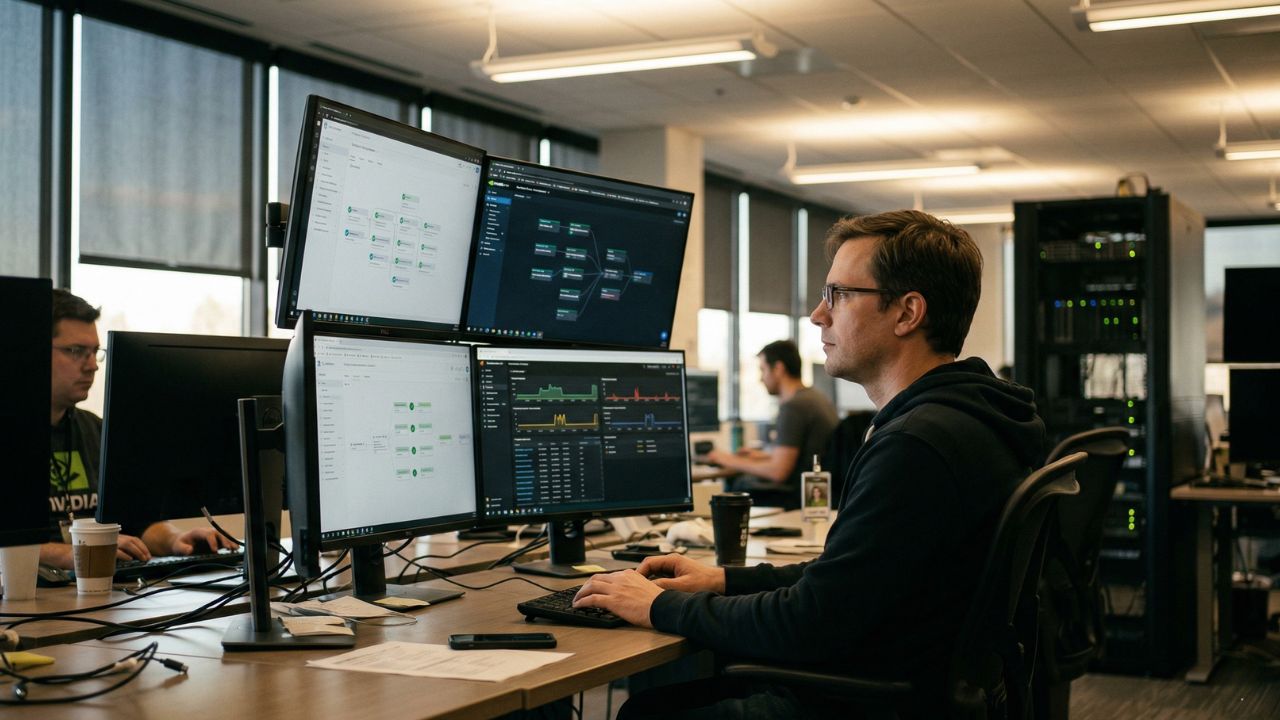
Nvidia CEO Jensen Huang has officially declared the end of traditional programming, confirming that writing manual syntax is a dead-end career path.
Software engineers are no longer being hired to write monolithic boilerplate; they must immediately evolve to architect, govern, and orchestrate distributed swarms of autonomous AI agents.
Quick Facts
- Zero percent coding: Nvidia wants its engineers to spend exactly zero percent of their time writing syntax, focusing entirely on solving undiscovered problems.
- The token mandate: High-earning developers are now expected to burn through hundreds of thousands of dollars in AI compute tokens annually to justify their salaries.
- A new discipline: The industry is moving away from manual typing toward system-level workflow orchestration and strict context engine governance.
- The orchestration hub: Teams must restructure to build an agentic AI coding workflow or risk obsolescence in the token economy.
The End of the Syntax Era
Mainstream reporting treats Nvidia's recent announcements as the death of coding, but it actually signals the birth of a radically different engineering discipline.
The unit of productivity is shifting from lines of code written per day to the volume of AI compute tokens consumed.
At recent industry appearances, Huang pushed a framework called "Purpose vs Task," arguing that manual coding is merely the task, while discovering novel solutions is the actual purpose.
To survive this transition, engineers must stop writing every line themselves and direct fleets of autonomous AI agents to execute complex, multi-step tasks at superhuman speeds.
Mastering the Agent Swarm
The second-order effect of this massive shift is the urgent need for developers to master system-level orchestration.
You can no longer just know Python or C++; you must know how to govern an autonomous workforce.
This involves managing open-source agent platforms like OpenClaw and utilizing frameworks like the NVIDIA Agent Toolkit.
Developers are effectively becoming managers of a machine-driven ecosystem, setting parameters, reviewing outputs, and managing technical debt generated by non-human coders.
"If that $500,000 engineer did not consume at least $250,000 worth of tokens, I am going to be deeply alarmed. This is no different than a chip designer who says 'I'm just going to use paper and pencil.'" — Jensen Huang
The Governance Mandate
Handing over the keys to autonomous agents introduces unprecedented risks to production codebases and enterprise budgets.
Developers who allow agents to run unmonitored risk breaking critical infrastructure and racking up massive cloud bills through infinite looping API calls.
To prevent financial disaster, engineering leaders must implement strict AI agent token cost ROI analysis before scaling their autonomous operations.
It is about balancing the speed of machine execution with hard-coded circuit breakers that stop runaway compute costs.
Why It Matters?
The token economy fundamentally changes what it means to be a valuable software engineer.
Those who stubbornly cling to writing boilerplate will find themselves priced out of the market by peers who command armies of AI workers.
Offshore development centers are already feeling the heat, forcing leaders to transition your offshore hub to an agentic orchestration center to survive.
The engineers who thrive in this new era will be the ones who treat AI agents not as coding assistants, but as a highly scalable digital workforce that requires expert direction.
Frequently Asked Questions
What is the role of a software developer in an AI agent ecosystem?
A developer transitions from a syntax writer to an AI swarm manager, architecting and governing distributed autonomous agents rather than writing monolithic boilerplate code.
How do developers implement autonomous agent orchestration for enterprise apps?
They utilize frameworks like the NVIDIA Agent Toolkit and OpenClaw to set up workflows where agents can perceive, reason, and act on enterprise knowledge with strict human oversight.
What skills are required to manage an Nvidia AI agent swarm?
Engineers need deep expertise in context engine governance, prompt engineering, Agentic FinOps, and the ability to design hard-coded circuit breakers.
How does the shift from writing syntax to agentic workflow management work?
It involves moving away from manual typing and instead focusing on defining the problem, setting the parameters for the AI agents, and reviewing the orchestrated compute outcomes.
What is the difference between an AI coding assistant and an autonomous AI software engineer?
An assistant helps a human write code line-by-line, while an autonomous agent executes multi-step tasks independently in the background, making its own decisions based on a given goal.
How do developers prevent AI agents from breaking production codebases?
By implementing strict context engine governance, adding evaluation guardrails, and utilizing specialized tools like Cisco AI Defense to govern agent actions.
What are the best frameworks for building multi-agent systems?
Currently, developers are leveraging platforms like the NVIDIA Agent Toolkit, OpenClaw, and LangChain to build secure, autonomous enterprise agents.
How will token constraints affect daily software architecture decisions?
Architecture will prioritize token efficiency. Developers must design workflows that minimize infinite looping and optimize API calls to prevent catastrophic compute bills.
Why is context engine mastery more important than traditional programming languages?
Because defining the exact context and rules for an AI model determines the success of the entire workflow, making it a more impactful skill than memorizing syntax.
How do software architects maintain technical debt when using autonomous AI workers?
They must actively monitor agent outputs, regularly refactor AI-generated code, and enforce strict code review protocols before agentic code merges into the main branch.