Agent-to-Agent Communication Workflows: Building the AI Swarm
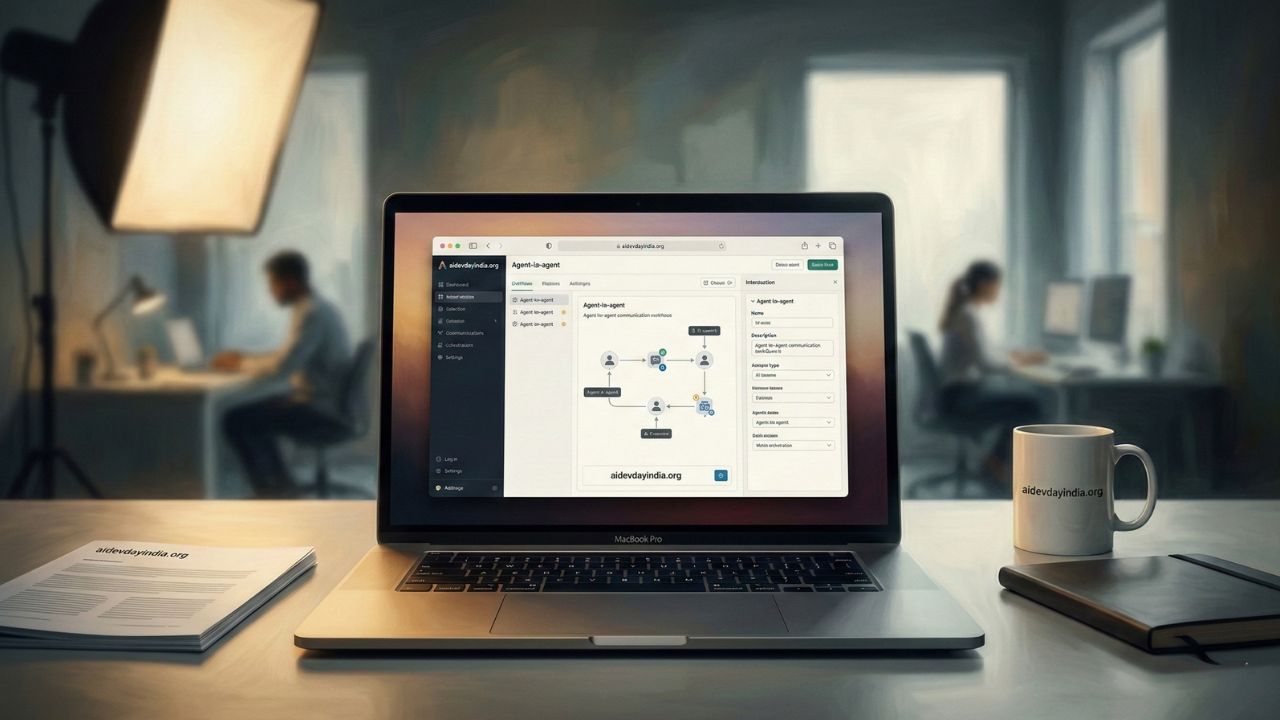
Key Takeaways:
- Beyond Silos: Orchestration allows multiple specialized agents to collaborate, solving problems no single model can handle alone.
- Structured Handshakes: Effective workflows rely on precise triggers and parameters to pass state and data between nodes.
- Resilient Swarms: Implementing message queues and standardized error-handling protocols prevents system-wide collapses during API downtime.
- Scale with Logic: Moving from single-agent prompts to multi-agent swarms requires a fundamental shift in system architecture.
Introduction
The future of enterprise automation isn't found in a single "super-bot," but in a synchronized digital workforce. Agent-to-agent communication workflows allow disparate models to function as a unified swarm, automating complex multi-step departments.
This deep dive is part of our extensive guide on the Agentic AI Engineering Handbook.
Mastering agent-to-agent communication workflows is essential for building an autonomous digital workforce that utilizes message queues and error handling for resilient AI swarms. To understand where orchestration fits into your build, review the full Agentic AI Architecture guidelines found in our parent handbook.
The Mechanics of Agent Interaction
Hierarchical vs. Peer-to-Peer Communication
In an AI swarm, communication typically follows one of two architectural patterns:
- The Manager-Worker Model: A central "Supervisor" agent analyzes a request and delegates sub-tasks to specialized worker nodes.
- The Chain Model: Agents pass data sequentially, where the output of the "Researcher" becomes the direct input for the "Writer."
Triggers and Parameters: The "Handshake"
For one agent to effectively talk to another, you must define strict triggers and parameters.
Triggers: These are specific conditions (like a successful database query) that signal the next agent to begin its work.
Parameters: These are the structured data payloads passed between agents, ensuring the second agent has the context required to proceed without "hallucinating" missing information.
Architecting a Resilient Swarm
Message Queues for Task Orchestration
High-volume swarms cannot rely on synchronous "waits." Utilizing message queues (like RabbitMQ or Kafka) allows agents to pick up tasks asynchronously.
This ensures that if the "Designer" agent is slow, the "Researcher" can continue gathering data for the next ten tasks without a system bottleneck.
Handling Error Loops and Feedback
Error loops are a common risk in autonomous swarms. If Agent A provides an unreadable output and Agent B rejects it, they may enter a recursive loop that drains your token budget.
Implementing a "Circuit Breaker" or a maximum retry parameter is a mandatory quality control step, as detailed in our guide on how to evaluate AI agent performance.
Choosing an Orchestration Framework
While custom Python scripts work for simple tasks, enterprise swarms require robust frameworks. Platforms like LangGraph or CrewAI provide built-in state management, allowing agents to "remember" what was discussed in previous steps of the workflow.
These frameworks often integrate with Episodic memory systems for AI agents to ensure the swarm learns from its past interactions.
Conclusion
Moving from a single chatbot to a coordinated swarm represents the highest tier of AI maturity. By mastering agent-to-agent communication workflows, organizations can transition from simple task automation to full departmental autonomy.
Success in this field requires strict attention to triggers, parameters, and asynchronous message queues to ensure your swarm remains resilient and cost-effective in production.
Scale Securely with Proven Tools. Try Buddy Punch

We may earn a commission if you buy through this link. (This does not increase the price for you)
Frequently Asked Questions (FAQ)
Agents communicate through structured API calls or shared state objects, passing data as parameters while following a predefined orchestration logic (like a supervisor or chain model).
Triggers are events that initiate an agent's task, while parameters are the specific pieces of data (context, variables, or files) passed between agents to maintain consistency.
Implementing "Circuit Breakers," setting maximum retry limits, and utilizing "LLM-as-a-judge" to validate agent outputs before they are passed to the next node prevents endless recursive loops.
Industry leaders currently favor LangGraph for its stateful, cyclic graph capabilities and CrewAI for its role-based, intuitive orchestration of specialized agents.
Message queues act as buffers, holding tasks in a line so that agents can process them as compute resources become available, which is essential for scaling high-traffic agentic workflows.
Sources & References
- Official GitHub Repository: Agentic AI Architecture: The Engineering Handbook
- Agentic AI Engineering Handbook: The Blueprint for Autonomy
- Episodic memory systems for AI agents
- Anthropic: Model Context Protocol (MCP) and Multi-Agent Systems
- LangChain: LangGraph: Orchestrating Agents as Graphs
- NIST: Secure Development Framework for AI Systems (SP 800-218)
Open Source Resources:
Internal Sources
External Sources