The Human Edge: 5 Soft Skills AI Cannot Replace (Yet)
The Panic is Real, but the Solution is Human
We all feel it. You see a new AI tool that can write code, design logos, or analyze data in seconds, and you think: "What is left for me to do?"
It is easy to feel overwhelmed. But here is the secret: AI is amazing at tasks, but it is terrible at being human.
AI can process data, but it cannot negotiate a difficult contract with a nervous client. It can write a script, but it cannot lead a team through a crisis. It can calculate the best route, but it can't decide where we should go.
To survive the AI revolution, you don't need to become a robot. You need to become more human. Here are the 5 critical soft skills AI cannot replace in 2026, complete with real-world examples of how to use them.
Explore AI Career Training & Certifications Hub
1. Radical Empathy (The "Trust" Builder)
AI can say "I am sorry," but it doesn't feel sorry. In sales, healthcare, and leadership, people want to be understood, not just processed.
- The Scenario: A client is angry because a project is late.
- The AI Approach: Sends a polite, grammatically perfect email apologizing for the delay based on a template.
- Result: The client feels managed.
- The Human Approach: You call the client. You hear the stress in their voice. You say, "I know this delay puts you in a tough spot with your own boss. Let's fix this together so you look good."
- Result: The client feels supported.
Why it matters: In 2026, trust is the most expensive currency. Emotional intelligence in the age of automation is your superpower. It allows you to read a room, sense frustration, and diffuse anger, things an algorithm simply cannot do.
2. Strategic Thinking (The "Why" vs. The "How")
AI is the ultimate "Doer." If you tell it to "Optimize this spreadsheet," it will do it perfectly. But it cannot ask: "Should we even be using this spreadsheet?"
- The Scenario: Your company wants to launch a new product.
- The AI Approach: Analyzes 10 years of sales data to predict the best price point.
- The Human Approach: You look at the market and realize the culture is shifting. You decide to pivot the product entirely to match a new social trend that the data hasn't captured yet.
Strategic thinking vs algorithmic processing: AI follows rules. Humans break them to innovate. You are the Driver; AI is just the GPS.
3. Complex Communication (Storytelling)
You can ask ChatGPT to write a speech, but it will sound... bland. It lacks soul. It lacks the "messiness" of real life.
- The Scenario: You need to convince your team to work late on a big deadline.
- The AI Approach: "Team, overtime is required to meet Q3 objectives. Pizza will be provided."
- The Human Approach: You tell a story about why this project matters. You use humor. You acknowledge their tiredness. You inspire them with a vision of the finish line.
The Human Edge: Great leaders don't just share facts; they tell stories that inspire action. This is a human skill AI cannot replace.
4. Critical Thinking (The "Bullshit" Detector)
We live in an era of "Deepfakes," hallucinating chatbots, and infinite noise. AI can generate false information very confidently.
- The Scenario: An AI agent writes a research report for you.
- The Trap: It cites a court case that doesn't exist (a real problem with current AI!).
- The Human Role: You are the editor. You spot the anomaly. You ask, "Does this make sense contextually?" You verify the source.
Critical thinking vs AI: Your judgment is the safety net. The ability to question sources, spot bias, and verify facts is becoming a standalone job requirement.
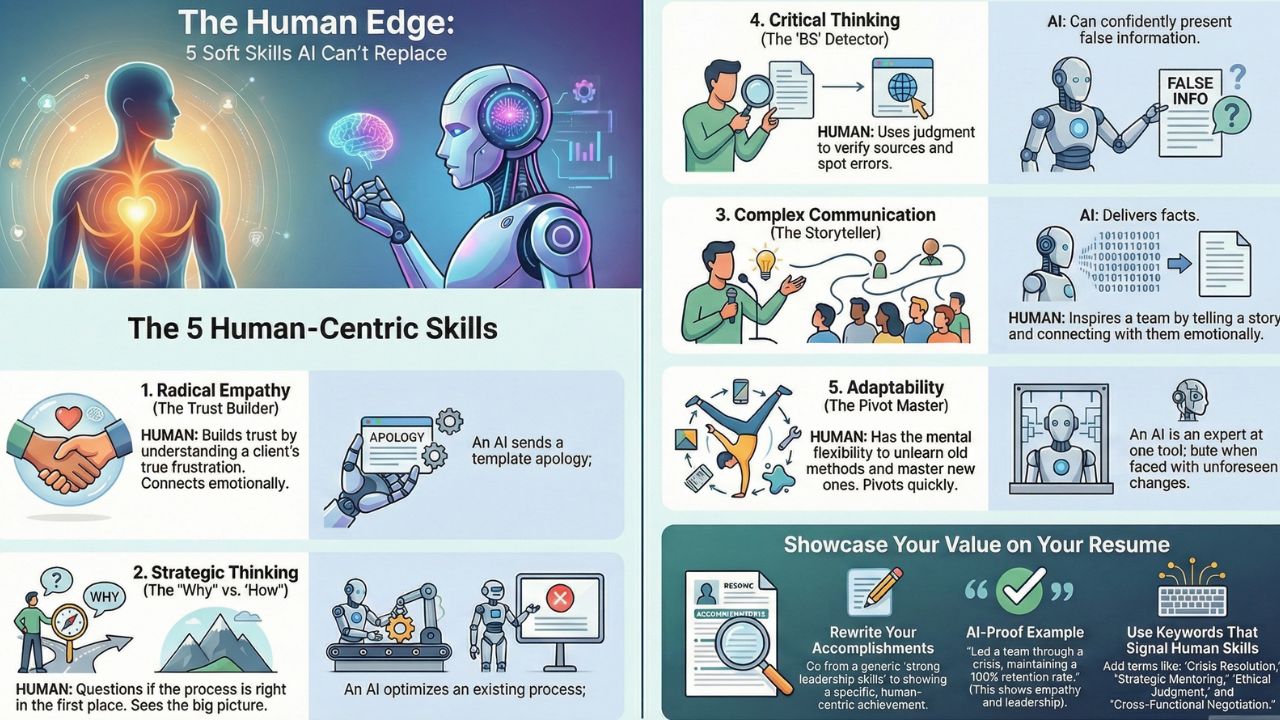
5. Adaptability (The "Pivot" Master)
The only constant in the AI era is change. Tools that are hot today will be obsolete in 6 months.
- The Scenario: Your company switches from software "A" to a new AI tool "B" overnight.
- The Old Way: "But I spent 5 years becoming an expert in Software A! I quit."
- The Adaptable Way: "Okay, Software A is dead. How can I use my knowledge of the industry to master AI Tool B in one week?"
Future proof skills: It’s not about knowing one specific tool perfectly. It’s about having the mental flexibility to unlearn old methods and learn new ones instantly without panicking.
Action Plan: How to Highlight Human Skills on a Resume
Don't just list "Communication Skills" on your CV. That is boring. In the AI era, you need to prove your human value.
1. Rewrite Your Bullets:
- Bad Example: "Strong leadership skills."
- Good Example (AI-Proof): "Led a remote team of 10 people through a major restructuring, maintaining 100% retention rate during the crisis." (Shows Empathy & Leadership).
2. Use New Keywords:
Add terms like "Stakeholder Management," "Crisis Resolution," "Strategic Mentoring," "Ethical Judgment," and "Cross-Functional Negotiation." These signal to recruiters that you handle the messy, human stuff that bots can't touch.
3. Show the "Human" Result:
Don't just say you managed data. Say you "interpreted data insights to negotiate a 20% cost saving with a vendor." (Data is AI; Negotiation is Human).
Final Thought: You Are Not Obsolete
The calculator didn't kill the mathematician. It just stopped them from doing long division. AI is the same. It is here to do the boring, repetitive work.
This frees you up to do the fun, high-value work: Leading, Creating, Connecting, and Dreaming. The future belongs to the Emotional Intelligence masters.
Frequently Asked Questions (FAQ)
The top 5 are Empathy (Emotional Intelligence), Strategic Thinking, Complex Communication (Storytelling), Critical Thinking (Judgment), and Adaptability. These rely on human intuition and social nuances that algorithms lack.
As AI takes over logical and analytical tasks, the value of human connection increases. EQ allows you to build trust, resolve conflict, and lead teams, areas where logic alone fails.
Focus on outcomes that required human intervention. Mention crisis management, negotiation, mentorship, and ethical decision-making. Show how you used soft skills to solve problems AI couldn't.
It is unlikely. Leadership requires inspiring people, navigating office politics, and making ethical choices with incomplete information. AI can provide data to support a leader, but it cannot be the leader.
Sources and References
- TalentHR: "12 Soft Skills Examples That Are Most in Demand (2025-2026)"
- Cambridge Infotech: "Will AI Replace My Job? 10 Best Roles Changing in 2026"
- Harvard Business School (Working Knowledge): "How Humans Outshine AI in Adapting to Change"
- Proaction International: "The Growing Importance of Soft Skills in the AI Era"
- Industry Connect: "How to Demonstrate Emotional Intelligence During a Job Search"