The 4.0 GPA Cheat Code: Best AI Tools for Thesis & Research
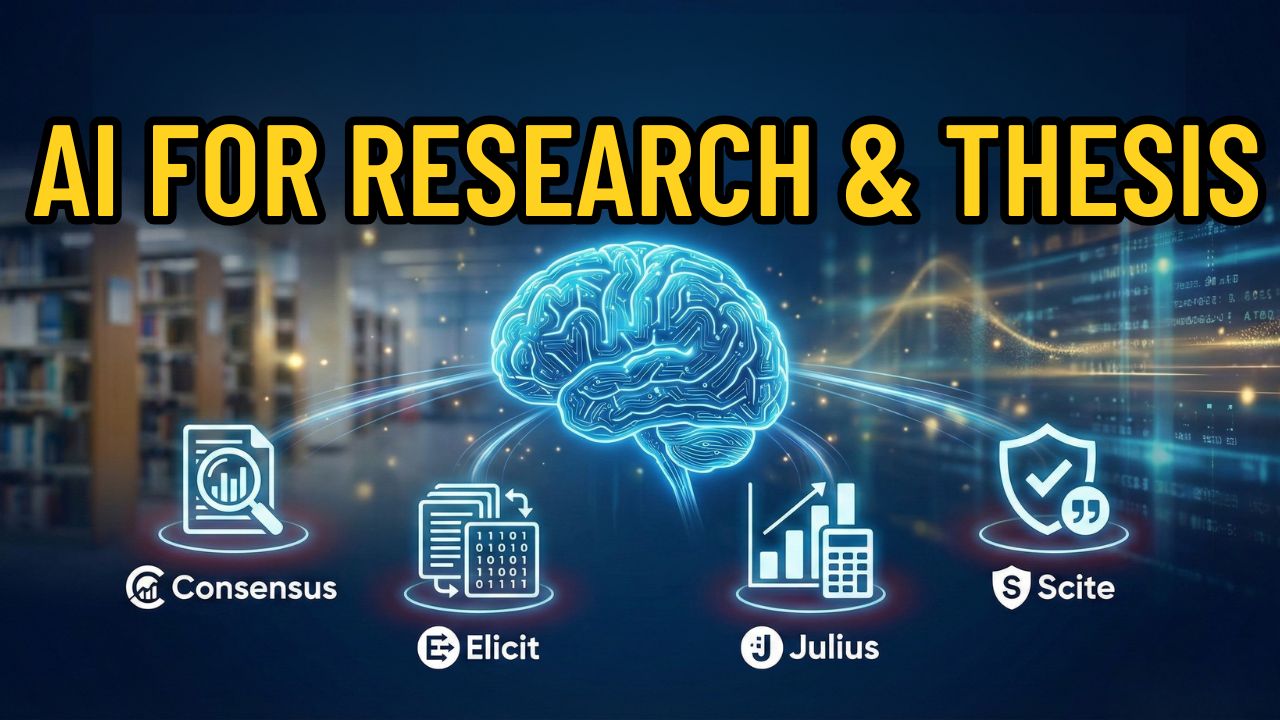
Stop Asking ChatGPT to "Write My Essay"
We get it. The deadline is tomorrow, and you are staring at a blank page. The temptation to ask an AI chatbot to write the whole thing is high.
But here is the problem: Professors know. The "robot voice" is easy to spot, and AI detectors are getting smarter. Plus, generic chatbots often make up facts (hallucinations), which is a guaranteed way to fail.
The best AI tools for academic research in 2026 aren't for faking the work, they are for speeding up the hard parts: reading, analyzing data, and finding sources. Here is your "Cheat Code" to a 4.0 GPA without breaking the rules.
Explore AI Career Training & Certifications Hub
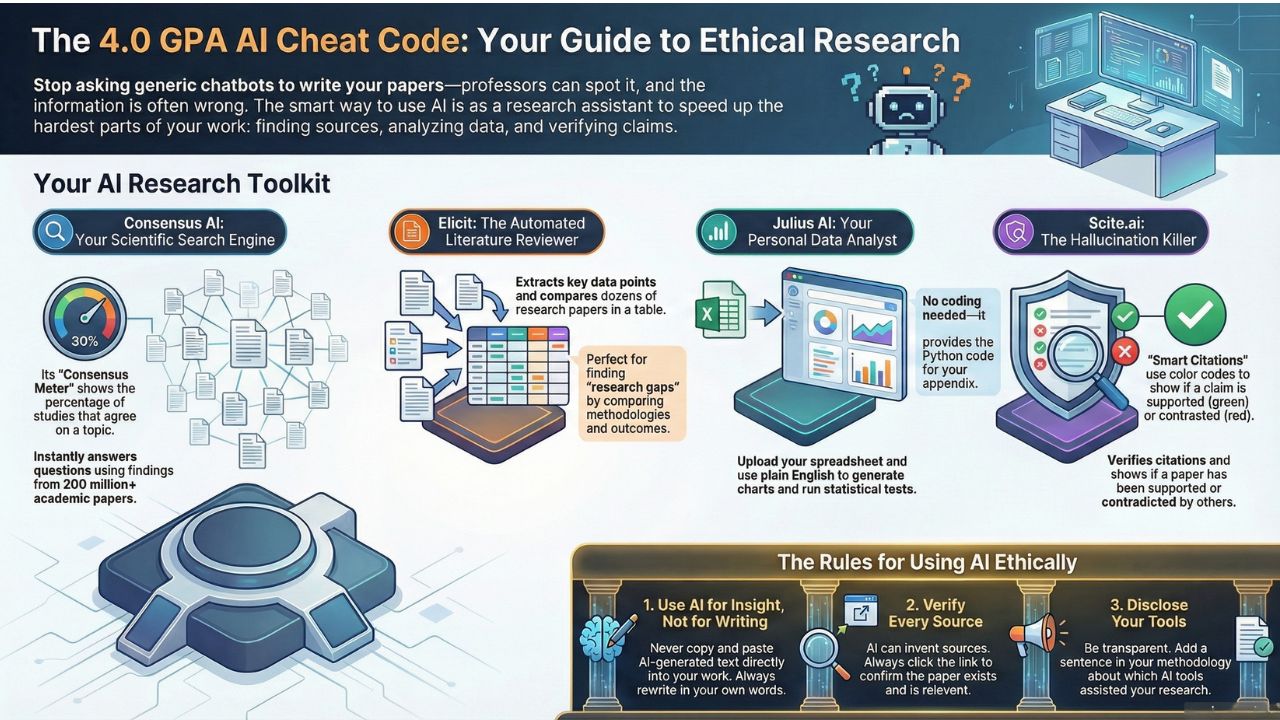
1. Consensus AI: The "Google" for Scientists
If you search for "does coffee help memory" on Google, you get blog posts and ads. If you search on Consensus, you get science.
- What it does: It is a search engine that only looks at peer-reviewed academic papers. It reads 200 million papers instantly to answer your question.
- Best Feature: "The Consensus Meter." It scans thousands of papers and tells you: "70% of studies say Yes, 30% say No." This is perfect for the "Background" section of your thesis.
How to use Consensus AI for literature review?
- Ask a Question: Type "Does remote work improve employee productivity?"
- Filter by Quality: Toggle "High Impact Journals Only" to ensure you are citing the best sources.
- Synthesize: Click the "Synthesize" button. It writes a one-paragraph summary of the top 10 papers for you, complete with citations like (Smith et al., 2024).
- Cost: Free version available (Student discount for Pro).
2. Elicit: The Automated Research Assistant
Writing a literature review used to take weeks of reading. With Elicit, it takes minutes.
- What it does: You upload a PDF (or search for a topic), and it extracts the key data for you. It acts like a super-smart research assistant.
- Best Feature: "The Matrix." You can ask it to make a table comparing 50 different papers. You define the columns, like "Sample Size," "Methodology," "Location," or "Conclusion", and Elicit fills in the rows for every paper.
Elicit vs Consensus for academic research:
- Use Consensus when you have a specific question and want a quick answer.
- Use Elicit when you need to dig deep, compare methodologies, and find "Research Gaps" for your own study.
3. Data Analysis: No More SPSS Nightmares
For graduate students, the scariest part is often the statistics. You have the data, but you don't know how to code in Python or R. Automated data analysis tools for graduate students are here to save you.
- Tool: Julius AI
- What it does: You upload your Excel sheet, and you talk to it in plain English.
Workflow:
- Upload your survey data (results.csv).
- Prompt: "Check for missing values and clean the data."
- Prompt: "Show me a bar chart comparing male vs. female test scores."
- Prompt: "Run a t-test to see if the difference is significant."
Why it's ethical: It doesn't fake the data; it just acts as a super-smart calculator. It even gives you the Python code it used, so you can put it in your appendix.
4. Scite.ai: The "Hallucination Killer"
The biggest risk with AI? It lies. It might invent a paper that doesn't exist. Scite is your safety net. It checks if a paper has been supported or contradicted by other scientists.
- Best Feature: "Smart Citations." It doesn't just count citations; it classifies them.
- Supporting: (The paper agrees with the claim).
- Contrasting: (The paper disagrees).
Use Case: Before you submit your thesis, run your bibliography through Scite. If your main source has a lot of "Contrasting" citations, you know you are building your argument on bad science.
Academic Integrity Guide for Using AI in Research
Using AI is not cheating if you use it correctly. Here are the rules for using AI to find research gaps 2026:
- Don't Copy-Paste: Never copy AI-generated text directly into your thesis. Use AI to find the information, then write it in your own words.
- Verify Everything: If AI gives you a citation, click the link. If the link is broken or the paper doesn't exist, don't use it.
- Disclose It: Many universities now allow AI if you are honest.
- Add a sentence to your methodology: "Initial literature search was assisted by Consensus AI to identify relevant papers. Data visualization was generated using Julius AI."
Frequently Asked Questions (FAQs)
Yes, if used as a research assistant and not a writer. Using tools to find papers, summarize complex text, or clean data is generally accepted, similar to using a calculator for math. Always check your university's specific AI policy first.
Consensus is best for answering specific questions (e.g., "Does X cause Y?") using scientific consensus. Elicit is better for deep literature reviews, extracting specific details from papers (e.g., "What was the sample size in these 10 studies?"), and comparing them side-by-side.
Yes. Tools like Julius AI or ChatGPT Data Analyst can visualize data and run statistical tests. However, you must understand why the test was run to defend your thesis during your defense.
Never trust a general chatbot (like standard ChatGPT) for citations. Use purpose-built academic tools like Scite.ai, Consensus, or Elicit that link directly to the PDF of the peer-reviewed source.