Org Chart Vs Work Chart: The Blueprint for a Hybrid AI Workforce
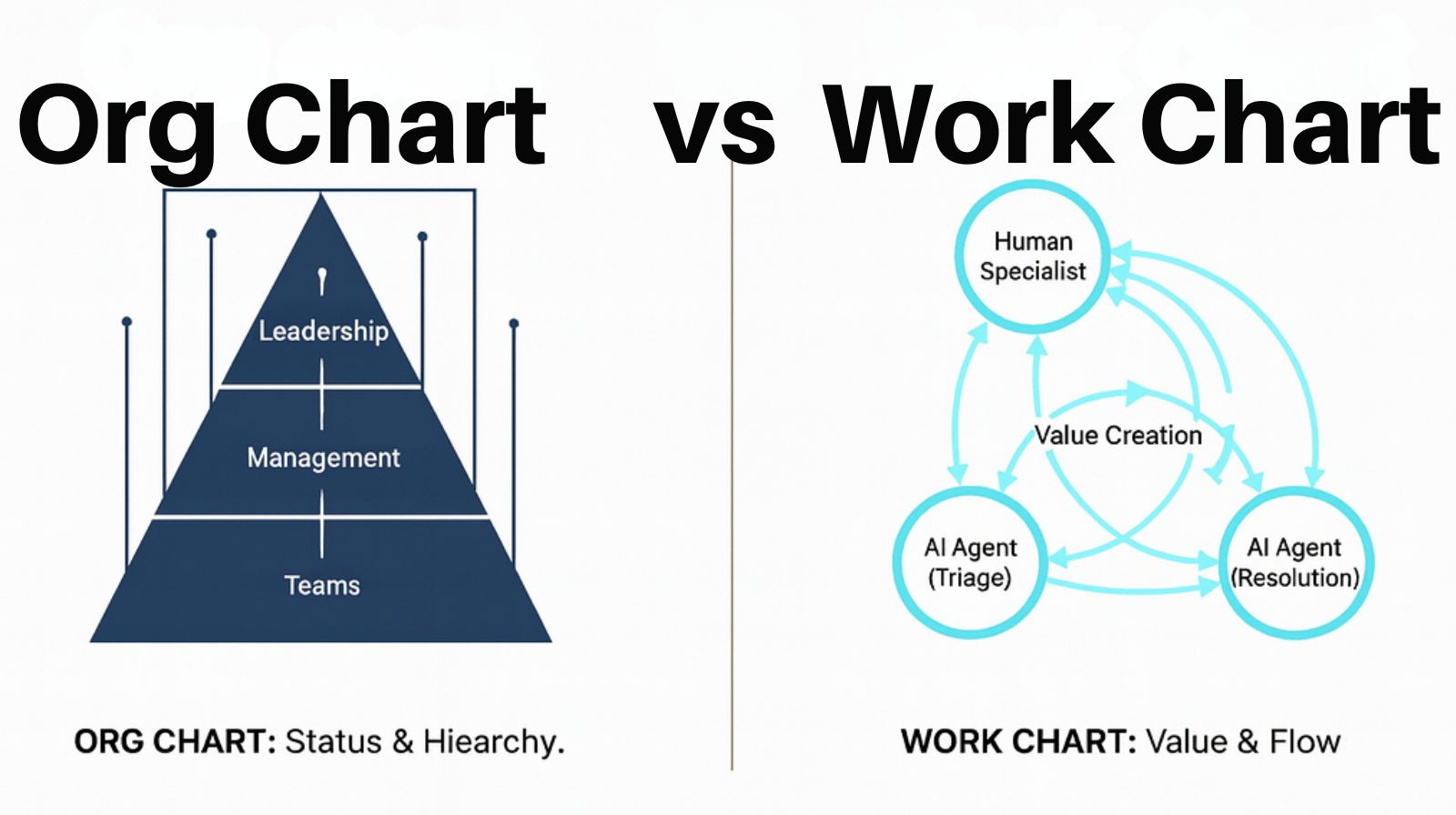
For the better part of a century, the Organizational Chart (Org Chart) was the single most defining document of any large business. It was the rigid, unforgiving pyramid that answered one critical question: Who reports to whom? It mapped seniority, dictated reporting lines, and was the bedrock of managerial power.
Today, that system has become outdated. The moment organizations started deploying autonomous AI Agents, not as mere software tools, but as a new class of Digital Employee, the traditional pyramid of power fractured. You can't fit an agent into a traditional HR structure or management chain. They don't take holidays, they don't have feelings, and their efficiency far surpasses that of a human worker doing repetitive tasks.
The challenge facing modern leaders isn't just technology adoption; it's organizational restructuring. The blueprint for this new Hybrid Workforce/Human-Agent Teams is the Work Chart.
Related Deep Dives on the AI Workforce Transformation
The Fundamental Shift: From Status to Service
The transition from the Org Chart to the Work Chart is a fundamental shift in perspective from status to service.
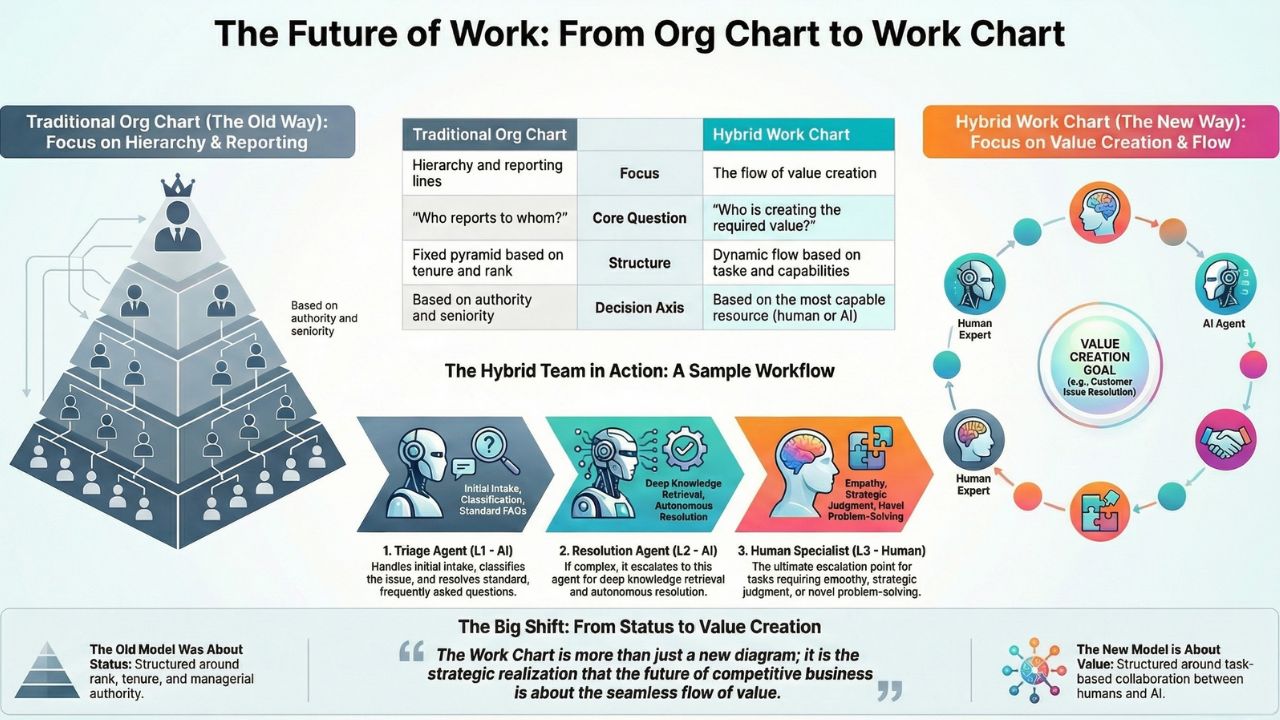
| Traditional Org Chart | Hybrid Work Chart |
|---|---|
| Focus: Hierarchy and reporting lines. | Focus: The flow of value creation. |
| Question: "Who reports to whom?" | Question: "Who is creating the required value?" |
| Structure: Fixed pyramid based on tenure and rank. | Structure: Dynamic flow based on tasks and capabilities (human or digital). |
The Work Chart is a visual map that tracks the entire process from a specific business challenge (e.g., "Onboard a new client") to the final business outcome. Critically, it assigns responsibility for each step of that journey to the most capable resource, regardless of whether that resource is a person or an AI Agent. This change allows organizations to move from rigid departments to flexible, Human-Agent Teams focused purely on results.
The Work Chart in Action: Customer Issue Resolution
To understand the power of flow over hierarchy, consider a typical customer support workflow transformed into a Hybrid Org Chart. In the old model, a manager oversees 10 human agents based on rank and salary. In the Work Chart model, the manager becomes the Ecosystem Orchestrator, overseeing a finely tuned machine dedicated solely to the goal of "Customer Issue Resolution."
Here is how the work is automatically distributed across the tiers of Digital Employees and human specialists:
1. The Triage Agent (Level 1: Intake and Screening)
- Role: This first-tier AI Agent handles the initial flood of inquiries.
- Task: It quickly performs initial intake, classifies the issue (e.g., "billing issue," "technical bug," "general query"), and resolves all standard, frequently asked questions (FAQs).
- Efficiency: By screening out 80% of routine noise, this agent frees up human specialists for complex tasks.
2. The Resolution Agent (Level 2: Deep Knowledge and Synthesis)
- Role: If the issue is complex and requires deep knowledge, it escalates automatically to this advanced Digital Employee.
- Task: This agent is responsible for complex knowledge retrieval. It synthesizes answers from vast internal documents, cross-references compliance data, and attempts autonomous resolution.
- Result: It acts as a super-researcher and problem-solver, minimizing the need for humans to dig through data.
3. The Human Specialist (Level 3: Empathy and Strategic Judgment)
- Role: The human specialist becomes the ultimate escalation point, the Human-in-the-Loop (HITL).
- Task: The Work Chart ensures the person is reserved only for tasks requiring complex empathy, ethical judgment, creative problem-solving, or handling novel, non-standard cases that the AI hasn't been trained on.
- Value: Human capital is no longer wasted on repetitive tasks but is focused solely on high-value, high-impact activities.
The New Leadership: Meet the Ecosystem Orchestrator
In the Work Chart model, the human manager's job pivots entirely. They are no longer checking individual attendance or tracking hours. They become the Ecosystem Orchestrator, responsible for the overall efficiency and governance of the Human-Agent Team.
The Orchestrator's core responsibilities include:
- Workflow Design: Ensuring the data flows seamlessly between the Triage Agent and the Resolution Agent.
- Governance: Setting the Circuit Breakers, automated kill switches that halt an agent if it starts to hallucinate, violate policy, or incur excessive costs.
- Continuous Improvement: Monitoring key metrics like the Autonomy Score (the frequency with which an agent requires human intervention) to ensure the system is constantly optimizing and requiring less human oversight.
The Work Chart is more than just a new diagram; it is the strategic realization that the future of competitive business is about the seamless flow of value created by a perfectly integrated Hybrid Org Chart.

Frequently Asked Questions (FAQs)
The traditional Org Chart maps reporting relationships ("Who reports to whom") and hierarchy. The Work Chart is the new blueprint; it maps the flow of value creation ("Who creates value") by linking specific outcomes to the human and Digital Employees (AI Agents) responsible for each task, regardless of their position in the hierarchy.
The Autonomy Score is a key performance indicator (KPI) for an AI Agent. It measures the frequency with which an agent requires human intervention to successfully complete a task. A high Autonomy Score indicates greater independence and efficiency, which is a metric used during the Agent Performance Review.
The Prompt Architect is the specialist who designs the agent’s core persona, boundaries, and ethical rules by crafting precise System Prompts. The Agent Orchestrator is the manager responsible for designing and optimizing the workflows between multiple agents and human teams, ensuring seamless collaboration across the Work Chart.