AI Workforce Transformation Strategy 2026
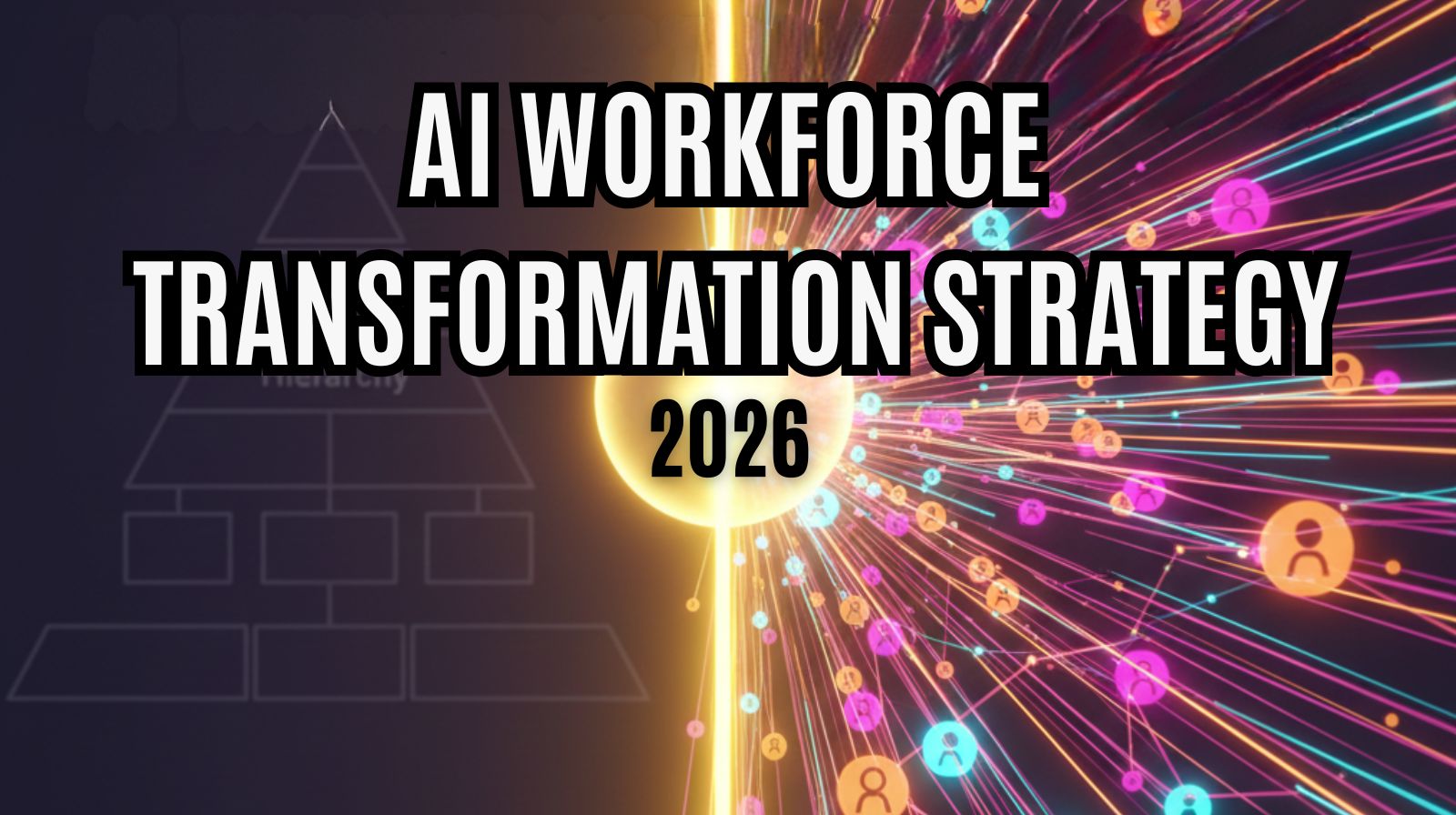
The Org Chart, a rigid pyramid of reporting lines that defined corporate structure for decades, is dead. It defined who reported to whom, and where accountability lay. But as autonomous AI Agents move from being passive tools to becoming active, decision-making partners, this traditional structure is no longer adequate. We are not just automating tasks; we are integrating an entirely new workforce. The leaders who will win the next decade are not just "technology enablers," but Ecosystem Orchestrators of sophisticated Human-Agent Teams. The blueprint for this new era is not the Org Chart, but the Hybrid Org Chart, centered around a concept called the Work Chart.
1. From Hierarchy to Flow: The Work Chart Blueprint
The core difference between the old and the new world is simple: An Org Chart shows who reports to whom. A Work Chart shows who creates value, regardless of whether that "who" is human or digital. In a traditional customer support structure, a manager oversees a team of human agents based on seniority. In the Hybrid Org Chart, the manager oversees a cross-functional Work Chart focused purely on the goal of "Customer Issue Resolution”.
Deep Dive: Read our detailed analysis on this shift: Org Chart Vs Work Chart: The Blueprint for a Hybrid AI Workforce.
This is where the first Digital Employees show up:
- Triage Agent (Level 1): An AI Agent that handles initial intake, classification, and standard requests.
- Resolution Agent (Level 2): A more advanced AI Agent responsible for complex knowledge retrieval and synthesizing an answer from multiple sources.
- Human Specialist (Level 3): The ultimate escalation point, reserved for tasks requiring complex empathy, strategic judgment, or handling novel, non-standard cases.
In this model, the human manager shifts from supervising individuals to being the Ecosystem Orchestrator, responsible for the flow of the entire system, ensuring the agents collaborate effectively, escalate appropriately, and continuously improve.

2. The New Roles: Architects and Orchestrators
When you introduce a new class of employee, you create new managerial roles. The rise of AI Agents necessitates entirely new specializations focused on designing, deploying, and governing them. The days of the pure coder are giving way to roles centered on language, governance, and architecture:
Deep Dive: Explore the roles in detail: Prompt Architect & Agent Orchestrator: New AI Roles.
The Prompt Architect: Designing the Agent's Soul
This role is paramount. The Prompt Architect is not just an engineer writing clever inputs, but the designer of the agent’s soul. They craft the System Prompts that define an agent's fundamental persona, ethical constraints, and operational boundaries. For instance, if the Resolution Agent is required to act with a friendly and patient demeanor, it’s the Prompt Architect who writes the digital DNA, the System Prompts, to enforce that behavior across thousands of interactions.
The Agent Orchestrator: Managing the Team Flow
If the Prompt Architect designs the individual agent, the Agent Orchestrator designs the team. This person ensures the Research Agent feeds data correctly to the Writing Agent, or that the Triage Agent seamlessly hands off to the Human Specialist. This is the new cross-functional workflow manager, making sure multi-agent systems communicate without friction.
3. The New HR: Hiring, Benchmarking, and Performance
You don't "install" an AI Agent; you "hire" it. This means you must have an HR process for your Digital Employees that mirrors human recruitment and management.
Deep Dive: The foundation of this new structure is the AI Agent HR system. Learn the three-step framework for hiring, benchmarking, and governing your Digital Employees in our dedicated article: AI Agent HR: Hiring & Performance Review for Digital Employees
Benchmarking and Hiring
Before an agent is deployed, it must go through a structured "interview" and Benchmarking process. Instead of a resume, you assess its performance against predefined metrics, ensuring it meets the functional requirements before it ever touches a real customer or a critical system.
Agent Performance Review
Once deployed, every agent is subject to an Agent Performance Review. This moves beyond simple uptime metrics.
Key performance indicators (KPIs) for agents include:
- Autonomy Score: A measure of how often the agent needs human intervention to complete its task.
- Cost per Task/Token Burn: The financial efficiency of the agent.
- Error Rate: How often the agent needs a human to fix a mistake.
Governance: Ensuring Safety and Accountability
This governance layer is essential and is managed through clear protocols for human involvement:
- Human-on-the-Loop (HOTL): For strategic oversight where a human reviews the agent's work after it's completed, focusing on compliance and long-term strategy.
- Human-in-the-Loop (HITL): For active, necessary intervention during a critical task, ensuring quality and safety.
- Circuit Breakers: Automated kill switches that stop an agent immediately if it begins to hallucinate, violate policy, or incur excessive costs.
4. The Geo-Economic Shift: India's New Business Model
Nowhere is the impact of the Hybrid Org Chart more profound than in the global IT service industry. For three decades, the success of the Indian IT Service Sector was built on the model of Labor Arbitrage Shift, providing equivalent services at a fraction of the cost due to geographic wage differences. Today, a single AI Agent can match the productivity of an entire offshore team, fundamentally eroding this cost advantage.
Deep Dive: How India's IT sector is adapting, read our detailed article: How India’s IT Giants Are Training the AI Agent Workforce
This disruption is forcing an existential shift in the business model of firms like TCS and Infosys:
- Old Model: Time and Material (charging clients by the human hour).
- New Model: Outcome-based billing (charging by the task completed, regardless of whether a person or an AI Agent did it).
For companies like TCS and Infosys, this is not a technical upgrade; it's an existential shift in the entire business model. The ability to successfully implement and scale Hybrid Org Charts will determine which firms survive and which fail. The future of global services is no longer about arbitrage; it’s about Orchestration.

Frequently Asked Questions (FAQs)
The traditional Org Chart maps reporting relationships ("Who reports to whom") and hierarchy. The Work Chart is the new blueprint; it maps the flow of value creation ("Who creates value") by linking specific outcomes to the human and Digital Employees ( AI Agents ) responsible for each task, regardless of their position in the hierarchy.
The Autonomy Score is a key performance indicator (KPI) for an AI Agent. It measures the frequency with which an agent requires human intervention to successfully complete a task. A high Autonomy Score indicates greater independence and efficiency, which is a metric used during the Agent Performance Review.
The Prompt Architect is the specialist who designs the agent’s core persona, boundaries, and ethical rules by crafting precise System Prompts. The Agent Orchestrator is the manager responsible for designing and optimizing the workflows between multiple agents and human teams, ensuring seamless collaboration across the Work Chart.
The Labor Arbitrage Shift describes the fundamental breakdown of the legacy business model in the Indian IT Service Sector. Historically, these firms profited by charging clients based on Time and Material due to lower geographic wages. Now, since AI Agents can perform many of these tasks, the competitive edge shifts from cheap labor to efficiency, forcing firms to move to Outcome-based billing.