Bitbucket Rovo vs. GitHub: AI Code Review Cost & ROI
What's New in This Update
- Updated feature set comparisons based on GitHub Copilot Workspace's Q2 2026 releases.
- New data from the 2026 DORA metrics report on how automated PR reviews impact cycle times.
- Added guidance on tracking shadow AI usage and token consumption in enterprise procurement.
Executive Snapshot: The Bottom Line on AI Code Reviews
- Pricing Scrutiny: Bitbucket Rovo dev code review pricing requires strict utilization monitoring to ensure a positive return on investment. The $20/seat baseline scales rapidly if token usage goes unchecked.
- Velocity Benchmarks: Evaluating Bitbucket vs GitHub in 2026 means measuring the true impact on the Developer Velocity Index—cycle time reduction—not just counting lines of AI-generated code.
- Compliance Needs: Both automated ticket resolution and code generation must retain human-in-the-loop validation to maintain strict SOC2 and ISO 27001 compliance standards.
Manual pull request reviews remain a significant bottleneck in modern engineering pipelines. In fact, a recent 2026 DORA (DevOps Research and Assessment) report highlights that the average pull request sits idle for three days waiting for peer feedback. Manual code reviews are officially the primary bottleneck dragging down deployment frequency in engineering swarms.
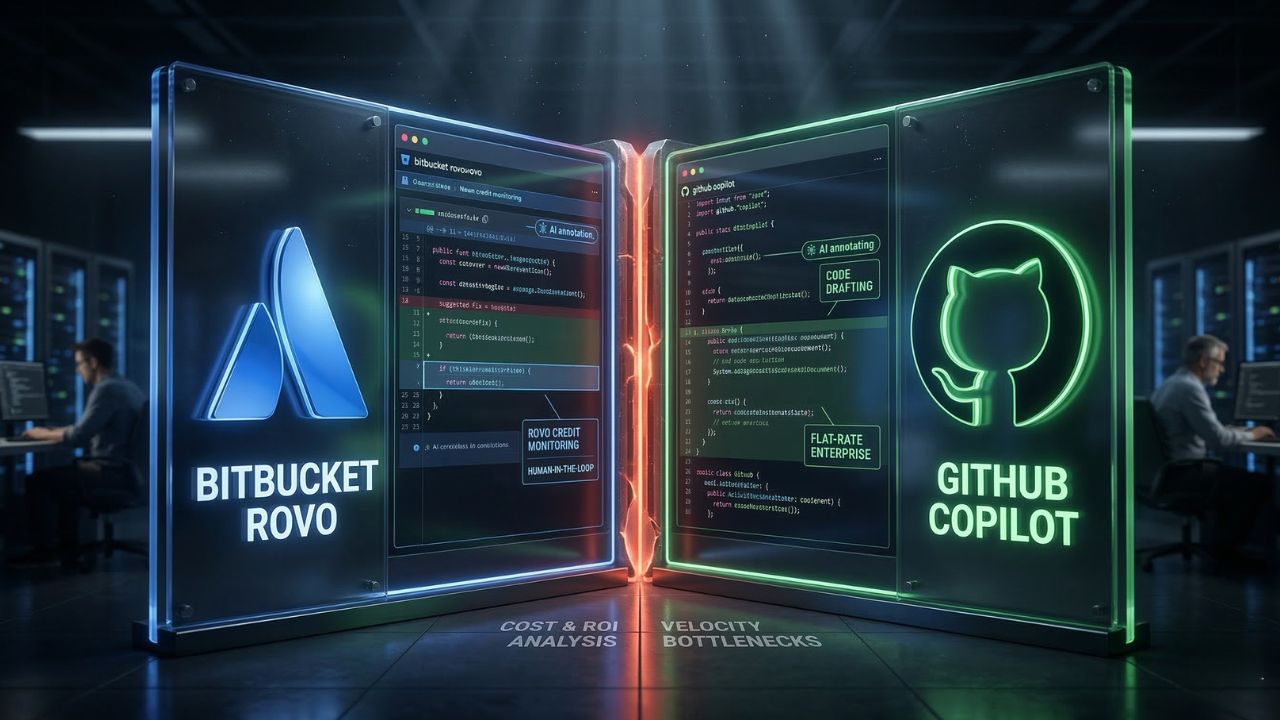
Teams are blindly pouring budgets into AI seats without knowing if these tools actually accelerate deployment or just introduce un-audited, bloated code. To assess whether the financial investment aligns with operational output, we analyzed if Bitbucket Rovo’s premium price tag actually delivers the 30% velocity boost it promises, or if GitHub Copilot Enterprise remains the superior financial decision.
As detailed in our master guide on Atlassian Rovo vs. Microsoft Copilot ROI comparison, integrating Artificial Intelligence into your B2B technology stack requires a rigorous understanding of how external models interact with proprietary data.
Leaders must aggressively compare the value of dedicated Atlassian intelligence against competing repository tools to ensure the ROI justifies the added per-seat cost.
Unpacking Bitbucket Rovo Dev Code Review Pricing
Introducing autonomous agents to your repository layer promises massive efficiency gains, but it also introduces complex cost variables. Many technical leaders wonder if charging $20 per user is too steep for an AI code reviewer, especially when developers already leverage local autocomplete tools.
The base per-user cost of Atlassian Rovo in 2026 sits at approximately $20 per month, but organizations must actively audit for hidden credit traps. While the advertised per-user cost may appear straightforward on a pricing page, consumption-based architectures often conceal significant true-up costs at the end of the billing cycle. If your agents are running continuous background checks on massive monorepos, the token usage spikes.
To scale effectively, engineering managers need to map out exactly how their developers trigger these backend costs during daily pulls and commits. If your team is evaluating these limits, decode the Atlassian Rovo credit systemto prevent sudden budget overruns.
GitHub Copilot Enterprise Pricing & Features
On the other side of the aisle, GitHub Copilot Enterprise demands $39 per user per month. While twice as expensive as Rovo's baseline, Copilot Enterprise embeds deeply into the developer's Integrated Development Environment (IDE), offering real-time code generation alongside pull request summaries and repository-wide Q&A.
The critical difference lies in the context graph. GitHub Copilot draws context primarily from the codebase and active files. Rovo, powered by Atlassian Intelligence, pulls context from Jira tickets, Confluence product requirement documents (PRDs), and Bitbucket code simultaneously. This cross-platform awareness allows Rovo to flag when a pull request fulfills a Jira ticket's acceptance criteria, a capability GitHub natively lacks unless heavily integrated via third-party webhooks.
AI Code Review Market Comparison (2026)
The following table breaks down the core evaluation criteria for your 2026 continuous integration stack:
| Evaluation Metric | Bitbucket Rovo Focus | GitHub Copilot Enterprise Focus |
|---|---|---|
| Primary Workflow | Automated PR auditing connected directly to Atlassian context (Jira/Confluence) | Broad repository insights, IDE autocomplete, and native GitHub issue tracking |
| Budget Consideration | Base $20/month per user (Requires strict monitoring of Bitbucket Rovo dev code review pricing and credit limits) | Flat-rate enterprise seat licensing at $39/month per user (Predictable billing) |
| Productivity Goal | 30% velocity boost in engineering swarms by tying code directly to business logic | Accelerated code drafting, reducing boilerplate writing, and speeding up initial commits |
| Security Posture | Enterprise-grade data privacy; data is not used to train Atlassian's foundational models | Enterprise privacy guarantees; fine-grained access control within the GitHub ecosystem |
Architecting the 2026 Developer Velocity Index (DVI)
When deploying AI-powered project management and code analysis, speed is the ultimate metric. However, speed without quality creates technical debt. Leaders must analyze whether Rovo's code review is faster than a human peer review, and crucially, if it maintains the same rigorous standard for security and architectural integrity.
McKinsey's Developer Velocity Index demonstrates that organizations empowering developers with the right tooling achieve four to five times faster revenue growth. But simply adding AI does not automatically increase velocity. You must measure lead time for changes, deployment frequency, mean time to recovery (MTTR), and change failure rate.
A major consideration for enterprise architects is whether these tools can support legacy modernization. Teams actively evaluating whether they can use Rovo to refactor older systems must assess the tool's specialized language support. This is especially critical given recent market shifts regarding legacy modernization capabilitiesdriven by frontier models handling massive context windows.
Pro-Tip: Defining the Scope of AI Review
Stop wasting AI seats on basic search and summarization. To realize true financial value, audit whether your setup allows Rovo to autonomously suggest inline code fixes or if it is merely identifying bugs in Pull Requests without offering solutions. Generating actionable code patches rather than just flagging syntax errors is what dramatically moves the Developer Velocity Index forward.

Deploying Rovo Agents for Actionable Patches
The true power of the 2026 Atlassian suite lies in its agentic capabilities. Instead of a passive chatbot, you can configure Rovo to act as an active participant in your CI/CD pipeline. When a developer opens a PR, a Rovo agent can trigger automatically, read the associated Jira ticket, verify the code against the acceptance criteria, and leave inline comments highlighting logic gaps.
If you want to move beyond simple chat interfaces, you must deploy autonomous Atlassian Rovo AI agentsthat execute multi-step workflows. This transforms the tool from an expense into an active, value-generating team member.
The Hidden Trap: Context-Blind Autonomy and SOC2 Risks
What most teams get wrong about AI code reviews is assuming that maximum automation equals maximum efficiency. Fully removing human developers from the review pipeline introduces severe regulatory risks and degrades code quality over time.
Relying entirely on autonomous agents without mandatory peer review violates foundational SOC2 change management controls. Auditors require a verifiable trail proving that a qualified human authorized code changes before they reach production. Admins must strictly monitor how Rovo handles SOC2 compliance during code analysis to prevent unverified, hallucinated code from being merged.
Automated ticket resolution and code generation must retain human-in-the-loop validation. Deploying specialized agents without a comprehensive security framework is a major organizational vulnerability. Ensure your deployment is secure by cross-referencing your setup against the Atlassian Intelligence admin governance framework.
Furthermore, choosing the best AI code review tools for enterprise teamsrequires balancing raw coding velocity with strict vulnerability scanning protocols.
Conclusion: Measuring True ROI in AI Code Reviews
Blindly adopting AI tools without tracking their direct impact on the Developer Velocity Index is a fast track to bloated software budgets and compliance nightmares. AI code review isn't just about paying a flat subscription fee; it's an operational shift designed to determine whether that financial investment actually ships secure, bug-free code faster to the end user.
To truly justify Bitbucket Rovo dev code review pricing against GitHub Copilot Enterprise, engineering leaders must treat these models as workflow accelerators, not autonomous replacements for senior developers. You must maintain strict human-in-the-loop protocols and aggressively monitor your AI credit consumption to ensure every dollar spent translates to merged, secure pull requests.
Stop guessing on your engineering budgets based on marketing hype and start measuring actual output. If your AI integration isn't measurably reducing your pull request cycle times and lowering your change failure rate, it's just an expensive syntax checker.
Scale Securely with Proven Tools. Try Blackbox AI

We may earn a commission if you buy through this link. (This does not increase the price for you)
Frequently Asked Questions (FAQ)
Evaluating Rovo requires assessing its built-in security features. Teams must audit if the platform can autonomously flag vulnerabilities during the pull request phase before the code is merged into the main branch, integrating closely with native Atlassian security gates.
Bitbucket Rovo dev code review pricing operates independently of base repository costs. Standard plans cover hosting and basic CI/CD pipelines, while Rovo introduces specialized AI credit consumption models that must be budgeted separately, usually adding around $20 per active developer seat.
A key factor in an AI tool's effectiveness is its contextual awareness. Organizations must evaluate Atlassian's data privacy controls to understand how Rovo indexes private repositories to match internal formatting and syntax standards. Currently, Rovo leverages Jira tickets and Confluence docs to understand business context alongside the repo data.
Language compatibility is crucial for enterprise adoption. Engineering leads must review Atlassian's latest 2026 documentation to confirm support for their specific tech stack. Currently, Rovo supports mainstream languages like Python, JavaScript/TypeScript, Java, Go, and C++, but legacy languages require specific capability audits.
Accelerating the testing phase is a major goal for the Developer Velocity Index. Rovo can draft functional unit tests based on the logic of newly committed code blocks, though teams must maintain a human-in-the-loop validation process to ensure these AI-generated tests meet SOC2 and internal quality standards.
Procurement teams frequently look for flexible billing. You must audit your 2026 enterprise contract to see if Atlassian offers pure pay-as-you-go scaling or if you are locked into rigid, predefined credit tiers. Most enterprise deployments currently require annual seat commitments with hard token limits.
Sources & References
- NIST Artificial Intelligence Risk Management Framework (AI RMF 1.0)
- The EU Artificial Intelligence Act
- McKinsey & Company: Developer Velocity: How software excellence fuels business performance (External B2B Industry Benchmark)
- Atlassian Rovo vs. Microsoft Copilot: Is the $20/User AI Worth It?
- The Rovo Credit Trap: 2026 Atlassian AI Pricing Secrets.
External Sources
Internal Sources