The Rovo Credit Trap: 2026 Atlassian AI Pricing Secrets
What's New in This Update
- 2026 FinOps Data: Added fresh statistics detailing how automated retries and external API connectors are draining enterprise AI budgets.
- Ghost Credits Explained: A new breakdown defining "Ghost Credits" and how invisible background polling causes premature soft-caps.
- Governance Controls: Expanded guidance on establishing exact organizational limits for Jira vs. Bitbucket resource sharing.
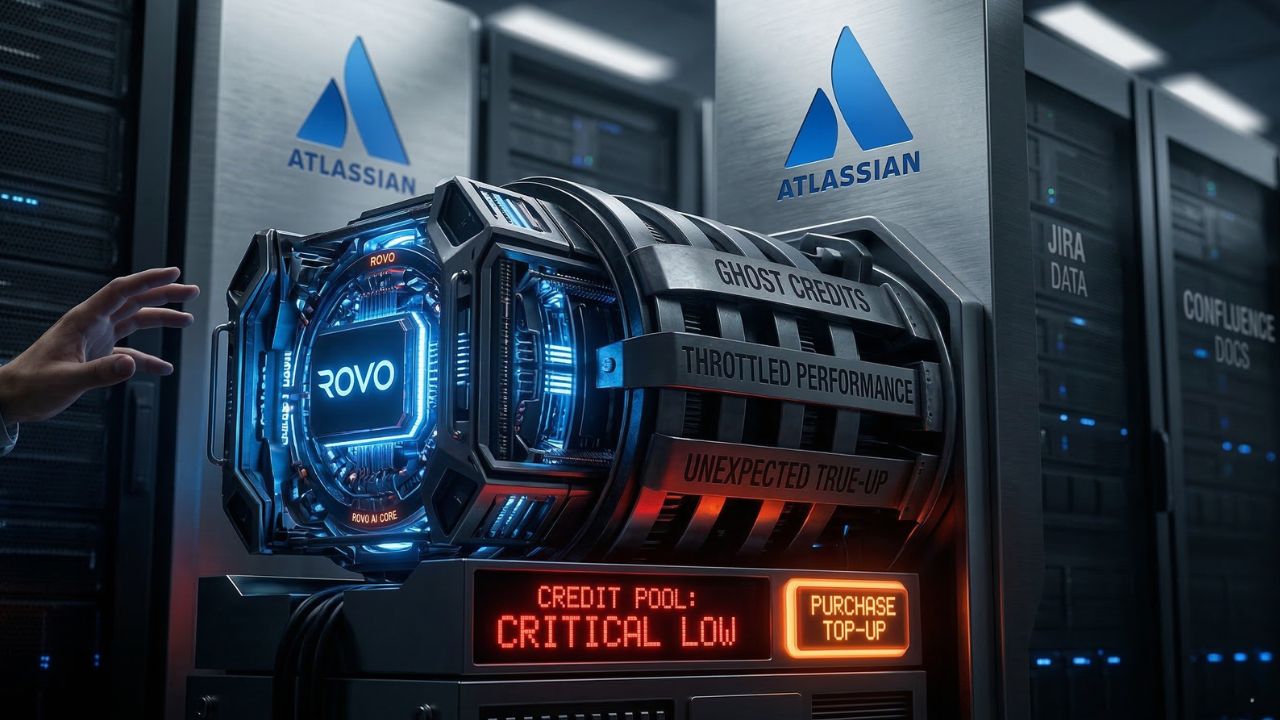
Bottom Line: Rovo Pricing Snapshot
- The Core Issue: Consumption-based "Ghost Credits" can cause unexpected five-figure true-ups if not monitored proactively.
- The Solution: Map agent actions to strict credit budgets before deployment to maintain developer velocity.
- The Metric: Standardize on internal agents over heavy third-party connector pulls to conserve the credit pool.
Many engineering leaders assume that a flat per-user AI license guarantees predictable software costs. However, hidden consumption metrics often throttle developer productivity mid-sprint, triggering unexpected true-up bills that shatter IT budgets.
As detailed in our master guide evaluating the Atlassian Rovo vs. Microsoft Copilot ROI, organizations face a critical choice between ecosystem lock-in and specialized developer experience (DevEx) tools. Here is how to navigate the financial realities of scaling Rovo in 2026 without blowing your budget on hidden metrics.
How Are Rovo AI Credits Calculated?
Deploying AI without tracking its micro-transactions is a massive financial risk. Every time a Rovo agent performs an action—whether it is summarizing a Jira ticket, formatting a complex Confluence document, or generating custom reports—it consumes a specific fraction of your tenant's shared credit pool.
Administrators must recognize that simple read-only queries cost significantly less than complex, multi-step generative tasks. Comprehensive Atlassian Intelligence admin governanceis required to establish clear guidelines on which automated actions are necessary for sprint tracking versus which are wasteful.
| AI Action Type | Estimated Credit Weight | Recommended Usage Frequency | Risk of Runaway Costs |
|---|---|---|---|
| Basic Ticket Summary | Low | High (Every PR/Ticket) | Low |
| Confluence Page Generation | Medium | Moderate (Sprint Planning) | Medium |
| Cross-Platform Data Fetch | High | Low (Strategic Audits Only) | Severe |
The Hidden Trap: Third-Party Connectors and Ghost Credits
The most dangerous assumption enterprises make is believing their AI pricing tiers are genuinely unlimited. While the marketing language may highlight flat per-user fees, the backend infrastructure operates on strict consumption caps designed to protect the vendor's cloud compute margins.
Organizations frequently consume far more than they expect because they fail to account for the total cost of ownership beyond basic per-unit usage. The hidden trap almost always lies in third-party connector configurations.
When your Rovo agent reaches outside the Atlassian ecosystem to fetch data from external repositories, Salesforce, or Google Drive, it requires substantially more computational overhead. This process is very similar to how agentic RAG architecturespull massive context windows. Furthermore, when these external APIs fail or timeout, autonomous agents often retry the connection repeatedly in the background. We refer to these as "Ghost Credits"—tokens burned entirely by invisible, failed automated retries. This silently drains your monthly allotment, leading to soft-caps that degrade agent performance precisely when your developers need it most.
Expert Insight: The FinOps Reality of Tokens
Merely measuring the consumption of AI tokens does not reflect the actual tasks performed or the value delivered to customers. Input tokens (prompts) are typically billed at a much lower rate than generated output tokens, meaning verbose AI agents and background polling will cost you exponentially more over a billing cycle.
FinOps for Rovo: The 3-Step Audit
To avoid surprise invoices, engineering leaders must adopt strict Financial Operations (FinOps) protocols for AI. Agentic workflows require strict enterprise AI governance frameworksto keep costs under control.
- Baseline Profiling: Before giving developers open access, run a 14-day controlled pilot. Measure the credit burn rate of a standard software engineer versus a product manager. Identify who the "power users" are and determine if their consumption translates to measurable business value.
- Limit External Polling: Restrict third-party API access for general-purpose Rovo agents. If an agent needs to scan GitHub or Slack, limit the context window and disable automated retry loops.
- Establish Quotas: Configure hard stops or alert thresholds in the Atlassian Admin Center at 70%, 85%, and 95% of your monthly credit pool.
Optimizing Bitbucket vs Jira AI Budgets
To scale developer velocity without breaking the bank, organizations must segregate their workflows. This means analyzing whether heavy repository scanning operations are pulling from the exact same quota as your routine project management automations.
If your organization heavily relies on automated code evaluations, you must isolate these high-compute tasks. As detailed in our Bitbucket Rovo dev code review pricingbreakdown, generating automated PR summaries and inline code suggestions burns through tokens incredibly fast. Ensure your infrastructure budget allocates specific credit pools to engineering (Bitbucket) distinct from operations (Jira) so that heavy code reviews don't freeze your product management pipelines.
How to Track and Enforce Budget Limits
The only way to prevent a mid-cycle billing disaster is to implement real-time alerts for approaching budget thresholds. Administrators must leverage the Atlassian Admin Center to monitor usage patterns continuously and detect inefficiencies as you start deploying Rovo agentsacross multiple Jira instances.
Implementing a robust tagging strategy is essential to organize and track resources according to specific projects or teams. By attributing AI costs directly to the departments utilizing them, you enforce financial accountability and prevent runaway API usage across your tenant.
Conclusion
Navigating the Atlassian Rovo dev pricing and credit system doesn't have to end in a mid-sprint financial bottleneck. By proactively mapping your AI agent actions to a strict consumption budget, you can unlock the true DevEx benefits of Rovo without falling for the "Ghost Credit" trap.
The key is shifting from a passive procurement mindset to an active, engineering-focused FinOps strategy. Before you deploy another autonomous workflow, ensure your systems administrators have locked down external API connectors and established real-time consumption alerts.
Ready to move from theory to execution? Stop wasting your premium AI seats on basic search queries. Now that your budget is secured, learn how to architect systems that actually move Jira tickets and update documentation securely.
Optimize your coding workflow with AI. Try Blackbox AI

We may earn a commission if you buy through this link. (This does not increase the price for you)
Frequently Asked Questions (FAQ)
Credits are deducted based on computational complexity. A basic Jira ticket summary costs significantly fewer credits than a complex Rovo agent retrieving external data. Organizations must audit these weights to avoid draining their monthly pools prematurely on low-value automations.
Most enterprise plans operate on a generous but capped allocation system rather than a truly unlimited tier. Organizations must carefully review their specific 2026 service agreements to understand their exact usage ceilings and avoid unexpected performance throttling.
Exceeding the monthly limit typically results in throttled agent performance or a hard stop on AI-generated actions. To resume normal autonomous workflows, organizations usually must wait for the next billing cycle or purchase emergency mid-cycle top-ups.
In most consumption-based enterprise AI contracts, unused Rovo credits expire at the end of the billing period. They generally do not roll over, meaning organizations should optimize daily usage to maximize their financial investment.
Credit pooling depends on your organization's specific billing configuration. Generally, AI consumption across the Atlassian cloud tenant draws from a centralized pool, meaning heavy Bitbucket PR reviews could negatively impact your Jira agent availability.
Atlassian traditionally offers specialized pricing structures for academic and non-profit organizations. Procurement teams should contact their enterprise representative directly to determine exact discount eligibility for Rovo agents and broader Atlassian Intelligence add-ons.
Administrators can monitor usage metrics directly through the billing sections of the Atlassian Admin Center. Setting up automated alerts is highly recommended to proactively manage the budget and implement limits before hitting the absolute ceiling.
No, actions contained entirely within the Atlassian ecosystem typically consume fewer credits. Third-party connector agents require external API calls and complex data parsing, which drains the AI credit pool at a significantly faster rate.
While base Atlassian Intelligence features are often included in Cloud Enterprise, specialized Rovo agents usually require specific licensing. Extensive DevEx capabilities frequently demand supplemental capacity upgrades or dedicated credit pool purchases to scale effectively.
Mid-cycle credit additions are subject to standard enterprise pricing true-ups, which can be expensive if not pre-negotiated. It is financially safer to accurately forecast agent consumption during your annual contract renewal process.