Best AI Tools for Academic Research 2026: The Ultimate Productivity Stack for PhDs
By Sanjay Saini | Last Updated: May 12, 2026
What's New in This Update
- Added fresh insights on using automated qualitative coding via NVivo's latest 2026 updates.
- Expanded the section on Scite to highlight its reliability scores for filtering out retracted papers.
- Included new guidance on ethically leveraging generative tools for thesis outlining without risking plagiarism.
Quick Summary: Key Takeaways
- Slash Reading Time: Let Elicit and Research Rabbit automate your literature reviews so you can focus on reading what matters.
- Write with Confidence: Apply intelligent writing assistants to refine your academic tone while avoiding generative AI plagiarism traps.
- Analyze Faster: Process massive datasets and qualitative transcripts in minutes using Python integrations and NVivo.
- Perfect Citations: Automate your bibliography and end the misery of manual reference formatting.
- Visual Impact: Create publication-ready figures instantly, regardless of your graphic design skills.
The search for the best AI tools for academic research in 2026 stops right here. Drowning in a sea of PDFs and facing the blinking cursor of a blank thesis page is a familiar struggle for every PhD student, but it does not have to be your permanent reality.
Academia has fundamentally shifted. Achieving your doctorate or publishing a high-impact paper is no longer just about who works the hardest; it is about who works the smartest with the available technological stack.
Adopting the best AI tools for academic research isn't about cutting corners. It is about offloading administrative drudgery so you can dedicate your energy to actual critical thinking and scientific discovery.
The New Era of the PhD Workflow
Early-stage researchers often fall into the trap of doing everything manually—from hand-coding qualitative interview transcripts to struggling with complex statistical formulas in R. Today, intelligent systems serve as co-pilots across the entire research lifecycle.
Whether you operate in STEM fields running massive Python scripts or in the Humanities parsing historical texts, the platforms detailed below represent the gold standard for the modern researcher.
1. Literature Search: Stop Wasting Months on Manual Reviews
Remember the days of endless keyword guessing in Google Scholar? Those days are effectively over.
Modern discovery platforms function like a super-powered research assistant. They map connections between authors, summarize abstract concepts, and highlight research gaps long before you read the full text.
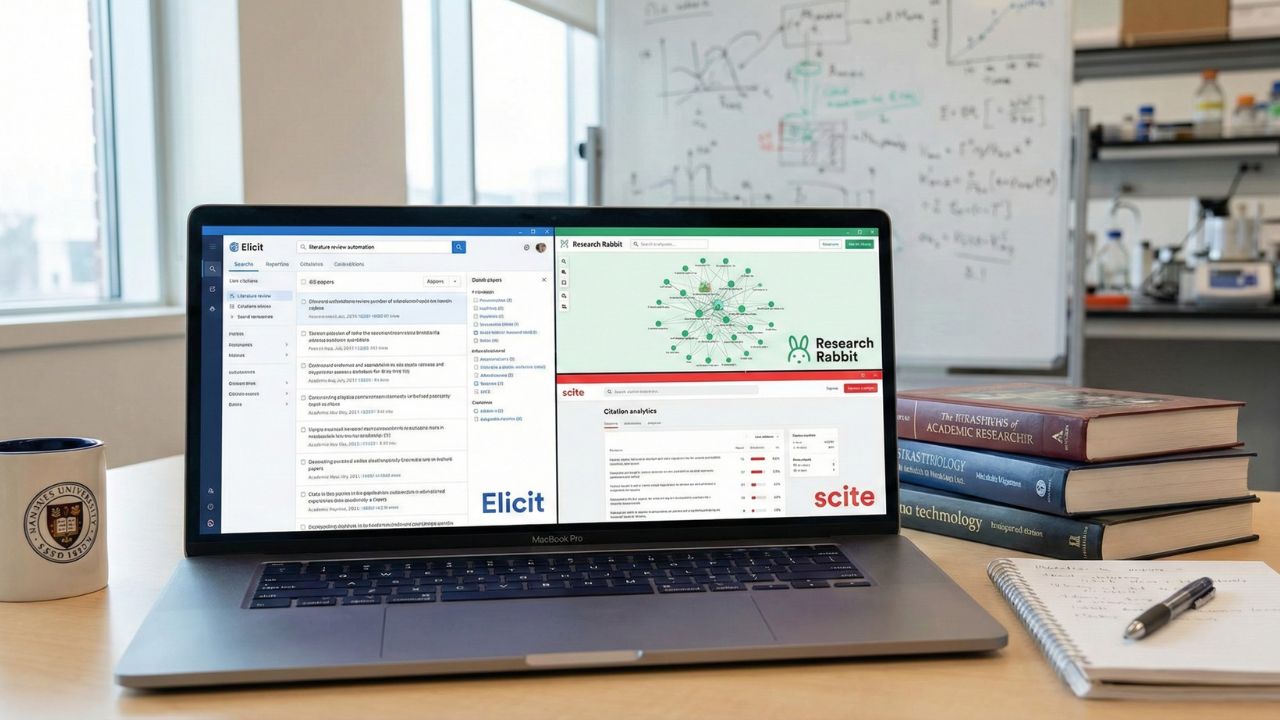
Elicit and Research Rabbit are currently leading this space. They allow you to ask natural language questions and receive precise answers backed by peer-reviewed citations.
Each platform serves a distinct purpose. Elicit is exceptional for extracting specific methodologies or sample sizes across dozens of papers simultaneously. Research Rabbit, on the other hand, excels at visual mapping, helping you discover "seed" papers and understand the broader academic conversation.
To master these specific platforms and optimize your discovery phase, read our deep dive on mapping citations and automating literature reviews.
2. Writing Assistants: Draft Faster Without Losing Your Voice
Writer’s block is the greatest threat to a finished thesis. Staring at an empty document while trying to synthesize complex data often leads to days of wasted effort.
Intelligent writing assistants have evolved far beyond simple grammar checkers. Platforms like Gemini and specialized academic tools such as SciSpace help you structure arguments, outline complex chapters, and refine dense technical language into clear, readable prose.
The goal is never to let the machine write your paper for you. Instead, you use these tools to overcome the initial hurdle of a blank page, relying on them for feedback, structural organization, and tone adjustments.
If you are struggling with your manuscript, check out our comparison to find the right tool for drafting your thesis chapter.
3. Data Analysis: From Raw Data to Actionable Insights
Data analysis used to require agonizing weeks of debugging code or meticulously hand-coding qualitative transcripts line by line.
Now, artificial intelligence acts as a direct co-pilot for your data. For qualitative researchers, modern integrations within software like NVivo can identify major themes and sentiment across hundreds of interview pages in seconds.
For quantitative research, platforms like Julius AI and advanced Python libraries allow you to interact with your dataset using plain English. You can request specific graphs, run statistical significance tests, and filter anomalies simply by asking.
This democratization of data science means you spend significantly less time fighting software and more time interpreting your actual results.
Ready to upgrade your analytical capabilities? Explore our guide on qualitative and quantitative data analysis.
4. Citation Management: Never Fix a Bibliography Manually Again
There is nothing more painful than realizing your bibliography is incorrectly formatted at 3 AM the night before your submission deadline.
While Zotero and Mendeley have been staples for years, their new algorithmic integrations elevate them entirely. Modern citation managers automatically format your references, scan your library to identify missing metadata, and even suggest relevant papers you might have overlooked.
Total automation is the only sustainable way to handle the hundreds of references required for a doctoral dissertation.
Learn how to configure your library perfectly in our step-by-step tutorial for handling bibliography automation.
5. Scientific Illustrations: Create Journal-Ready Figures
A brilliant scientific argument can easily be rejected by reviewers if accompanied by confusing, low-quality figures.
You no longer need to be a graphic designer to create professional, impactful diagrams. Generative tools bridge the gap between your raw data and beautiful visual communication.
BioRender remains the industry standard for life sciences, while broader tools like Figma and Canva are increasingly adopted for creating clean academic posters and conceptual flowcharts.
These platforms ensure your visuals match the rigor of your text. Stop struggling with MS Paint or outdated PowerPoint graphics.
See what is possible when creating complex scientific figures.
6. Collaborative Research: Sync Your Lab in Real-Time
Research is rarely a solitary pursuit. Managing a laboratory team, sharing massive datasets securely, and co-authoring papers requires a highly organized digital infrastructure.
Notion has emerged as a top choice for managing project timelines and lab wikis, while Overleaf remains the undisputed leader for collaborative LaTeX writing in STEM disciplines.
When you weave automated workflows into these platforms, you essentially build a virtual lab manager that keeps your entire team focused and on schedule.
To streamline your group's output, read our breakdown of syncing your research team's data.
Conclusion: Build Your AI Research Stack
The best AI tools for academic research are ultimately those that seamlessly integrate into your daily habits without adding friction. Do not attempt to adopt all these platforms simultaneously. Select one major pain point—like literature review organization or data analysis—and master the corresponding tool before moving to the next. By slowly building an automated tech stack, you will reclaim hundreds of hours, allowing you to focus on the science rather than the administration.

Frequently Asked Questions (FAQ)
The top contenders are Elicit, Research Rabbit, and Scite. Elicit is best for extracting data, Research Rabbit for visual mapping, and Scite for verifying citation reliability.
Gemini is excellent for brainstorming outlines, simplifying complex jargon, and acting as a conversational partner to overcome writer's block. It should not be used to generate the core text of a thesis.
It depends on your need. Elicit is better if you have a specific research question and need to compare methodologies across papers. Research Rabbit is better for exploration and finding "seed" papers.
Zotero (with plugins) and EndNote remain the most reliable. New AI features in these tools help correct metadata and automate formatting styles like APA 7th edition.
Yes. NVivo's automated insights can help auto-code transcripts for sentiment and themes, drastically reducing the time needed for initial data sorting.
Sources & References
- How to Use Elicit and Research Rabbit for Literature Search
- Best AI Writing Assistants for Thesis and Research Papers
- AI Data Analysis Tools for Research
- How to Automate Academic Citations with AI Tools
- Nature: Tools for modern research
- Zotero: AI Plugins and Features
Internal Resources:
External Authorities: