Best AI Writing Assistants for Thesis and Research Papers (2026)
By Sanjay Saini | Last Updated: May 12, 2026
What's New in This Update
- Added analysis of Gemini 3.0's structural outlining capabilities for massive documents.
- Updated the plagiarism section to address forensic stylometry and the failure of basic AI detectors.
- Included fresh workflows for integrating SciSpace directly into your drafting process without losing institutional compliance.
Quick Summary: Key Takeaways
- Structure First: Use Gemini 3.0 or Claude Opus to map out complex arguments and chapter hierarchies before writing a single word.
- Refine, Don't Generate: Leverage tools like Wordtune and SciSpace to elevate your rough drafts into formal academic prose—never let the AI write the core argument.
- Maintain Integrity: The newest AI mode checkers use forensic stylometry to catch synthetic text. Maintain your unique voice to ensure your thesis passes ethical review.
- Automate Formatting: Offload the tedious work of citation formatting to dedicated AI managers rather than general language models.
Drafting a PhD thesis or a peer-reviewed research paper is an exercise in endurance. Staring at an empty Word document while trying to synthesize three years of complex lab data often leads to crippling writer's block. The pressure to sound "academic" forces many researchers to agonize over sentence structure instead of focusing on their actual scientific discoveries.
The best AI writing assistants for thesis and research papers act as your intellectual sounding board. They remove the friction of the drafting process, allowing you to organize your thoughts, refine your tone, and ensure your arguments flow logically. When used ethically, these tools transform a messy collection of notes into a structured, submission-ready manuscript.
This guide explores the specific platforms you need to accelerate your writing phase. For a broader look at managing your entire PhD workflow, start with our foundational guide on the Best AI Tools for Academic Research.
The Blank Page Problem: Why Academic Writing Needs a Co-Pilot
Traditional academic writing is incredibly inefficient. You gather hundreds of PDFs, extract specific data points, and then attempt to weave those isolated facts into a coherent, 80,000-word narrative. The cognitive load required to maintain a consistent tone while tracking complex citations drains your mental energy.
Artificial intelligence solves the "blank page problem." By interacting with a language model, you can quickly convert bullet points into rough paragraphs, ask the system to challenge your logic, or request alternative phrasing for awkward sentences. You retain complete authorship of the ideas, but you offload the mechanical drudgery of drafting.
Gemini 3.0 & Claude: The Structural Architects
Before you worry about sentence-level editing, you must finalize your document's architecture. Large Context Window models like Google's Gemini 3.0 and Anthropic's Claude 3.5 Sonnet are exceptional at structural organization.
How to use them effectively:
- Chapter Outlining: Feed the AI your raw research question, methodology summary, and key findings. Ask it to generate a detailed, section-by-section outline for a 30-page chapter. This provides an immediate roadmap to follow.
- Reverse Outlining: If you have written a confusing, rambling draft, paste it into the AI and ask for a "reverse outline." The model will summarize what you actually wrote, revealing gaps in your logic and highlighting paragraphs that belong in different sections.
- Jargon Translation: When you need to explain complex domain-specific concepts in your introduction, ask the AI to explain your concept "to a first-year undergraduate." You can then adapt that clear, simplified phrasing into your final text.
If you are struggling to find the right papers to feed into these outlines, you should optimize your discovery phase first. Learn how to map your literature efficiently using our guide on Elicit and Research Rabbit.
SciSpace: The Literature Synthesizer
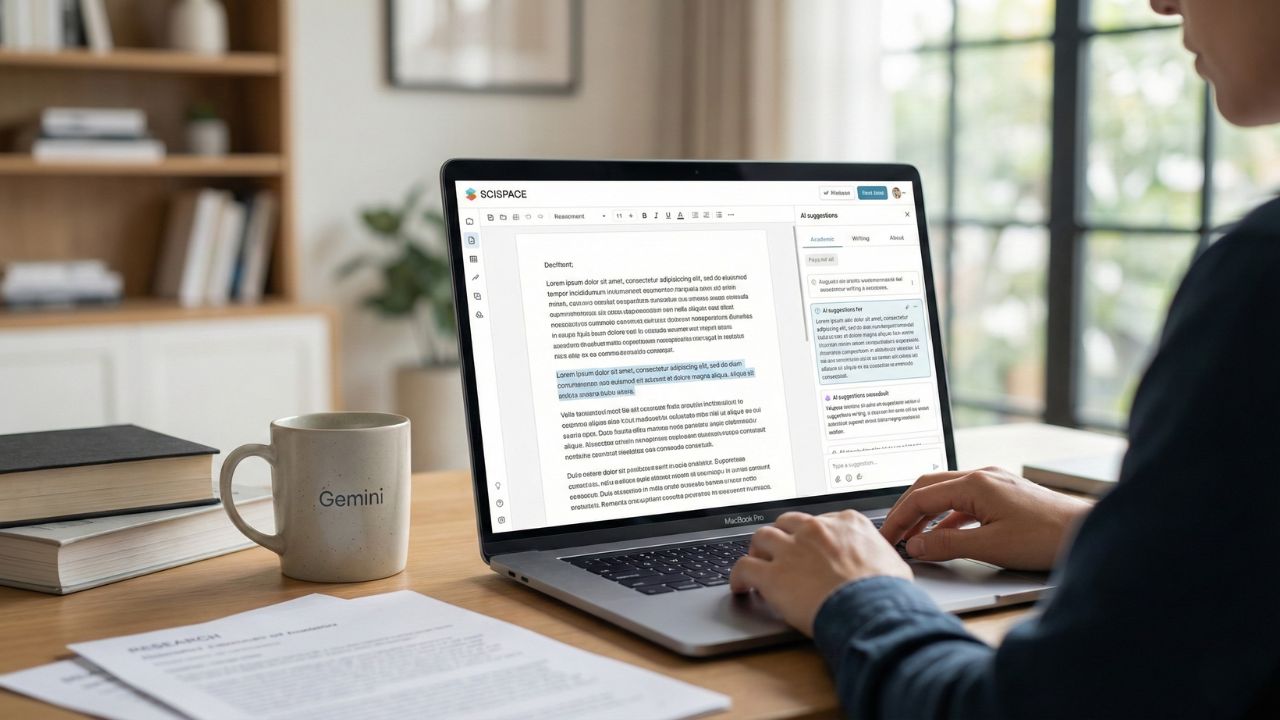
SciSpace (formerly Typeset.io) bridges the gap between reading papers and writing your own. It is specifically trained on scientific literature, making it far more reliable than generic chatbots when discussing academic concepts.
Key features for thesis writers:
- Academic Paraphrasing: If your rough draft sounds too casual, SciSpace can rewrite sentences to match the formal tone expected by journal editors.
- Contextual Understanding: You can highlight a confusing equation or paragraph in a source PDF, and the integrated AI copilot will explain it in plain English, helping you synthesize the information accurately into your own literature review.
- Direct Formatting: The platform offers thousands of journal-specific templates, allowing you to draft and format your paper simultaneously without fighting MS Word margins.
Wordtune & QuillBot: The Tone Refiners
Once your structure is solid and your arguments are in place, the focus shifts to sentence-level clarity. Wordtune and QuillBot operate as intelligent editors, operating directly within your browser or word processor.
Unlike basic spellcheckers, these tools understand semantic meaning. They suggest structural changes to improve flow, reduce passive voice, and eliminate redundancy.
Pro Tip: Write your initial drafts quickly, ignoring grammar and style. Once you have your ideas on the page, run the text through Wordtune's "Formal" setting to elevate the prose into a polished academic register. This two-step process separates the creative thinking phase from the analytical editing phase, drastically increasing your writing speed.
Coordinating these drafts with your principal investigator requires specialized shared environments. Ensure your team is aligned by adopting the best collaboration platforms for research teams.
Managing the Misery of Citations
A brilliant thesis can be rejected for sloppy bibliography management. Do not use generative language models to format your citations—they frequently hallucinate page numbers and invent DOIs.
Instead, rely on dedicated, AI-enhanced reference managers like Zotero or EndNote. These tools extract metadata directly from the publisher, organize your library, and automatically format your bibliography in APA, MLA, or specific journal styles.
For a detailed walkthrough on setting up a bulletproof reference workflow, read our tutorial on How to Automate Academic Citations.
The Ethical Boundary: AI as a Tool, Not an Author
The academic community has established strict boundaries regarding artificial intelligence. Using a tool to check your grammar, organize your outline, or suggest transitional phrasing is widely accepted. Generating entire paragraphs of text and claiming them as your original work is plagiarism.
Journals and universities now deploy advanced forensic stylometry to analyze document submissions. These systems detect the distinct structural fingerprints of synthetic text.
To protect your academic integrity:
- Never copy-paste: Do not move unedited text from a chatbot directly into your manuscript.
- Verify all claims: If an AI suggests a factual claim, you must independently verify it and cite the primary source.
- Disclose usage: Many journals now require a methodology statement detailing exactly which AI tools were used during the drafting process and how they were applied.
If you are concerned about how institutions detect synthetic text, you need to understand the technology they use. Review our analysis of the Best AI Plagiarism Checkers for Research Papers.
Final Thoughts: Write Smarter
Adopting the best AI writing assistants for thesis and research papers allows you to focus your cognitive energy where it belongs: on scientific discovery and critical analysis. By utilizing Gemini for structure, SciSpace for synthesis, and Wordtune for clarity, you build a resilient, efficient drafting workflow. Treat these platforms as highly capable editorial assistants. Let them handle the mechanics of language so you can clearly communicate the impact of your research to the global academic community.
Frequently Asked Questions (FAQ)
Gemini is excellent for brainstorming, outlining, and simplifying complex jargon. However, it should never be used to write the core text of your thesis due to the risk of hallucinations and lack of personal voice.
SciSpace helps by explaining complex papers you are reading and by rephrasing your own drafts to sound more academic. It acts like a specialized tutor for scientific language.
Yes, Wordtune is one of the best tools for this. Its 'Formal' mode is specifically designed to elevate casual drafting into professional, submission-ready academic English.
Never copy-paste large blocks of text. Use AI to generate outlines or alternative phrasings, then write the final sentences yourself. Always verify every citation the AI suggests against the primary literature.
Absolutely. You can paste a rough draft into Gemini or ChatGPT and ask it to analyze the logical flow or suggest better transition sentences between paragraphs to ensure a cohesive argument.
Sources & References
- Best AI Tools for Academic Research 2026 (Pillar Page)
- How to Use Elicit and Research Rabbit for Literature Search
- How to Automate Academic Citations with AI Tools
- Best AI Plagiarism Checkers for Research Papers
- SciSpace (Typeset.io) Official Platform
- Nature: Guidelines on AI usage in scientific submissions
Internal Resources:
External Authorities: